
India’s Air Pollution Crisis: Beyond Technical Fixes
India’s air pollution problem extends beyond Delhi-NCR and winter smog. The major sources are already known, but effective control requires transport, energy, agricultural, waste-management and institutional reforms alongside science and technology.
Syllabus Mapping: GS Paper III — Environmental Pollution, Public Health, Urbanisation, Agriculture, Energy and Environmental Governance.
Source & Date: The Indian Express, 18 November 2026.
Why in News?
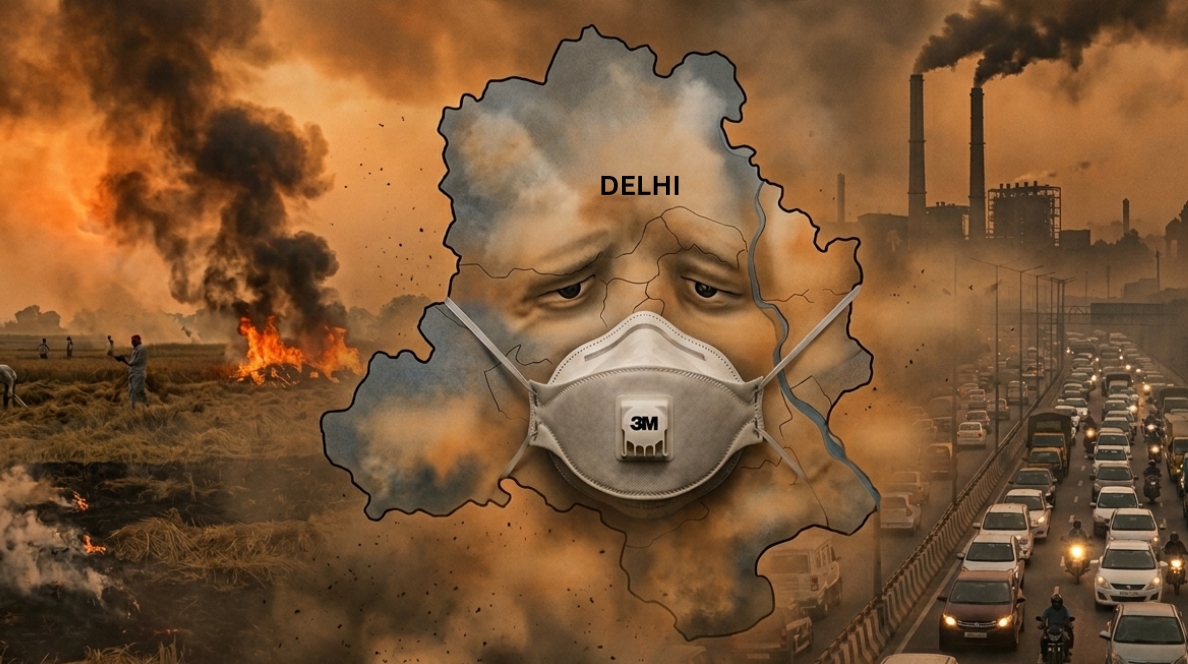
Air pollution in India is often discussed as a Delhi-NCR winter problem, but unhealthy air affects large parts of the country throughout the year, both outdoors and indoors.
The major sources of pollution are already broadly known. The deeper policy challenge is no longer simply identifying pollution, but converting existing knowledge into cleaner transport, household energy, agriculture, waste management and industrial regulation.
Pollution Sources Are Not a Mystery
Air pollution comes from multiple sources.
Some are seasonal, such as crop-residue burning and firecrackers.
Others contribute throughout the year, including:
- transport;
- industries;
- power plants;
- construction;
- municipal waste burning;
- household use of polluting fuels.
In colder regions, burning firewood, dung cakes and waste for heating can add further emissions.
Weather influences how pollutants disperse or accumulate, but meteorology does not create emissions.
This distinction is crucial because unfavourable weather can worsen pollution, but durable improvement requires reducing emissions at source.
What Does Pollution Control Actually Require?
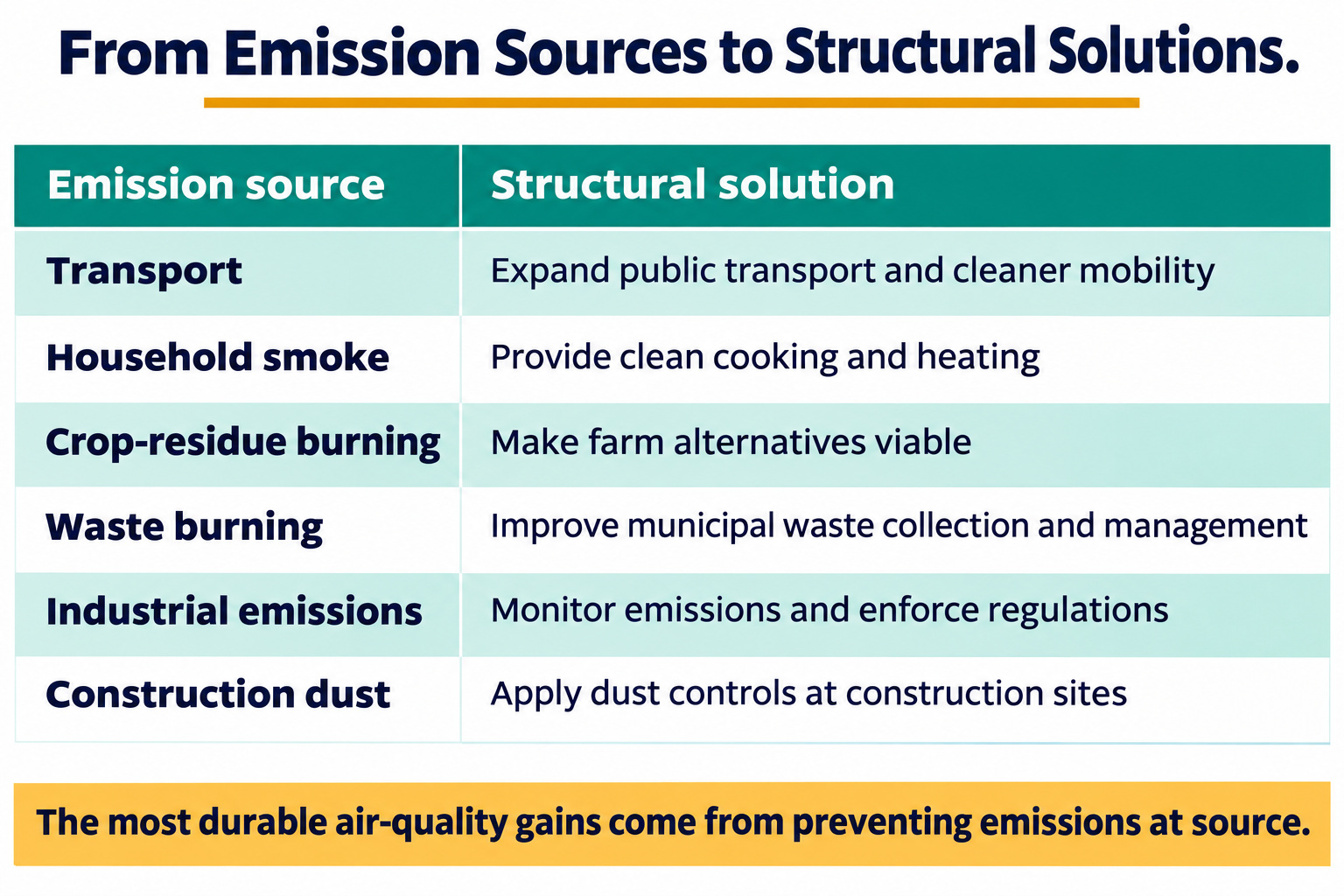
At the most basic level, pollution control requires two things:
reducing the number of emitting sources and reducing emissions from those that remain.
This translates into practical policies such as:
- reliable public transport;
- reduced dependence on private vehicles;
- clean cooking and heating fuels;
- alternatives to crop-residue burning;
- effective municipal waste collection;
- stronger industrial emission controls.
The fundamental policy solutions are therefore already reasonably clear.
Why Stubble Burning Is Not Just a Technology Problem?
Crop-residue burning receives intense attention during north India's winter pollution episodes.
But farmers do not burn residue simply because appropriate machines do not exist.
Their decisions are influenced by cropping patterns, short turnaround periods between crops, labour costs, machinery access and the economics of residue disposal.
Thus, farm-burning policy must consider agricultural incentives and rural livelihoods.
A technological solution that is economically unviable for farmers is unlikely to be adopted at scale.
Firecrackers Also Involve Social Behaviour
Pollution from firecrackers illustrates a different challenge.
Restrictions and enforcement can reduce use, but behavioural and cultural factors also matter.
Schools, communities and social or religious institutions can influence attitudes towards pollution-intensive practices.
Environmental policy therefore often requires social norm change alongside regulation.
Why Monitoring and Source Apportionment Still Matter?
Scientific research remains essential.
Air-quality monitoring, emission inventories and source-apportionment studies help identify where pollution comes from and allow governments to target interventions more efficiently.
They can also reveal changes in pollution sources over time.
However, uncertainty will never disappear completely.
Policy should therefore not wait for perfect estimates of the exact contribution of every source before acting on major known emitters.
Ambient Air Is Not the Same as Personal Exposure
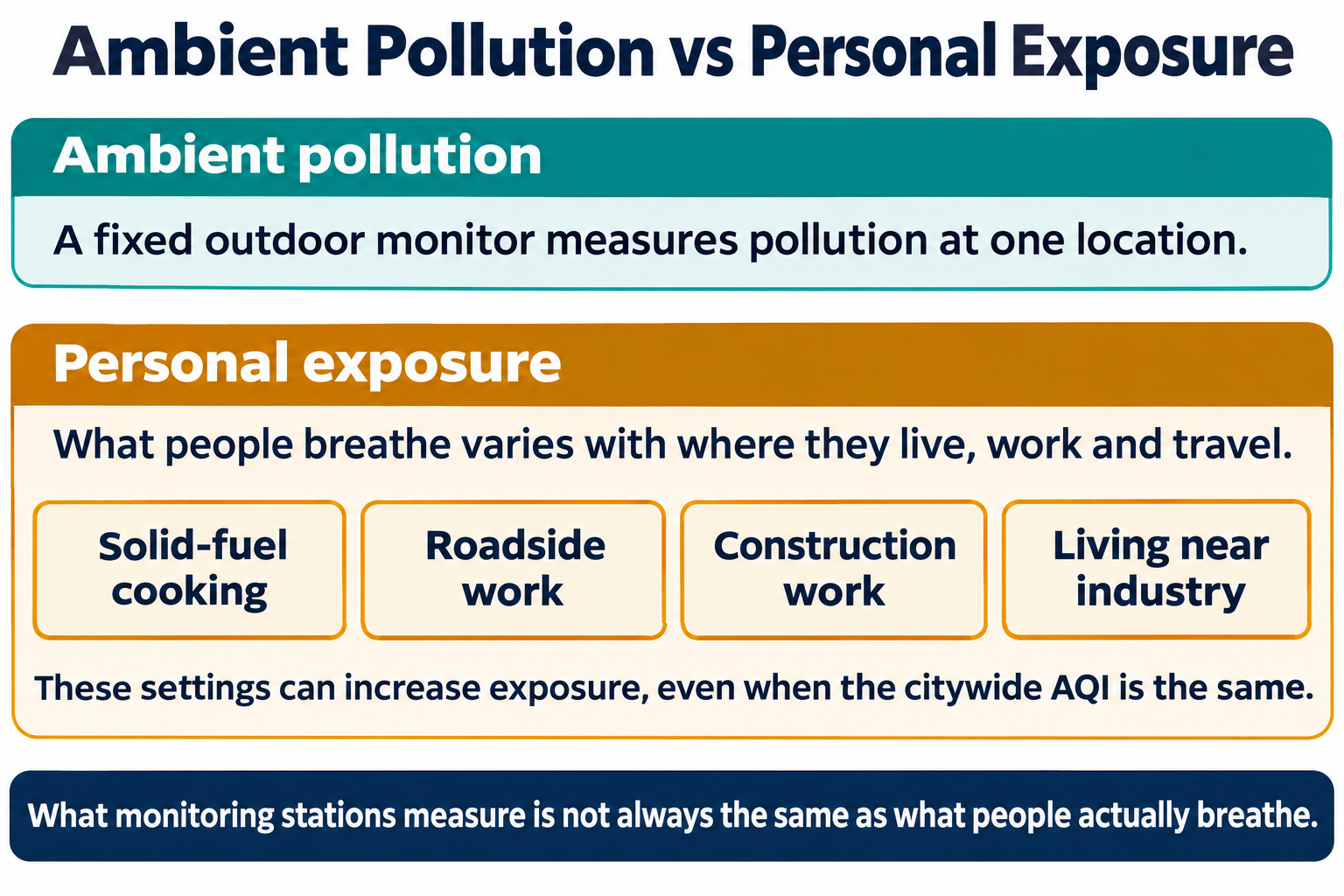
Air-quality policy often relies heavily on outdoor monitoring stations.
But a monitor on a rooftop does not necessarily capture the air an individual actually breathes.
For example, a woman cooking with biomass fuel may experience extremely high pollution exposure inside the home even when the nearest ambient monitor shows lower concentrations.
Similarly, construction workers, traffic police, sanitation workers and street vendors may experience exposure very different from citywide averages.
This is why personal exposure is distinct from ambient air quality.
Household Air Pollution Is Often Overlooked
Millions of households still face pollution from solid fuels used for cooking or heating.
Such pollution directly affects people inside homes and can also contribute to outdoor pollution.
Women may bear disproportionate exposure because household cooking responsibilities remain unevenly distributed.
This makes clean household energy simultaneously an environmental, health and gender issue.
Research Should Refine Action, Not Delay It
More scientific knowledge is useful.
Better exposure studies, emission inventories and atmospheric models can improve policy design.
But research should not become a reason for postponing intervention.
If transport, waste burning or dirty household fuels are already recognised as major pollution sources, authorities do not need perfect precision before acting.
The appropriate relationship is:
science identifies and refines interventions; governance implements them.
The Problem of “Technology-First” Solutions
Visible technological interventions often attract political attention because they can be presented as quick solutions.
Examples include proposals such as smog towers or artificial rain.
Such interventions may have limited or situation-specific applications, but they do not remove the underlying emissions continuously being generated by vehicles, industry, waste burning or household fuels.
The risk is that technological spectacle can substitute for slower but more important reforms.
Why Institutional Solutions Receive Less Attention
Improving public transport or municipal waste management is less dramatic than launching a new pollution-control device.
But such reforms can produce much larger long-term benefits.
They require:
- predictable financing;
- administrative capacity;
- coordination across departments;
- sustained enforcement;
- political willingness to confront vested interests.
The air-pollution crisis is therefore partly a problem of state capacity and implementation.
Who Counts as an Air-Pollution Expert?
Air pollution requires expertise from many disciplines.
Atmospheric scientists understand aerosols and meteorology.
Engineers design pollution-control systems.
Doctors and epidemiologists study health effects.
But effective policy also needs:
agricultural economists;
urban planners;
- transport specialists;
- behavioural scientists;
- municipal administrators;
- public-health professionals;
- social scientists.
The problem is therefore inherently interdisciplinary.
Expertise Must Also Be Scrutinised
Not every proposed technological intervention is necessarily effective or cost-efficient.
Independent scientific evaluation is important before governments spend large public resources.
Journalists, regulators, researchers and civil society therefore play an important role in scrutinising:
whether technologies actually reduce exposure;
whether they can operate at the required scale;
whether cheaper alternatives exist;
whether public spending generates measurable air-quality benefits.
Expertise involves evaluating proposed solutions as much as designing them.
Pollution Is Also an Equity Issue
Pollution exposure is not evenly distributed.
Street vendors, sanitation workers, construction labourers, farmers and communities near industrial facilities may face greater risks because of where and how they work.
Low-income households may also have fewer choices about housing, transport or clean energy.
For people dependent on daily wages, avoiding polluted environments may simply not be economically possible.
Air pollution therefore has an important environmental-justice dimension.
Core Policy Lesson
India does not primarily suffer from a lack of knowledge about the broad causes of air pollution.
The larger failure lies in translating that knowledge into sustained institutional action.
Science remains essential for monitoring, exposure assessment and improving interventions, but cleaner air ultimately requires better public transport, clean household energy, agricultural alternatives, functioning waste systems, industrial regulation and stronger administrative capacity.
The central policy shift must therefore be from searching repeatedly for spectacular technical fixes towards systematic reduction of emissions at source and protection of those most exposed.
Probable Mains Question
“India’s air-pollution crisis is increasingly a problem of governance and implementation rather than lack of scientific knowledge.” Discuss with reference to emission control, personal exposure, household air pollution and the limitations of technology-first solutions.
Prelims Drill
MCQ 1
With reference to air pollution, consider the following statements:
1.Unfavourable meteorological conditions can increase the concentration of pollutants near the surface.
2.Meteorological conditions themselves are the primary source of particulate emissions.
3.Household use of solid fuels can contribute to both indoor and outdoor air pollution.
Which of the statements given above are correct?
A. 1 only
B. 1 and 3 only
C. 2 and 3 only
D. 1, 2 and 3
Correct Answer: B
Explanation: Meteorology affects dispersion and accumulation of pollutants but does not itself generate the emissions. Solid-fuel combustion can create severe household exposure and also add to ambient pollution.
MCQ 2
Consider the following statements:
1.Source-apportionment studies help estimate the contribution of different pollution sources.
2.Personal exposure to air pollution is always identical to concentrations measured by the nearest ambient monitoring station.
3.Air-pollution control can require interventions in transport, agriculture, household energy and waste management simultaneously.
Which of the statements given above are correct?
A. 1 only
B. 1 and 3 only
C. 2 and 3 only
D. 1, 2 and 3
Correct Answer: B
Explanation: Personal exposure varies according to occupation, location, travel and indoor conditions, so it may differ substantially from ambient-monitor readings. Effective air-pollution control is inherently multi-sectoral.
More Current Affairs - Daily
- India’s State Capacity Stagnation: The Missing Link in Reform 21 Nov 2026
- Holding Two Offices: What Does the Constitution Say About an Office of Profit? 21 Nov 2026
- The Price of War: West Asia Crisis Is Raising India’s Energy Import Bill 21 Nov 2026
- Surveillance Pricing : How Is Personal Data Used to Set Prices? 21 Nov 2026