
Higher Education Faculty for the AI Era: Recruitment, Pedagogy and Campus Reform
Generative AI is changing teaching, assessment, academic integrity and student support, requiring India to redesign faculty recruitment, professional development and campus governance rather than merely filling vacancies.
Higher Education Faculty for the AI Era: Recruitment, Pedagogy and Campus Reform
- Syllabus Mapping: GS Paper II — Education, Human Resource Development and Institutional Reform; GS Paper III — Artificial Intelligence and Technology; GS Paper IV — Academic Integrity, Ethics and Student Welfare.
- Source & Date: The Hindu, 28 September 2026, supplemented by UNESCO and current UGC faculty-development frameworks.
Why Does Faculty Reform Matter Now?
Indian higher education is facing two simultaneous structural pressures: persistent faculty shortages and rapid disruption caused by Generative AI. Vacant posts, dependence on ad hoc or guest faculty, uncertain career pathways and inadequate pedagogical preparation can weaken teaching quality, while AI tools can now generate explanations, essays, code and factual answers within seconds.
The role of a university teacher is therefore moving beyond simple information delivery towards a more complex academic function involving interpretation, critical discussion, verification, assessment design, mentoring and ethical guidance.
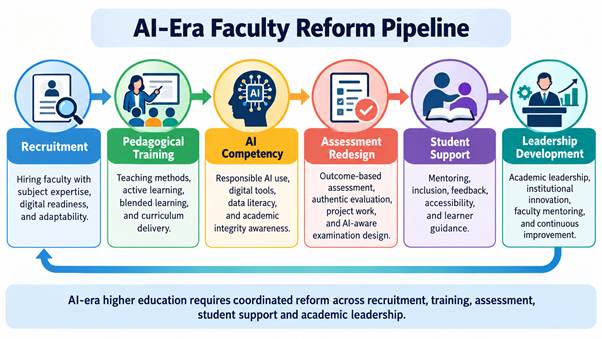
Recruitment → training → AI competency → assessment reform → student support → academic leadership
Why Recruitment Needs Redesign
Current faculty recruitment places strong emphasis on academic qualifications, subject knowledge and eligibility examinations, but these do not necessarily test whether a candidate can teach effectively, communicate complex ideas, mentor students or use digital tools responsibly.
A stronger recruitment model could assess disciplinary knowledge, classroom communication, pedagogical ability, digital competence and mentoring aptitude. One possible reform is an entry-level Lecturer or Assistant Lecturer pathway for strong postgraduate candidates, followed by progression based on defined teaching, research and professional-development benchmarks.
Such an entry-level faculty pathway is a reform proposal and not part of the present national recruitment structure.
Building AI-Era Teaching Competence
Teacher preparation must now include more than disciplinary knowledge. A structured higher-education pedagogy programme could cover learning science, assessment design, inclusive education, academic ethics, AI literacy, student mentoring and digital pedagogy.
UNESCO’s AI Competency Framework for Teachers identifies five broad dimensions: human-centred mindset, ethics of AI, AI foundations and applications, AI pedagogy, and AI for professional learning.
The framework also follows a progression model of Acquire → Deepen → Create, indicating that AI competence should develop continuously rather than through a one-time orientation.
Existing Faculty-Development Architecture
India already has a national professional-development structure through the Malaviya Mission Teacher Training Programme, which was created by restructuring and integrating earlier higher-education teacher-training mechanisms, including the former UGC-HRDC system.
Its training architecture can support faculty induction, refresher programmes, academic leadership, technology-enabled teaching and NEP-oriented professional development. This institutional network can be further used to embed AI literacy, assessment redesign and digital pedagogy into continuous faculty training.
AI Is Changing the Logic of Assessment
Traditional examinations often reward reproduction of factual and procedural knowledge that Generative AI can now generate easily. Assessment therefore needs to increasingly test reasoning, application, interpretation and independently demonstrable competence.
A more robust assessment model could move towards:
Recall-based questions → contextual problems → reasoning → application → oral defence → project work → disclosed AI use
Institutions also need clear rules distinguishing permitted AI assistance, AI use requiring disclosure, substitution of student competence, and deliberate fraud or impersonation.
A blanket prohibition on AI may be difficult to enforce, while unrestricted use can undermine independent learning. A more workable model is to classify assessments as AI-prohibited, AI-transparent or AI-integrated depending on the learning objective.
Academic Integrity and Student Welfare
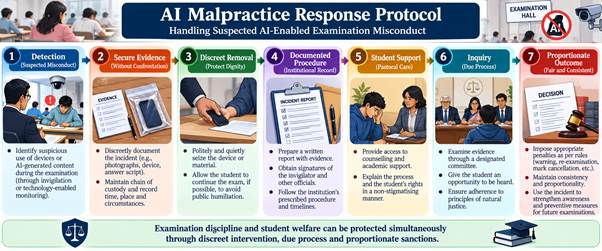
AI-enabled malpractice still requires institutional action, but academic discipline must operate through proportionate and humane procedures. Public confrontation, humiliation and uncertainty over consequences can intensify distress in already high-pressure academic environments.
A modern examination protocol should combine evidence preservation, discreet intervention, due process, proportionate sanctions and immediate supportive referral where serious distress is evident.
Disciplinary mechanisms and counselling functions should remain sufficiently separate so that students can seek psychological or emotional support without believing that disclosure will automatically worsen their academic case.
Academic integrity + procedural fairness + student welfare = responsible institutional governance
Building Faculty Capacity in Emerging Technology Fields
Universities also face shortages in AI, data science and computing, where academic institutions compete with substantially more lucrative private-sector employment.
One solution is cross-disciplinary upskilling. Civil, mechanical, electrical and other engineering faculty can be trained to apply machine learning and data tools within their own disciplines instead of requiring every institution to recruit large numbers of specialised Computer Science PhDs.
Industry engagement can simultaneously be strengthened through faculty industry fellowships, Professors of Practice, joint teaching and applied research partnerships.
Existing faculty → cross-training → interdisciplinary AI applications → reduced skill bottlenecks
Academic Leadership Also Needs Reform
Heads of Departments, Deans and Vice-Chancellors increasingly manage issues involving AI policy, examination disputes, student distress, digital governance, academic freedom and institutional accountability.
Leadership development should therefore include conflict resolution, crisis management, digital governance, student-support systems and technology-policy design, rather than focusing only on routine administration.
The Core Reform Agenda
India’s higher-education system should move from a narrow vacancy-filling approach towards a complete faculty-development ecosystem based on better recruitment, structured pedagogical preparation, continuous AI training, authentic assessment, industry exposure, student-support protocols and trained academic leadership.
The central principle is that AI should not reduce the importance of teachers; it should increase the value of the distinctly human capabilities that effective teachers provide, including judgment, mentorship, dialogue, contextual understanding and ethical guidance.
Probable Mains Question
“Generative AI requires higher education reform to move beyond digital adoption towards redesigning faculty roles, assessment and institutional governance.” Discuss.
Prelims Drill
MCQ 1
With reference to UNESCO’s AI Competency Framework for Teachers, consider the following statements:
- It includes AI ethics as a competency dimension.
- It includes AI pedagogy as a competency dimension.
- It treats AI competence purely as technical programming ability.
Which of the statements given above are correct?
A. 1 only
B. 1 and 2 only
C. 2 and 3 only
D. 1, 2 and 3
Correct Answer: B
Explanation: UNESCO’s framework covers human-centred thinking, AI ethics, AI foundations and applications, AI pedagogy and professional learning, making it substantially broader than technical programming ability.
MCQ 2
With reference to faculty development in Indian higher education, consider the following statements:
- The Malaviya Mission Teacher Training Programme is associated with professional development of higher-education faculty.
- It incorporates mechanisms that were earlier associated with UGC Human Resource Development Centres.
- Faculty development under the programme is confined exclusively to research publication skills.
Which of the statements given above are correct?
A. 1 only
B. 1 and 2 only
C. 2 and 3 only
D. 1, 2 and 3
Correct Answer: B
Explanation: The Malaviya Mission restructures earlier faculty-development mechanisms and covers teaching, learning, leadership, technology use and wider professional development rather than research publication alone.
More Current Affairs - Daily
- Election Commission of India: Constitutional Design and Evolution into a Three-Member Body 12 Oct 2026
- Loknayak Jayaprakash Narayan: Total Revolution and Contribution to Democracy 12 Oct 2026
- India’s Russia-Ukraine Initiative: From Black Sea Security to Strategic Autonomy 12 Oct 2026
- Jayaprakash Narayan: Architect of Total Revolution and Defender of Democracy 12 Oct 2026