
GST Reforms: From Rate Rationalisation to Compliance Simplification
As GST revenues and filing patterns stabilise, the reform focus is shifting from tax rates to simpler registration, faster refunds, smoother ITC, proportionate enforcement and technology-driven administration.
GST Reforms: From Rate Rationalisation to Compliance Simplification
- Syllabus Mapping: GS Paper II — Cooperative Federalism and Institutional Governance; GS Paper III — Taxation, Ease of Doing Business and Indian Economy.
- Source & Date: The Hindu, 9 October 2026.
Why in News?
The GST Council held its 57th meeting on October 8, 2026, shifting attention from tax-rate changes to the administrative and procedural architecture of GST.
After earlier rate rationalisation and the stabilisation of monthly collections, return filing and business familiarity with the system, the Council considered a five-part reform agenda covering process simplification, structural reform, ease of doing business, service exports and e-commerce.
Several proposals were approved, while some received in-principle approval or were referred for further examination. The latest tranche is intended to take effect from April 1, 2027.
The policy shift is:
GST rate rationalisation → compliance simplification → lower litigation → faster refunds → greater certainty
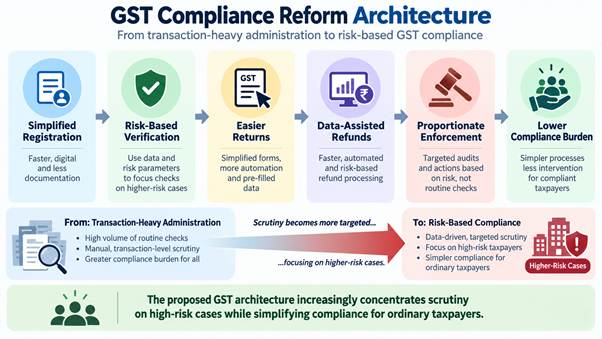
Registration Moves Towards a Risk-Based System
GST registration has often involved repeated document queries and verification even for low-risk businesses.
The proposed system seeks to provide greater certainty about required documents and rely more heavily on risk assessment, allowing most low-risk applications to move quickly while scrutiny is concentrated on suspicious cases.
The transition can be understood as:
Universal scrutiny → risk-based scrutiny
Small suppliers using e-commerce platforms are also expected to receive simplified registration, allowing eligible businesses to register in their home State rather than separately across every State in which they sell.
Compliance Burden for Small Businesses May Fall
An optional proposal has received in-principle approval for certain B2C businesses with annual turnover up to ₹5 crore to file returns annually rather than quarterly.
The proposal still requires further consideration.
Its underlying objective is:
Lower-frequency compliance → lower administrative cost → easier formalisation
Simplification is particularly significant for small firms because compliance costs can be disproportionately high relative to turnover.
Refunds Move Towards Automated Risk Assessment
GST refunds are particularly important for exporters and businesses with accumulated input tax credit because delayed refunds lock up working capital.
The proposed system reduces the target period for refund acknowledgement from 15 days to 10 days.
It would also use Customs and banking data for risk assessment, with 90% of eligible refund claims intended to be released within three working days after acknowledgement.
The reform chain is:
Integrated data → risk assessment → faster provisional refund → lower working-capital blockage
Input Tax Credit Coverage Is Proposed to Expand
Input Tax Credit (ITC) allows businesses to offset GST paid on inputs against the GST payable on their outward supplies, preventing cascading taxation.
The proposed framework would extend ITC eligibility to certain expenditures incurred in the normal course of business, including employee health and life insurance, which are currently restricted.
This reflects the fundamental GST logic:
Tax on inputs − credit for eligible input tax = tax on value addition
A separate problem arises when a genuine purchaser has paid tax but loses ITC because the supplier fails to file the required return.
Such situations can lock up the purchaser’s working capital despite possession of the invoice and payment of tax. The Council has asked an officers’ committee to examine the issue for a future solution.
Enforcement Becomes More Proportionate
A major set of proposals seeks to reduce coercive enforcement and litigation.
The Council recommended:
- removing the arrest powers of GST officers;
- raising the prosecution threshold from ₹1 crore to ₹5 crore;
- reducing the general penalty from ₹25,000 to ₹10,000;
- avoiding notices where the tax amount involved is below ₹10,000.
Existing notices below the proposed minimum threshold are also intended to be withdrawn.
The underlying approach is:
- Minor non-compliance → proportionate civil response
- Serious evasion → stronger enforcement
This seeks to separate routine compliance failures from deliberate tax fraud.
Inter-State Goods Movement Gets Greater Protection
The reforms also seek to reduce disruption of inter-State supplies.
Only GST officers in the originating or destination State would be permitted to inspect, detain or seize such consignments.
Officials in transit States would generally not intervene, and interception would require authorisation by a sufficiently senior officer along with specific intelligence relating to the consignment.
This can reduce uncertainty for logistics networks operating across several States.
Service Export Rules Become More Flexible
India’s service exporters have faced difficulties where overseas branches are involved.
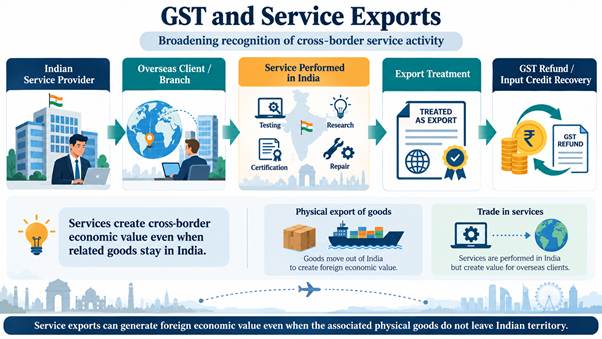
The proposed change would allow services supplied to foreign clients through an overseas branch to receive appropriate export treatment under GST.
The Council also addressed cases in which services such as testing, repair, certification and research are supplied to overseas clients but the physical goods do not leave India after the service.
Such transactions could now qualify as exports of services even where the goods remain in India.
This recognises that the economic substance of a service export may differ from the physical movement of goods.
RBI Rules Will Determine Receipt of Export Payments
Different regulatory systems have sometimes applied differing interpretations to when export payment is considered received.
The Council has proposed aligning this determination with Reserve Bank of India rules.
Greater regulatory alignment can reduce disputes between tax and foreign-exchange compliance systems.
Faceless Assessment Is the Next Administrative Step
The Union government also plans to introduce faceless assessment for Central GST taxpayers, broadly on the model used in income-tax administration.
States would decide whether to introduce comparable systems for State GST within their jurisdictions.
Faceless assessment seeks to reduce direct interaction between taxpayers and officials through:
digital allocation + standardised procedures + reduced discretion + greater transparency
Its success, however, depends on well-designed digital systems and effective grievance redressal.
GST Reform Reflects Cooperative Federalism
GST is administered through a shared Union-State framework.
The GST Council, created under Article 279A of the Constitution, brings together the Union and States to make recommendations on major GST-related matters.
Administrative reform therefore requires coordination across different tax jurisdictions.
This makes GST one of India’s most prominent institutional experiments in fiscal cooperative federalism.
Structural Issues Still Remain
The latest reform package does not eliminate all GST challenges.
it identifies continuing concerns relating to:
- inverted duty structures;
- unresolved ITC issues;
- implementation of faceless assessment across jurisdictions;
- and future rate adjustments.
The Council has indicated that rate discussions may increasingly be consolidated into an annual exercise, with changes applying from the beginning of the subsequent financial year.
The Core Policy Lesson
GST reform is moving into a different stage.
The initial challenge was creating a unified indirect-tax framework and stabilising revenue collection. The next challenge is reducing the friction businesses face while complying with that framework.
The transition is:
Tax unification → revenue stabilisation → rate rationalisation → procedural simplification → trust-based administration
A mature GST system therefore requires not only efficient revenue mobilisation but also predictability, quick refunds, seamless input credits, proportionate enforcement and low compliance costs.
Probable Mains Question
“The next generation of GST reforms must focus as much on administrative simplicity and taxpayer certainty as on revenue mobilisation.” Discuss in the context of the recent proposals of the GST Council.
Prelims Drill
MCQ 1
With reference to the Goods and Services Tax Council, consider the following statements:
- It is a constitutional body established under Article 279A.
- It includes representatives of both the Union and State governments.
- It makes recommendations on matters relating to GST.
- It is constituted by the Reserve Bank of India.
Which of the statements given above are correct?
A. 1 and 2 only
B. 1, 2 and 3 only
C. 2, 3 and 4 only
D. 1, 2, 3 and 4
Correct Answer: B
Explanation: Article 279A provides for the GST Council, consisting of Union and State representatives. It recommends key aspects of the GST framework. The Council is not constituted by the RBI.
MCQ 2
With reference to Goods and Services Tax, consider the following statements:
- Input Tax Credit helps prevent cascading taxation by allowing eligible tax paid on inputs to be set off against output-tax liability.
- GST is broadly based on the destination principle of taxation.
- Exports under the GST framework are generally treated as zero-rated supplies.
Which of the statements given above are correct?
A. 1 only
B. 1 and 2 only
C. 2 and 3 only
D. 1, 2 and 3
Correct Answer: D
Explanation: ITC reduces tax cascading by allowing eligible input taxes to be credited against output liability. GST is fundamentally destination-based, with tax accruing where consumption occurs, while exports are generally zero-rated so domestic taxes are not exported.
More Current Affairs - Daily
- Election Commission of India: Constitutional Design and Evolution into a Three-Member Body 12 Oct 2026
- Loknayak Jayaprakash Narayan: Total Revolution and Contribution to Democracy 12 Oct 2026
- India’s Russia-Ukraine Initiative: From Black Sea Security to Strategic Autonomy 12 Oct 2026
- Jayaprakash Narayan: Architect of Total Revolution and Defender of Democracy 12 Oct 2026