
Grey-Zone Warfare Along the LAC
Grey-zone warfare uses limited military, political, informational and infrastructural actions below the threshold of open war to gradually create strategic advantage.
Grey-Zone Warfare Along the LAC
- Syllabus Mapping: GS Paper II — India and its Neighbourhood; GS Paper III — Border Management, Internal Security and Defence Preparedness.
- Source & Date: The Indian Express, 27 October 2026.
Why in News?
Recent face-offs between Indian and Chinese personnel in parts of Arunachal Pradesh have renewed attention on China's use of grey-zone tactics along the Line of Actual Control. India has said that friction can arise when Chinese patrols diverge from established patrolling patterns, while China has said it is following existing agreements and conducting normal patrols.
The broader strategic concern is that the disputed and undemarcated LAC creates space for incremental actions that remain below the threshold of full-scale war.
What is Grey-Zone Warfare?
Grey-zone warfare refers to coercive activity that lies between normal peacetime competition and conventional armed conflict.
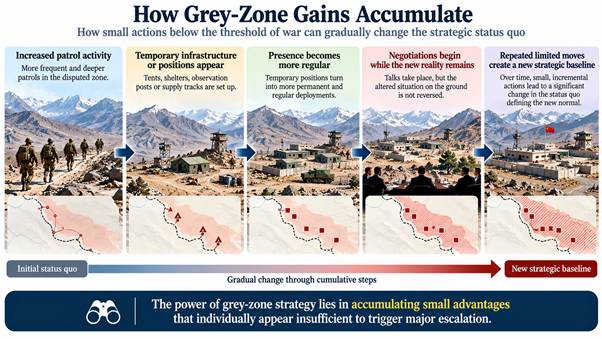
Its strength comes from ambiguity and limited escalation. Each individual action may appear too small to justify a major military response, yet repeated actions can cumulatively alter the strategic situation.
Such methods may combine patrol pressure, infrastructure, cyber operations, information campaigns, economic leverage and legal or diplomatic narratives.
“Nibble and Negotiate”
A central grey-zone tactic is incremental change.
Instead of attempting a dramatic territorial breakthrough, forces may increase patrols, establish temporary positions, improve roads or gradually normalise activity in a disputed area. Negotiations then take place after the ground situation has already changed.
This is often described as “nibble and negotiate”: many small tactical moves gradually shift the baseline without triggering the risks associated with an overt attack.
Infrastructure Is Part of the Strategy
Military infrastructure can itself function as a grey-zone instrument.
China has expanded highways, rail links, airfields and heliports near the Himalayan frontier, improving its capacity for surveillance, logistics and rapid troop movement.
Infrastructure therefore changes the local balance even before any fighting begins.
The “Three Warfares”
Grey-zone strategy is not limited to physical deployment.
The Chinese concept of the Three Warfares includes public-opinion warfare, psychological warfare and legal warfare.
Information campaigns can shape domestic and international perceptions. Psychological pressure can influence an adversary's decision-making, while legal or cartographic claims can be used to reinforce territorial narratives.
Repeated renaming of locations in Arunachal Pradesh, for example, can be understood within this wider effort to support territorial claims through non-kinetic means.
Why Grey-Zone Tactics Are Hard to Counter
The main challenge is proportionality.
If every small patrol deviation produces a major military response, escalation risks increase. But if each incident is treated as too minor to matter, cumulative changes may eventually become difficult to reverse.
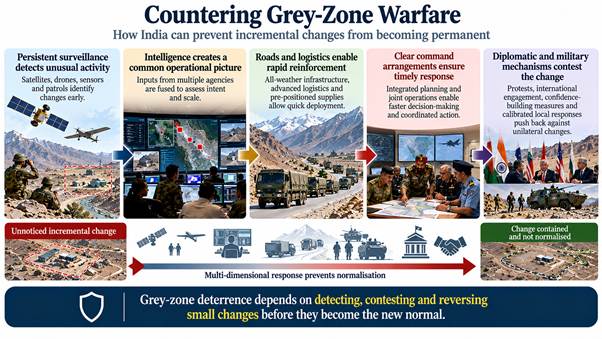
Effective deterrence therefore requires the ability to detect and contest changes early, before temporary tactical moves acquire permanence.
What India Needs
A response cannot rely on conventional forces alone.
India needs stronger surveillance, intelligence, border infrastructure, logistics and rapid reinforcement. Better coordination between the Army, ITBP and other agencies is also important because grey-zone situations often evolve faster than traditional administrative processes.
Diplomatic engagement remains necessary for avoiding unintended escalation, but it must operate alongside credible ground capability.
Core Policy Lesson
Grey-zone warfare seeks to exploit the space between peace and open war.
Its objective is not necessarily to win through a decisive battle, but to slowly change facts on the ground while keeping the cost of an adversary's response high.
For India, the strategic task is therefore to prevent incremental tactical gains from becoming permanent strategic realities. This requires persistent surveillance, faster decision-making, resilient border infrastructure, inter-agency coordination and credible deterrence.
Probable Mains Question
“Grey-zone warfare seeks to alter the strategic status quo through cumulative actions below the threshold of conventional war.” Explain the concept and discuss the capabilities India requires to counter such tactics along the Line of Actual Control.
Prelims Drill MCQ
With reference to grey-zone warfare, consider the following statements:
- It generally involves coercive activity below the threshold of conventional armed conflict.
- Its effectiveness may depend on ambiguity and gradual accumulation of tactical gains.
- It necessarily excludes cyber, information and economic instruments.
Which of the statements given above are correct?
A. 1 only
B. 1 and 2 only
C. 2 and 3 only
D. 1, 2 and 3
Correct Answer: B
Explanation: Grey-zone warfare can combine military and non-military instruments, including cyber, information, economic and political measures, while remaining below the threshold of full-scale war.