
Global Order Under Stress, Reformed Multilateralism and the 4F Crisis
External Affairs Minister S. Jaishankar highlighted the need for reformed multilateralism amid geopolitical tensions and intense global competition. He emphasized international frameworks and guardrails for essential supplies and highlighted the interconnected nature of the 4F crisis involving fuel, food, fertiliser and finance.
At the 81st session of the United Nations General Assembly (UNGA), External Affairs Minister S. Jaishankar highlighted concerns over geopolitical tensions, intense competition and disruptions affecting global supplies. He stressed the need for reformed multilateralism and international frameworks or “guardrails” to protect the stability of essential supplies, including fuel and food. The discussion is particularly relevant because disruptions in one sector can transmit shocks across food, energy, fertiliser and financial markets.
What is Multilateralism?
Multilateralism refers to cooperation among three or more countries through common rules, institutions and agreed frameworks to address shared international problems. The United Nations represents the principal institutional expression of multilateralism in the post-1945 international order.
Reformed multilateralism broadly refers to making international institutions more representative, legitimate, inclusive and effective, particularly by addressing the gap between existing institutions and contemporary geopolitical and economic realities.
What is the United Nations General Assembly?
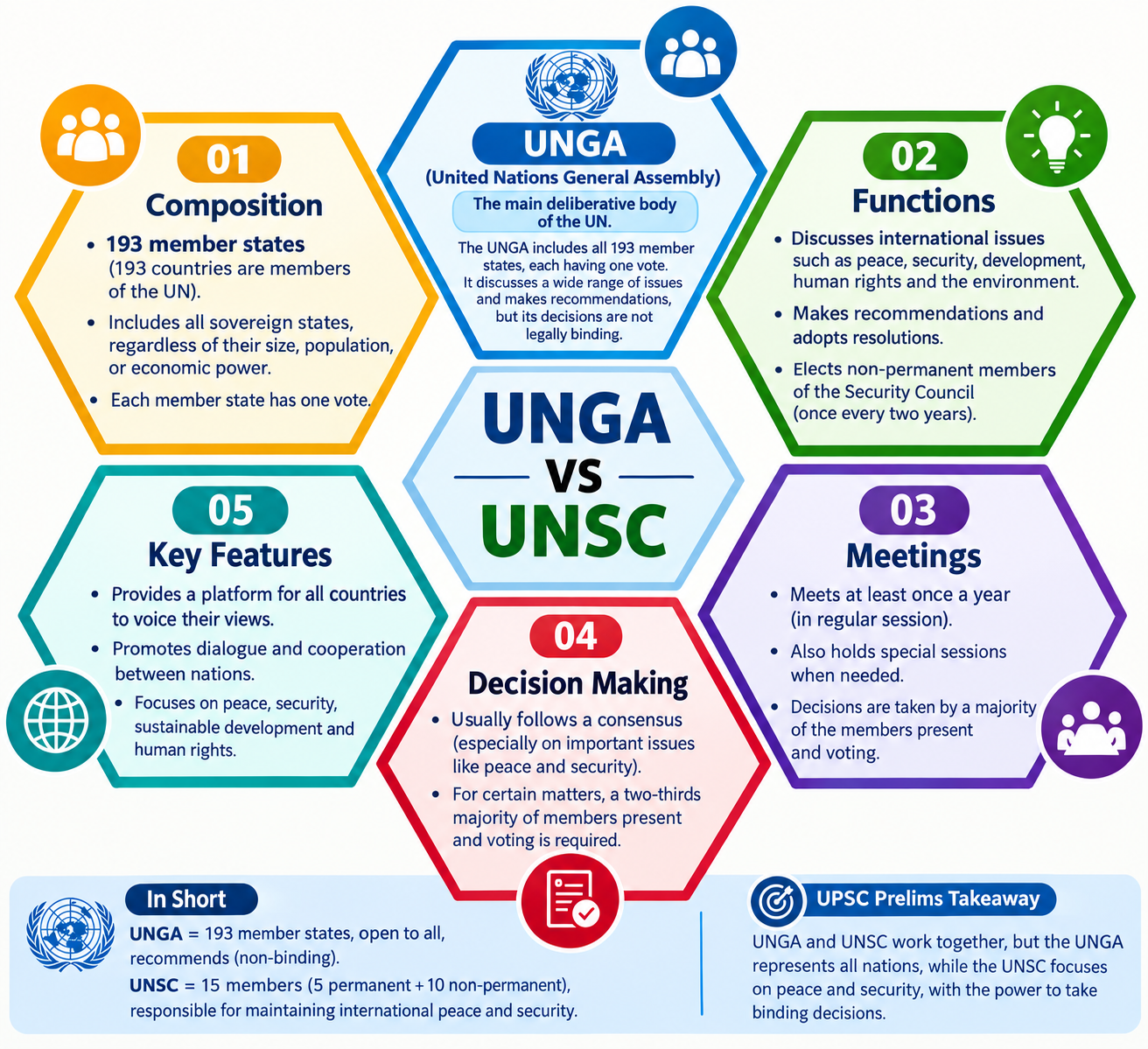
The UNGA is the UN's principal deliberative, policymaking and representative organ. It consists of all 193 UN Member States, with one vote for each country. It discusses issues ranging from international peace and security to development, human rights, humanitarian affairs and international law.
Important functions include:
- Approving the UN budget.
- Electing non-permanent members of the UN Security Council (UNSC).
- Electing members of other UN organs.
- Appointing the Secretary-General on the recommendation of the UNSC.
- Making recommendations on international issues and cooperation.
UNGA Voting System
Each Member State has one vote. Important questions—including peace and security recommendations, admission of new members and budgetary matters—require a two-thirds majority of members present and voting. Other questions generally require a simple majority. In practice, many resolutions are adopted through consensus after negotiations.
UNGA vs UNSC
| Base | UNGA | UNSC |
| Composition | 193 Member States | 15 members |
| Voting | One country, one vote | Permanent members have veto power |
| Main role | Deliberation, recommendations, policymaking | Primary responsibility for international peace and security |
| Representation | Universal | Limited membership |
| Binding nature | Generally recommendations | Can adopt legally binding decisions under the UN Charter |
Significance of Annual General Debate
The General Debate provides a global platform where heads of state, government and other senior representatives present their countries’ perspectives on major international issues. During the 81st session, the General Debate is being held during the high-level week in September 2026. It enables countries to articulate priorities, build diplomatic support and place emerging global issues on the international agenda.
What is the ‘4F Crisis’?
The 4F crisis refers to interconnected pressures involving:
Fuel + Food + Fertiliser + Finance
These four sectors are closely connected. Higher fuel prices increase transportation and production costs. Fertiliser production is energy-intensive, so energy disruptions can raise fertiliser prices. Expensive fertilisers can increase agricultural costs and ultimately affect food prices and availability. At the same time, higher commodity prices, debt pressures and tighter financial conditions can restrict access to finance, particularly for vulnerable developing economies. This creates a chain of economic and food-security risks.
Way Forward
The relevance of the UN in the 21st century depends not merely on the number of resolutions adopted but on its ability to facilitate legitimate, representative and effective collective action. Reformed multilateralism can focus on broader representation, stronger institutions, resilient supply chains, crisis coordination and greater participation of developing countries.
For India, this approach is relevant to its emphasis on strategic autonomy, diversified supply chains, energy and food security, and a more representative international order. The central challenge is to convert multilateral consensus into practical cooperation capable of responding to interconnected global crises.
MCQ English
Q1. With reference to the ‘4F crisis’ highlighted in the context of contemporary global economic challenges, consider the following pairs:
- Fuel — Energy and transportation costs
- Food — Food security and prices
- Fertiliser — Agricultural input costs
- Finance — Access to financial resources
Which of the pairs given above are correctly matched?
(A) 1, 2 and 3 only
(B) 2, 3 and 4 only
(C) 1, 3 and 4 only
(D) 1, 2, 3 and 4
Answer: (D) 1, 2, 3 and 4
Explanation:
- The 4F crisis refers to interconnected challenges involving Fuel, Food, Fertiliser and Finance.
- Fuel prices influence transportation and production costs.
- Fertiliser availability and prices directly affect agricultural production costs and food security.
- Financial pressures can restrict access to finance, particularly for vulnerable economies.
Therefore, all four pairs are correctly matched.
More Current Affairs - Daily
- Election Commission of India: Constitutional Design and Evolution into a Three-Member Body 12 Oct 2026
- Loknayak Jayaprakash Narayan: Total Revolution and Contribution to Democracy 12 Oct 2026
- India’s Russia-Ukraine Initiative: From Black Sea Security to Strategic Autonomy 12 Oct 2026
- Jayaprakash Narayan: Architect of Total Revolution and Defender of Democracy 12 Oct 2026