
ECI Freezes Trinamool Name and Symbol, Allots Interim Identities to Rival Factions
The Election Commission has frozen the original Trinamool Congress name and reserved symbol and allotted temporary names and symbols to rival factions pending final adjudication.
ECI Freezes Trinamool Name and Symbol, Allots Interim Identities to Rival Factions
- Syllabus Mapping: GS Paper II — Election Commission, Constitutional Bodies, Political Parties, Electoral Reforms and Representation of the People.
- Source & Date: Election Commission action reported on 17–18 September 2026, along with the Election Symbols (Reservation and Allotment) Order, 1968 and Supreme Court jurisprudence.
What Is the Latest Development?
After recognising the existence of rival claims within the All India Trinamool Congress (AITC) and freezing its original name and reserved “flowers and grass” symbol, the Election Commission allotted temporary identities to the two factions on 18 September 2026.
- Mamata Banerjee-led faction: Mamata All India Trinamool Congress — symbol: Football Player
- Arup Roy-led rebel faction: Democratic Trinamool Congress — symbol: Envelope
The Mamata faction had reportedly submitted three name options and symbol preferences including a football player and cricket bat. The Commission selected the football-player symbol.
These are interim arrangements. They do not determine which faction will ultimately inherit the original AITC name and reserved symbol.
Why Was the Original Name and Symbol Frozen?
Two rival groups each claimed to be the “real” party. Since the dispute could not be finally decided before the scheduled bypolls, ECI froze the disputed identity and asked both sides to submit alternative names and symbols.
The interim arrangement seeks to place the rival groups on an even electoral footing until a substantive decision is made under Paragraph 15.
About: Paragraph 15 of the Symbols Order
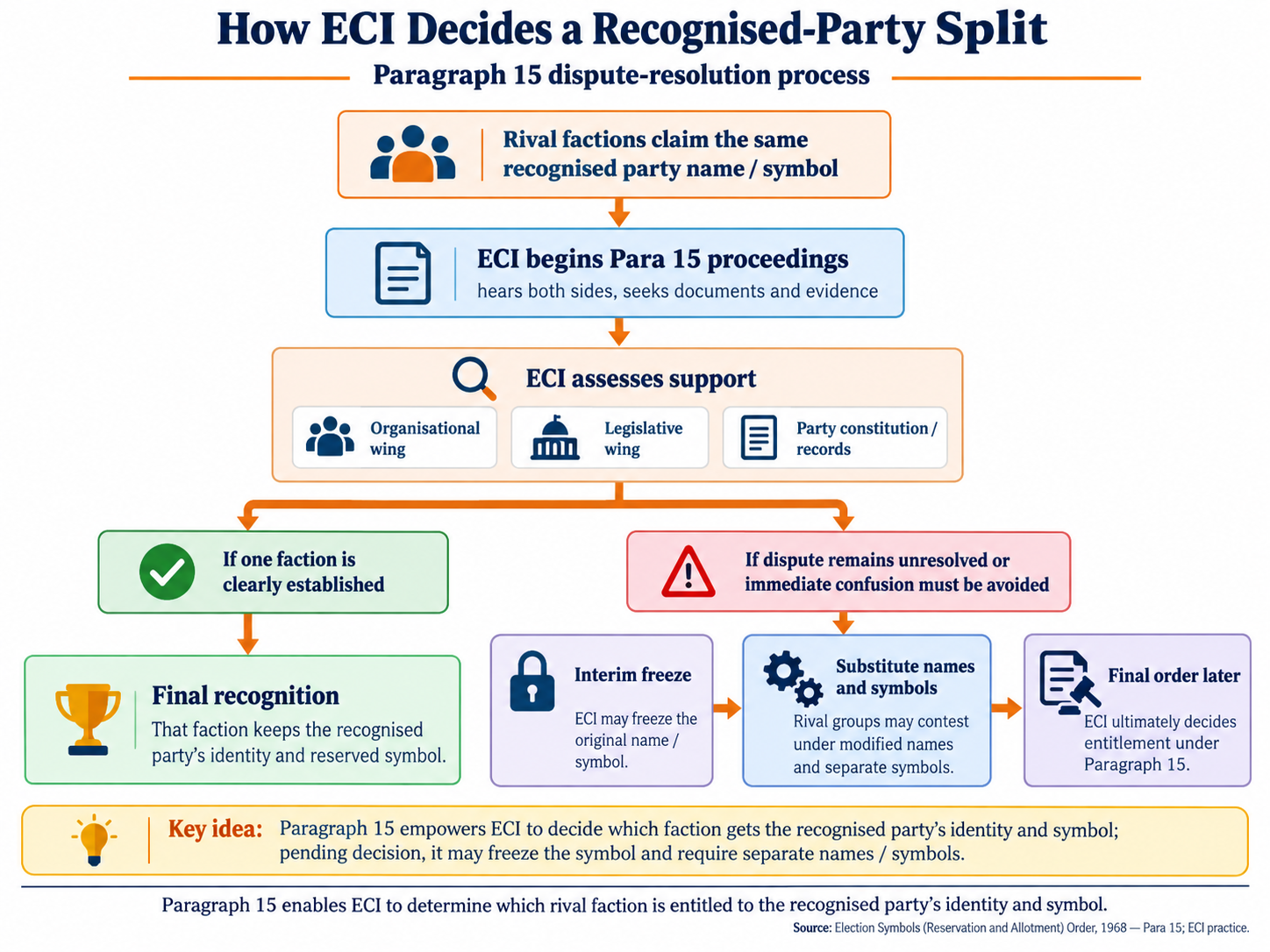
Paragraph 15 of the Election Symbols (Reservation and Allotment) Order, 1968 empowers the Election Commission to decide disputes where rival sections of a recognised political party each claim to represent that party.
The final determination can decide entitlement to:
Party identity + recognised status + reserved symbol
Where immediate adjudication is not feasible, ECI can adopt an interim solution such as:
Freeze original identity → allot temporary names → allot separate free symbols
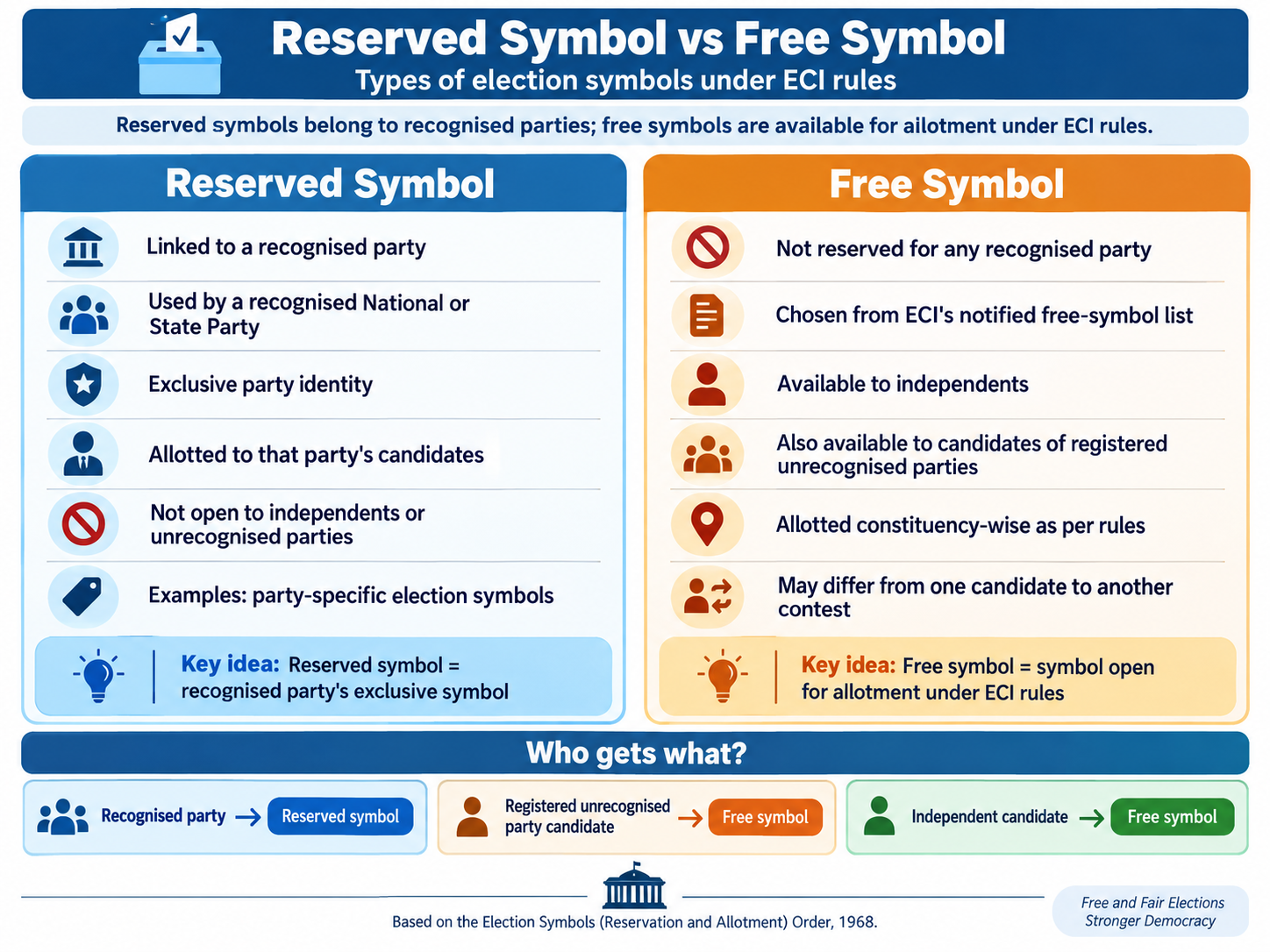
The original flowers and grass symbol remains frozen. The football player and envelope are substitute symbols for the rival factions during the interim period.
How Does ECI Decide the “Real” Party?
The leading precedent is Sadiq Ali v. Election Commission of India (1971).
The Supreme Court upheld ECI’s use of the test of majority, examining support within:
Organisational wing + Legislative wing
The inquiry is therefore not confined mechanically to the number of MLAs or MPs. Organisational control, party office-bearers and other viable evidence can also matter.
This is particularly relevant in the present dispute because the rival claims concern the legitimacy and tenure of the party’s organisational leadership.
Constitutional and Legal Basis
ECI’s authority is rooted principally in:
- Article 324 — superintendence, direction and control of elections.
- Rules 5 and 10 of the Conduct of Elections Rules, 1961 — relating to specification and allotment of symbols.
- Kanhaiyalal Omar v. R.K. Trivedi (1985) — Supreme Court upheld the validity of the Symbols Order and ECI’s authority over election symbols.
Why the Interim Allotment Matters
The latest order performs three immediate functions:
- Electoral continuity: Both factions can contest the forthcoming bypolls under legally identifiable names and symbols.
- Neutrality: Neither claimant receives premature control over the legacy TMC identity.
- Voter identification: Separate symbols reduce the possibility that rival candidates appear under the same party identity.
However, replacing a familiar party name and symbol immediately before polling can also generate voter confusion, demonstrating why symbol disputes have consequences beyond internal party organisation.
Institutional Concerns
The dispute highlights larger weaknesses in intra-party governance:
- Party constitutions and membership records are largely maintained internally.
- Organisational elections may be difficult to independently verify.
- Paragraph 15 prescribes no rigid outer time limit for final adjudication.
- A prolonged interim freeze can materially affect electoral recognition.
Reforms could include audited membership rolls, verifiable internal elections and time-bound adjudication, while retaining ECI’s capacity to issue interim orders where elections are imminent.
Probable Mains Question
“The Election Commission’s power to adjudicate factional disputes involves balancing intra-party democracy, voter recognition and electoral neutrality.” Discuss with reference to Paragraph 15 of the Election Symbols (Reservation and Allotment) Order, 1968.
Prelims Drill
MCQ 1
With reference to the Election Commission’s handling of disputes between rival factions of a recognised political party, consider the following statements:
- Paragraph 15 of the Election Symbols Order, 1968 empowers ECI to adjudicate rival claims.
- Pending final adjudication, ECI may freeze the original party name and reserved symbol.
- Allocation of temporary names and free symbols automatically determines the final ownership of the original party.
Which of the statements given above are correct?
A. 1 only
B. 1 and 2 only
C. 2 and 3 only
D. 1, 2 and 3
Correct Answer: B
Explanation: ECI can freeze the disputed identity and provide interim names and symbols. Such an arrangement does not finally decide which faction will inherit the original party identity.
Trap Identified: Interim allotment ≠ final recognition.
MCQ 2
Consider the following statements:
- In Sadiq Ali v. Election Commission of India, support in both organisational and legislative wings was relevant to deciding a party-split dispute.
- A reserved symbol is exclusively associated with a recognised political party.
- The Election Commission must necessarily allot the original reserved symbol to the faction with the greater number of MLAs.
Which of the statements given above are correct?
A. 1 only
B. 1 and 2 only
C. 2 and 3 only
D. 1, 2 and 3
Correct Answer: B
Explanation: Legislative strength is important but is not an automatic or exclusive determinant. ECI can consider organisational support and other relevant material before reaching its final decision.
Trap Identified: More legislators ≠ automatic entitlement to the reserved symbol.
More Current Affairs - Daily
- Election Commission of India: Constitutional Design and Evolution into a Three-Member Body 12 Oct 2026
- Loknayak Jayaprakash Narayan: Total Revolution and Contribution to Democracy 12 Oct 2026
- India’s Russia-Ukraine Initiative: From Black Sea Security to Strategic Autonomy 12 Oct 2026
- Jayaprakash Narayan: Architect of Total Revolution and Defender of Democracy 12 Oct 2026