
Eastern Maritime Corridor and India’s Energy Security
India’s high dependence on imported oil and gas, combined with concentration on western maritime routes, creates major chokepoint risks. The Chennai-Vladivostok Eastern Maritime Corridor offers a potential route-diversification strategy.
Eastern Maritime Corridor and India’s Energy Security
- Syllabus Mapping: GS Paper II — India-Russia Relations and Foreign Policy; GS Paper III — Energy Security, Infrastructure, Ports, External Trade and Critical Minerals.
- Source & Date: The Indian Express, 8 October 2026.
Why in News?
Conflict affecting the Strait of Hormuz and attacks around the Red Sea–Bab-el-Mandeb corridor have renewed attention on India’s dependence on vulnerable maritime energy routes.
India imports around one-third of its overall energy supply and remains highly import-dependent for crude oil, LNG and LPG. A large proportion of these imports, as well as much of India’s refining and LNG-regasification capacity, is concentrated on the west coast.
The Chennai–Vladivostok Eastern Maritime Corridor (EMC) has therefore gained strategic relevance as a possible eastern energy and trade route connecting India directly with the Russian Far East.
The core energy-security issue is:
Supplier diversification without route diversification → continued strategic vulnerability
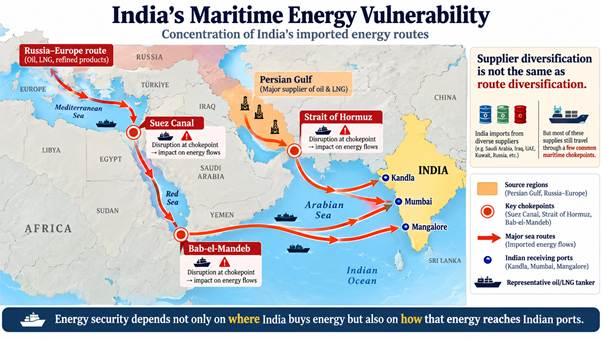
India’s Energy Imports Depend Heavily on Maritime Routes
India is among the world’s largest energy consumers and importers.
The source places crude-oil import dependence at roughly 85-90%, LNG dependence at around 50%, and LPG dependence near 60%. This means disruption of shipping routes can affect domestic energy availability, prices and inflation.
Energy security therefore involves more than securing overseas suppliers.
It requires:
Supplier diversity + route diversity + storage + refining capacity + resilient ports
West-Coast Concentration Creates a Strategic Vulnerability
India’s energy infrastructure has a strong western orientation.
According to the source, around 65-70% of oil imports and 75-80% of LNG imports are handled on the west coast. Much of India’s refining and LNG-regasification capacity is also located there.
This produces concentration risk:
Western ports + Arabian Sea routes → Hormuz/Bab-el-Mandeb exposure → disruption risk
A diversified supplier base therefore does not fully solve India’s vulnerability if those supplies continue to travel through the same maritime corridors.
Russia Has Become a Major Energy Supplier
Russia has emerged as a major crude-oil source for India in recent years.
However, much Russian oil has continued to reach India from Baltic ports through the Suez–Red Sea route, eventually arriving at western Indian ports.
This creates an important paradox:
Diversified supplier → same vulnerable route → incomplete energy diversification
The strategic objective is therefore to diversify the transport architecture alongside the supplier base.
Corridor Provides an Alternative Route
The Eastern Maritime Corridor connects Chennai with Vladivostok in Russia’s Far East.
It was launched in 2019 alongside India’s Act Far East Policy.
The source estimates the corridor at about 10,470 km, compared with roughly 16,070 km for the conventional Mumbai–St Petersburg route via Suez, reducing indicative transit time from about 36 days to 24 days.
The strategic chain is:
Vladivostok → East Asian seas → Chennai → eastern India
This can reduce dependence on westward shipping through Suez-linked routes.
EMC Complements India’s Wider Eurasian Connectivity
India is connected to Russia through two broad directions.
On the western side, the International North-South Transport Corridor (INSTC) connects India towards Russia and Eurasia through a multimodal transport network.
On the eastern side, the Eastern Maritime Corridor links India with Vladivostok.
Russia’s wider Trans-Arctic Transport Corridor seeks to connect its western, Arctic and Far Eastern transport systems using sea, rail, road and inland waterways.
Together, these provide the possibility of:
Western Eurasian connectivity + eastern maritime connectivity = greater route resilience
Russian Far East and Arctic Expand Resource Access
The corridor could also improve Indian access to the resource-rich Russian Far East and Arctic.
The region contains substantial reserves of oil, natural gas, coal, nickel, copper, precious metals, industrial minerals and rare earth elements.
This makes the EMC relevant beyond crude oil.
It can support:
Energy security + critical-mineral security + fertiliser security + industrial supply chains
For India, diversification into minerals and energy resources is increasingly important because clean-energy technologies, electronics and advanced manufacturing require reliable access to critical materials.
LNG Regasification Is a Key Energy-Infrastructure Link
LNG is natural gas cooled to approximately −162°C, allowing it to be transported economically by ship.
At the destination, specialised terminals warm LNG back into gaseous form through regasification before it enters pipeline networks.
Thus:
Natural gas → liquefaction → maritime transport → LNG terminal → regasification → pipeline distribution
The geographic concentration of regasification infrastructure can therefore itself create an energy-security vulnerability.
Commercial Viability Remains the Missing Link
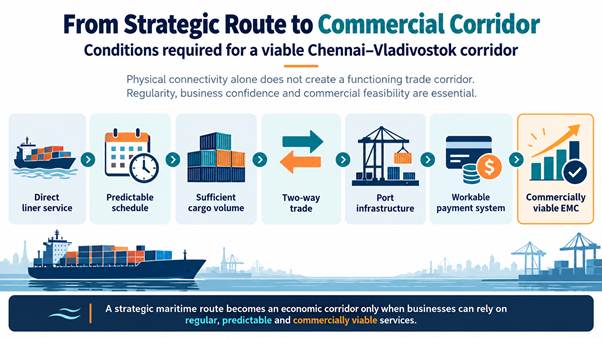
Although the EMC was announced as operational and cargo is moving, the source stresses that there is still no regular direct liner service connecting major Indian ports with the Russian Far East.
Without predictable sailings, businesses face:
uncertain transit times + volatile freight rates + weak delivery reliability
Some cargo consequently continues to rely on indirect transhipment through third-country ports.
The critical distinction is:
Occasional vessel movement ≠ commercially viable corridor
Trade Imbalance Creates a Backhaul Problem
India-Russia trade is heavily imbalanced in favour of Russian exports, particularly bulk commodities.
This creates a backhaul problem: ships moving Russian crude, coal or fertilisers towards India may have insufficient commercially viable cargo for the return journey.
A sustainable corridor therefore requires greater Indian exports such as:
pharmaceuticals + engineering goods + chemicals + agricultural products
The corridor needs two-way cargo flows to support regular scheduled services.
Building a Reliable Eastern Energy Corridor
The source identifies measures such as temporary incentives, preferential port charges, guaranteed berthing windows, minimum cargo commitments and cooperation between Indian and Russian shipping companies to overcome the initial commercial-risk problem.
The policy transition must be:
Route availability → scheduled shipping → predictable logistics → larger cargo volumes → sustainable corridor
The Core Policy Lesson
India’s energy-security debate must move beyond simply identifying new suppliers.
A country dependent on imported hydrocarbons remains vulnerable when its energy shipments, ports and processing infrastructure are concentrated along a limited set of routes.
The EMC therefore represents a broader strategic principle:
Supplier diversification + route diversification + geographic infrastructure diversification = stronger energy resilience
Its success, however, should ultimately be measured not by whether a ship can travel between Chennai and Vladivostok, but by whether importers and exporters can depend on a regular, commercially sustainable maritime service.
Probable Mains Question
“Energy security requires diversification not merely of suppliers but also of transport routes and infrastructure.” Discuss with reference to the strategic significance and commercial challenges of the Chennai–Vladivostok Eastern Maritime Corridor.
Prelims Drill
MCQ 1
Consider the following pairs:
- Strait of Hormuz — Persian Gulf and Gulf of Oman
- Bab-el-Mandeb Strait — Red Sea and Gulf of Aden
- Suez Canal — Mediterranean Sea and Red Sea
How many of the pairs given above are correctly matched?
A. Only one
B. Only two
C. All three
D. None
Correct Answer: C
Explanation: The Strait of Hormuz connects the Persian Gulf with the Gulf of Oman and Arabian Sea; Bab-el-Mandeb connects the Red Sea with the Gulf of Aden; and the Suez Canal provides a maritime connection between the Mediterranean and Red Sea. Together, these are crucial chokepoints for global energy and merchandise trade.
MCQ 2
With reference to energy and transport infrastructure, consider the following statements:
- Regasification converts LNG back into gaseous natural gas for transmission and use.
- The International North-South Transport Corridor is designed as a multimodal connectivity network involving sea, rail and road links.
- A maritime corridor automatically becomes commercially viable once an occasional cargo vessel completes the route.
Which of the statements given above are correct?
A. 1 only
B. 1 and 2 only
C. 2 and 3 only
D. 1, 2 and 3
Correct Answer: B
Explanation: LNG is regasified before entering normal gas-distribution systems, while the INSTC is a multimodal transport network. Commercial viability of a maritime corridor additionally requires factors such as predictable schedules, sufficient cargo volumes, competitive freight rates and reliable port services.
More Current Affairs - Daily
- Election Commission of India: Constitutional Design and Evolution into a Three-Member Body 12 Oct 2026
- Loknayak Jayaprakash Narayan: Total Revolution and Contribution to Democracy 12 Oct 2026
- India’s Russia-Ukraine Initiative: From Black Sea Security to Strategic Autonomy 12 Oct 2026
- Jayaprakash Narayan: Architect of Total Revolution and Defender of Democracy 12 Oct 2026