
Corporal Punishment in Indian Classrooms: Why It Persists Despite Legal Prohibition
Corporal punishment is legally prohibited in India, yet it persists because of social acceptance, weak grievance systems, power imbalances, inadequate teacher training and limited accountability.
Corporal Punishment in Indian Classrooms: Why It Persists Despite Legal Prohibition
Syllabus Mapping: GS Paper II — Education, Vulnerable Sections, Child Rights, Governance and Social Justice.
Source & Date: The Hindu, 15 November 2026.
Why in News?
Corporal punishment continues to be reported in Indian schools despite an explicit legal prohibition on physical punishment and mental harassment.
The persistence of such cases shows that the issue is not merely about the absence of law. It reflects a wider problem of school culture, weak enforcement, social attitudes towards discipline, power imbalance between adults and children and inadequate child-protection mechanisms.
What Is Corporal Punishment?
Under the Juvenile Justice (Care and Protection of Children) Act, corporal punishment refers to deliberate physical punishment inflicted on a child for discipline, reform or retribution.
The concept is broader than severe beating.
It can include spanking, pinching, forcing children into painful positions, confinement and other acts intended to cause pain or discomfort.
NCPCR guidelines also recognise mental harassment and discriminatory treatment as forms of harmful punishment.
This includes humiliation, derogatory remarks, name-calling, belittling and differential treatment based on caste, gender, class or community.
What Does the Law Say?
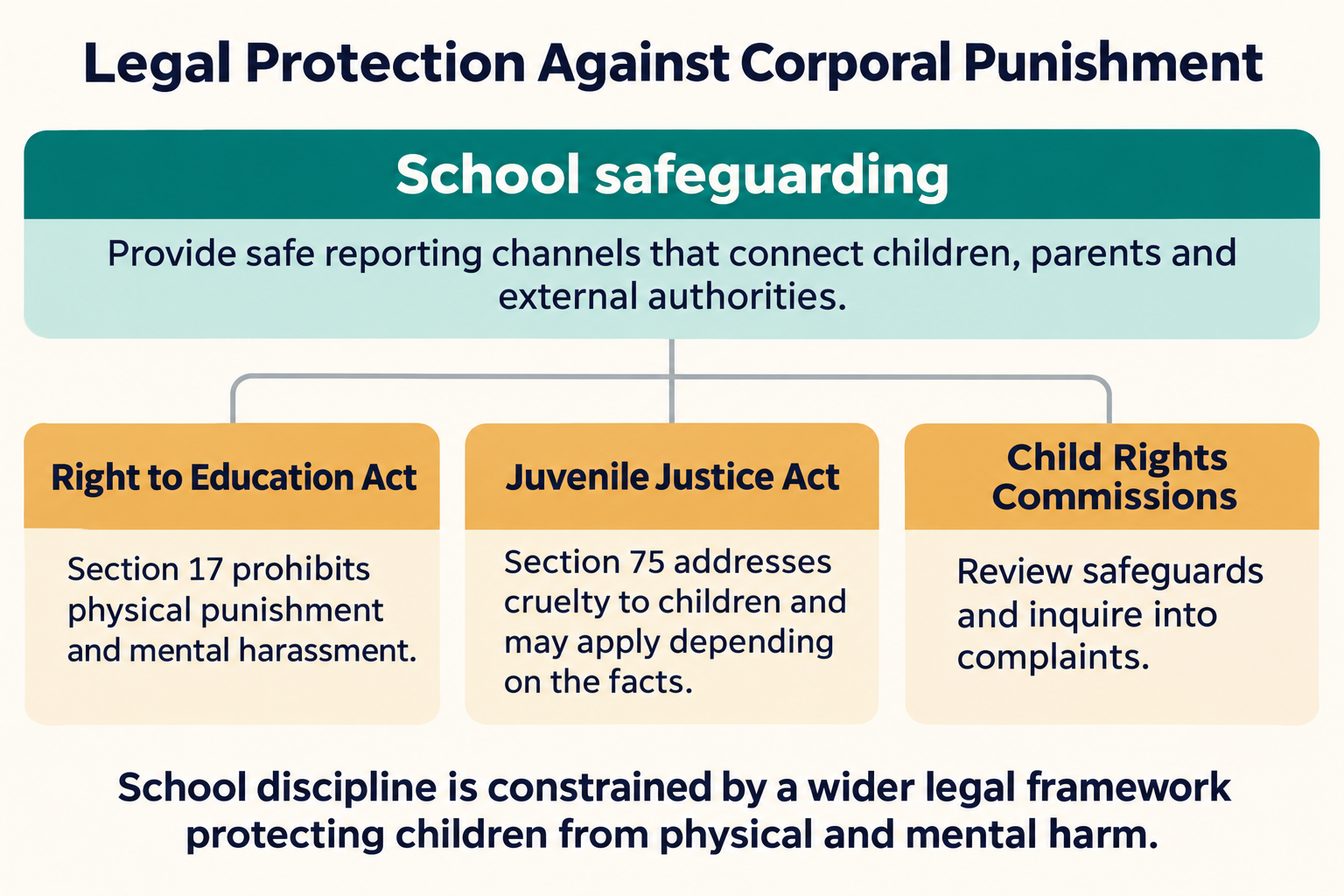
Section 17 of the Right of Children to Free and Compulsory Education Act, 2009 prohibits physical punishment and mental harassment.
Violation can attract disciplinary action under the applicable service rules.
The Juvenile Justice Act can also apply where a child is subjected to cruelty.
India is additionally a signatory to the United Nations Convention on the Rights of the Child, which requires protection of children from physical and mental violence.
Thus, the legal principle is clear: violence cannot be justified merely as a method of discipline.
Why Does Corporal Punishment Persist?
The first reason is social acceptance.
Physical punishment has historically been normalised in both families and schools as a legitimate way to enforce obedience.
When violence is interpreted as discipline rather than abuse, legal prohibition alone produces limited behavioural change.
The second reason is the power imbalance between students and school authorities.
Children often fear retaliation, academic penalties or humiliation if they complain.
Parents may also hesitate to challenge teachers or school management, especially where the school controls examinations, records and access to education.
Weak Enforcement and Underreporting
Section 17 of the RTE Act largely relies on departmental disciplinary action.
This can make enforcement dependent on the same institutional structure within which the alleged abuse occurred.
Where schools prioritise reputation or avoid external scrutiny, complaints may remain internal and underreported.
This creates a structural conflict between protecting the institution and protecting the child.
Legal Ambiguity Around “Mild” Punishment
Another difficulty is disagreement over what constitutes legally punishable conduct.
Some cases involve severe physical violence, while others involve acts defended as minor or corrective discipline.
Courts may therefore have to interpret the boundary between lawful supervision and impermissible punishment.
This ambiguity can weaken deterrence if teachers believe that “mild” physical punishment is socially or legally acceptable.
Why Corporal Punishment Harms Learning
Corporal punishment does not only create immediate physical pain.
It can generate fear, anxiety, loss of trust, school avoidance and reduced classroom participation.
Repeated humiliation can impair cognitive and socio-emotional development.
A school environment based on fear may also suppress questioning and creativity, thereby weakening the broader educational objective of developing confident and independent learners.
Teacher Stress Is Also a Governance Issue
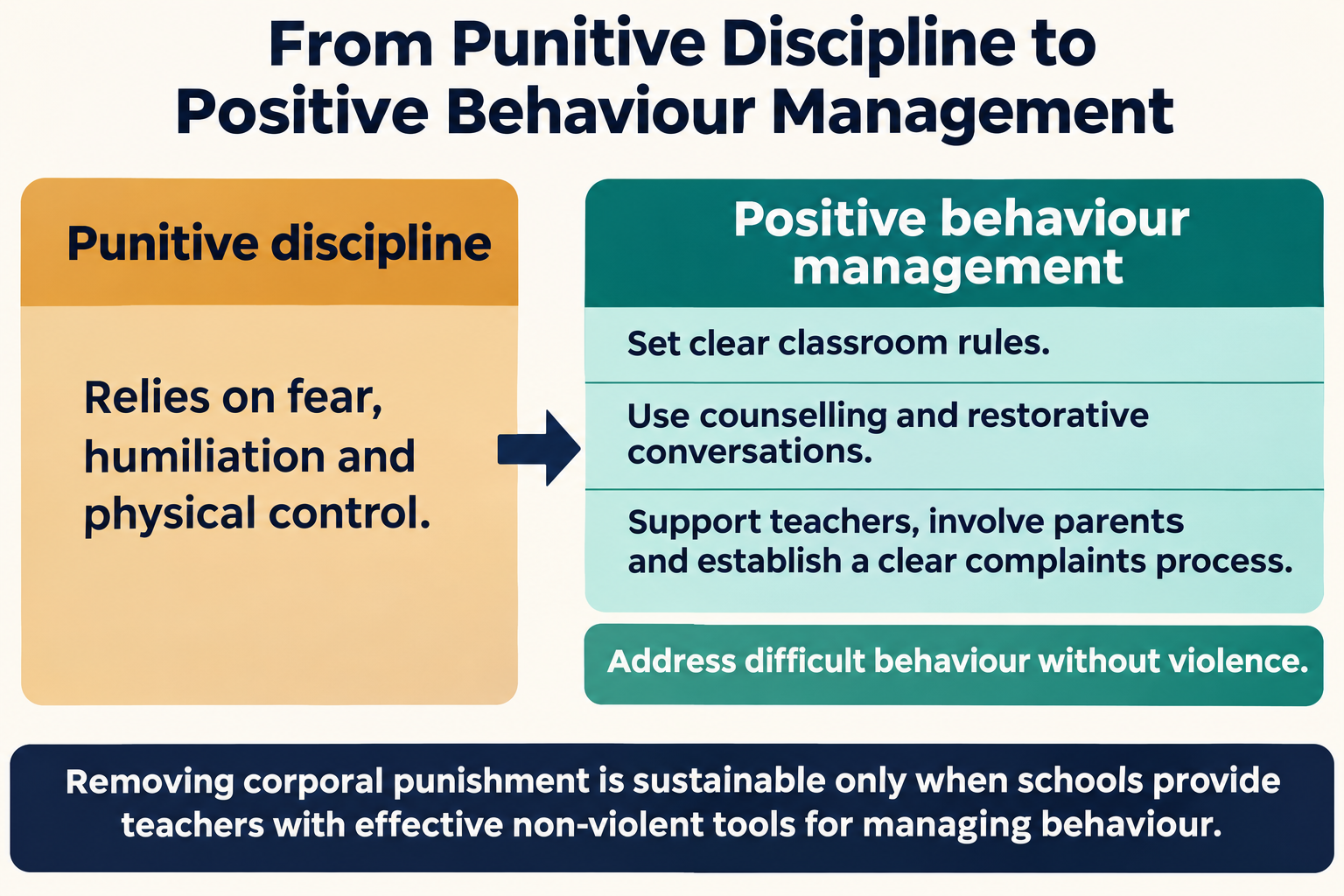
Large classrooms, administrative pressure and limited training can create difficult teaching environments.
Teachers may have to manage many students with very little counselling or behavioural support.
These pressures do not justify violence, but they explain why prohibition alone may fail.
Teacher training must therefore include classroom management, adolescent psychology, conflict resolution and non-violent disciplinary methods.
Need for Transparent School-Level Systems
Many schools lack a clear point of contact where children can safely report abuse.
A stronger system would include child safeguarding policies, functional child-protection committees, confidential complaint mechanisms and parent participation.
Schools should also maintain links with external authorities such as District Child Protection Units, Child Welfare Committees and the police where necessary.
This reduces the possibility that complaints are handled only within closed institutional hierarchies.
Role of Child Rights Institutions
The National Commission for Protection of Child Rights and State Commissions for Protection of Child Rights can play an important oversight role.
The child-protection framework should also ensure access to counselling, rehabilitation and legal remedies for affected children.
This moves the response away from a narrow disciplinary model towards a rights-based protection model.
Why Caste and Gender Matter
Corporal punishment may intersect with wider forms of discrimination.
Students from marginalised castes, classes or communities may experience disproportionate humiliation or violence.
Girls may also face gender-specific forms of control and verbal harassment.
Therefore, school safety cannot be separated from questions of social hierarchy, discrimination and equality.
Core Policy Lesson
Corporal punishment persists in Indian schools not because there is no law against it, but because legal prohibition has not been matched by institutional accountability, cultural change and effective alternatives to punitive discipline.
A durable solution requires stronger enforcement, child-friendly grievance systems, teacher training, parent participation and links between schools and external child-protection institutions.
The larger principle is that discipline in education must be based on dignity, safety and behavioural guidance rather than fear and violence.
Probable Mains Question
“The persistence of corporal punishment in Indian schools reflects a failure of implementation and institutional culture rather than merely a gap in law.” Discuss with reference to child rights, school governance and teacher capacity.
Prelims Drill
MCQ 1
With reference to corporal punishment in India, consider the following statements:
The Right to Education Act prohibits both physical punishment and mental harassment.
The Juvenile Justice framework can apply to cases involving cruelty towards children.
Corporal punishment refers only to severe physical beating and excludes humiliation or mental harassment.
Which of the statements given above are correct?
A. 1 only
B. 1 and 2 only
C. 2 and 3 only
D. 1, 2 and 3
Correct Answer: B
Explanation: Corporal punishment is understood broadly in child-protection frameworks and can include mental harassment and other degrading treatment in addition to physical violence.
MCQ 2
Consider the following statements regarding prevention of corporal punishment in schools:
Teacher training in behaviour management can reduce reliance on punitive discipline.
Internal school procedures alone are always sufficient for dealing with serious child abuse complaints.
Child-protection committees and grievance mechanisms can improve accountability.
Which of the statements given above are correct?
A. 1 only
B. 1 and 3 only
C. 2 and 3 only
D. 1, 2 and 3
Correct Answer: B
Explanation: Serious cases may require involvement of external child-protection and legal authorities. School-level mechanisms are important, but they should function within a broader accountability system.
More Current Affairs - Daily
- India’s State Capacity Stagnation: The Missing Link in Reform 21 Nov 2026
- Holding Two Offices: What Does the Constitution Say About an Office of Profit? 21 Nov 2026
- The Price of War: West Asia Crisis Is Raising India’s Energy Import Bill 21 Nov 2026
- Surveillance Pricing : How Is Personal Data Used to Set Prices? 21 Nov 2026