
Breakdown of Civic Infrastructure in India: From Reactive Relief to Preventive Urban Governance
Recurring infrastructure accidents show that India’s urban-safety challenge lies not only in standards but also in weak enforcement, maintenance, municipal capacity and accountability.
Breakdown of Civic Infrastructure in India
Syllabus Mapping: GS Paper I — Urbanisation and its Problems; GS Paper II — Local Governance, Accountability and Service Delivery; GS Paper III — Infrastructure and Disaster Management; GS Paper IV — Public-Service Accountability.
Source & Date: The Hindu op-ed, 23 September 2026, supplemented by BIS, Ministry of Housing and Urban Affairs and the Disaster Management Act. The opinion links recurring civic tragedies to weak enforcement, administrative accountability and inadequate maintenance.
Why Is Civic Infrastructure in Focus?
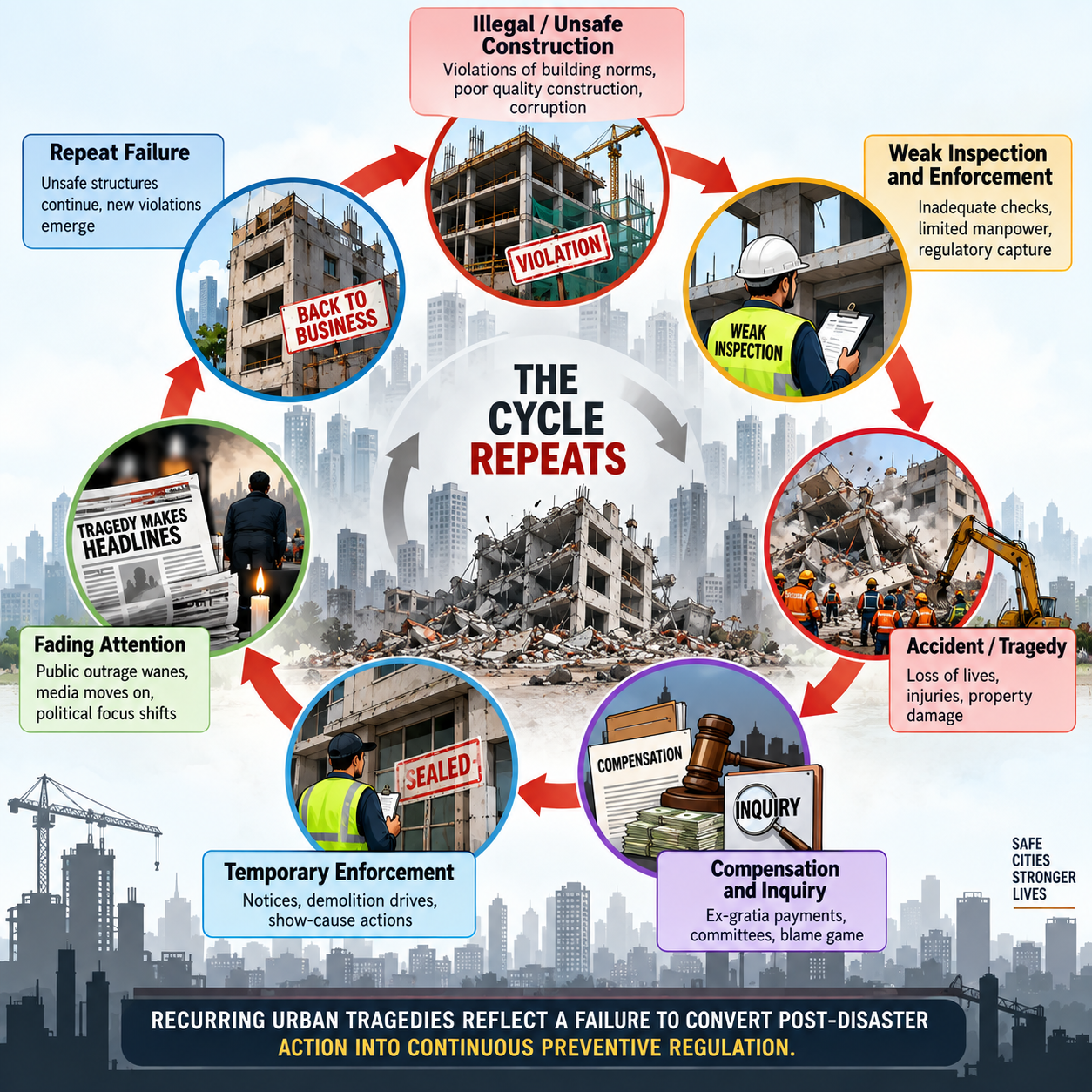
Repeated incidents involving building collapses, illegal structures, unsafe billboards, bridge failures, flooded basements and failing public infrastructure have raised questions about whether Indian cities remain trapped in a cycle of:
Accident → arrests/suspensions → compensation → inquiry → public attention fades → next accident
Building-collapse data underline the scale of the problem: 7,874 people died in structure collapses across India between 2020 and 2024, while Delhi recorded 169 deaths over five years.
The Core Problem: Enforcement Deficit
India does not lack safety frameworks.
The problem is often the gap between:
Rules on paper → approvals → inspection → enforcement → maintenance
Where unauthorised construction or dangerous alterations are knowingly ignored, responsibility cannot rest only with owners or contractors. Administrative oversight, inspection failures and regulatory connivance also become governance issues.
This reflects a classic principal-agent problem: officials entrusted with enforcing public-safety rules may lack capacity, incentives or accountability to do so consistently.
What Is the Current Building-Safety Framework?
The Bureau of Indian Standards established SP 7:2026 — National Building Construction Standards 2026 on 30 April 2026, superseding SP 7:2016, the earlier National Building Code of India.
The Model Building Bye-Laws, 2016, prepared for States, ULBs and development authorities, address orderly development and protection against hazards such as structural failure, earthquakes and fire. They also provide for action against unauthorised development, including sealing, demolition and prosecution under applicable laws.
However, these model standards become effective largely through State laws, municipal bye-laws and local enforcement.
Why Urban Local Bodies Matter
Building permissions, land-use enforcement, local roads, drainage, fire-safety coordination and municipal services place ULBs at the centre of urban-risk governance.
Yet many cities face:
- shortage of qualified technical staff,
- fragmented jurisdiction,
- weak inspection capacity,
- incomplete building records,
- political pressure and corruption,
- inadequate maintenance budgets.
Rapid urbanisation can therefore outpace the institutions responsible for regulating it.
Disaster Management Must Become Preventive
The Disaster Management Act, 2005 requires local authorities to ensure construction within their jurisdiction conforms to disaster-prevention and mitigation standards.
Following the 2025 amendment, Section 41A permits States to constitute Urban Disaster Management Authorities for State capitals and cities with Municipal Corporations, with responsibility for Urban Disaster Management Plans and their implementation.
This creates an opportunity to shift from:
Rescue after collapse → risk identification before collapse
Maintenance Is as Important as New Construction
India’s urban infrastructure challenge is no longer solely about creating new assets.
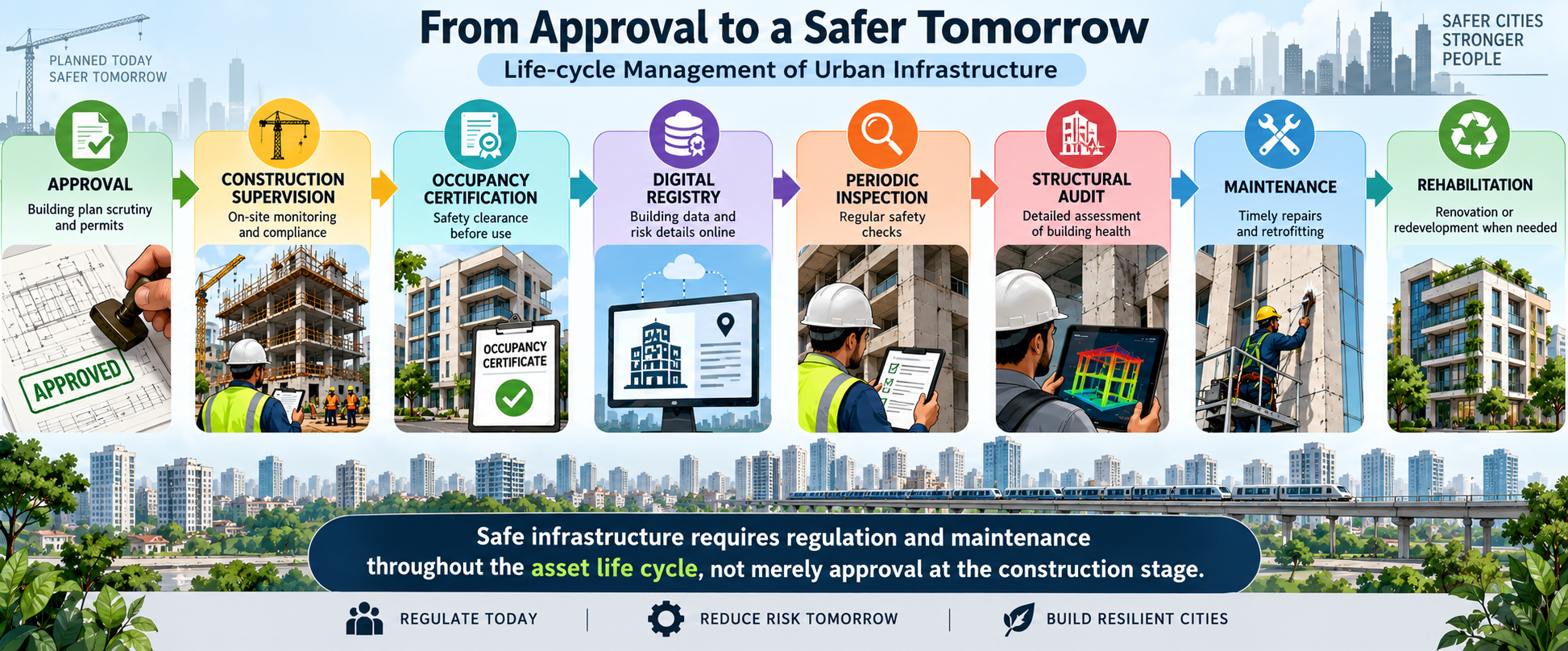
Bridges, buildings, drainage systems and transport infrastructure require a life-cycle approach:
Design → construction quality → inspection → maintenance → structural audit → rehabilitation
Treating infrastructure primarily as one-time capital expenditure can create a growing stock of assets without corresponding maintenance capacity.
Selective Enforcement Weakens Rule of Law
Anti-encroachment or safety enforcement loses legitimacy when action is concentrated on politically weak or marginal groups while comparable violations elsewhere remain untouched.
Effective urban governance requires:
uniform standards + transparent enforcement + appeal mechanisms + proportional action
Safety compliance should depend on the violation, not the social or political influence of the violator.
What Should Change?
India needs to move from accident-driven administration toward continuous urban-risk management through:
Digital building registries + periodic structural audits + risk-based inspections + public compliance certificates + clear officer accountability + maintenance budgeting + technology-enabled monitoring
A publicly accessible compliance history can also help citizens make informed choices about buildings and commercial establishments.
The larger governance principle is:
Infrastructure safety is not achieved when an asset is inaugurated; it must be maintained throughout its life cycle.
Probable Mains Question
“The recurring failure of civic infrastructure in Indian cities is less a problem of absence of standards than of weak enforcement, maintenance and municipal accountability.” Discuss.
Prelims Drill
MCQ 1
With reference to building regulation in India, consider the following statements:
- SP 7:2026 is titled the National Building Construction Standards 2026.
- SP 7:2026 superseded SP 7:2016, the National Building Code of India 2016.
- Model Building Bye-Laws, 2016 were prepared as guidance for State Governments, Urban Local Bodies and development authorities.
Which of the statements given above are correct?
A. 1 only
B. 1 and 2 only
C. 2 and 3 only
D. 1, 2 and 3
Correct Answer: D
Explanation: BIS established SP 7:2026 on 30 April 2026 and withdrew SP 7:2016 on the same date. Model Building Bye-Laws, 2016 provide a model regulatory framework for States and urban authorities.
MCQ 2
With reference to the Disaster Management Act, consider the following statements:
- Local authorities have responsibilities relating to conformity of construction with disaster-prevention and mitigation standards.
- Section 41A provides for Urban Disaster Management Authorities.
- Urban Disaster Management Authorities have no role in post-disaster relief..
Which of the statements given above are correct?
A. 1 only
B. 1 and 2 only
C. 2 and 3 only
D. 1, 2 and 3
Correct Answer: B
Explanation: Local authorities have preventive responsibilities, while Section 41A provides for Urban Disaster Management Authorities responsible for preparation and coordination of Urban Plans.
More Current Affairs - Daily
- Election Commission of India: Constitutional Design and Evolution into a Three-Member Body 12 Oct 2026
- Loknayak Jayaprakash Narayan: Total Revolution and Contribution to Democracy 12 Oct 2026
- India’s Russia-Ukraine Initiative: From Black Sea Security to Strategic Autonomy 12 Oct 2026
- Jayaprakash Narayan: Architect of Total Revolution and Defender of Democracy 12 Oct 2026