
Census 2027: India’s First Digital Census and the New Data Foundation for Governance
Census 2027 marks India’s first digital Census, combining mobile-based data collection and self-enumeration with major implications for welfare planning, caste data and future delimitation.
Census 2027: India’s First Digital Census
Census 2027 is India’s 16th Census and eighth since Independence. Its first phase began on 1 April 2026. For the first time, Census data is being collected digitally through mobile applications, while citizens can also use an optional self-enumeration portal.
The exercise is especially important because India’s previous Census was conducted in 2011, leaving many policies dependent on demographic data that no longer fully captures recent migration, urbanisation and population change.
Constitutional and Legislative Framework
The Census is conducted under the Census Act, 1948 and Census Rules, 1990. It is a Union subject under Entry 69 of the Union List in the Seventh Schedule and is administered by the Office of the Registrar General and Census Commissioner of India under the Ministry of Home Affairs.
Individual Census information is confidential; official data are released in aggregated form.
Two-Phase Enumeration
Phase | Major Information Collected |
Houselisting and Housing Census | Housing conditions, amenities, household particulars and assets |
Population Enumeration | Demographic, socio-economic, educational, migration and other individual characteristics |
Phase I was scheduled across States and UTs between April and September 2026. Population Enumeration is scheduled principally for February 2027, with separate arrangements for specified snow-bound areas.
The Government has also decided to undertake caste enumeration during Population Enumeration.
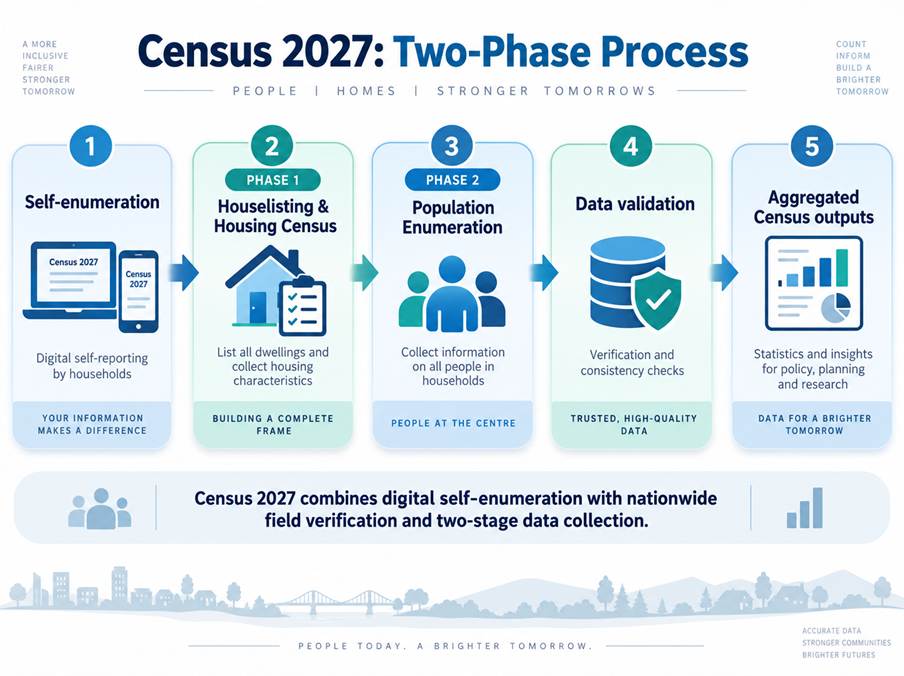
What Makes This Census Different?
Enumerators submit data through smartphone applications, supported by the Census Management and Monitoring System. Self-enumeration is available online and is followed by enumerator verification.
The mobile application and self-enumeration facility support 16 languages. The approved financial outlay is ₹11,718.24 crore, and about 30 lakh field functionaries are involved.
Digitalisation can accelerate processing and improve monitoring, but it also makes cybersecurity, confidentiality, digital accessibility and data-quality validation central governance issues.
Why Updated Census Data Matter
Reliable population data provide the denominator for health, education, welfare, housing, migration and infrastructure planning.
Long gaps between censuses can weaken beneficiary estimates, urban planning, disaster preparedness and tracking of demographic transitions.
Census data are therefore not merely population counts; they constitute the statistical foundation for evidence-based public administration.
Delimitation and Representation
Under Article 82, Parliament provides for readjustment of Lok Sabha constituencies after a Census through a delimitation law. Constitutional amendments have kept the existing allocation of seats among States frozen until the first Census taken after 2026.
Census 2027 is consequently relevant to a future delimitation exercise. The precise design and political consequences of any such exercise will depend on subsequent constitutional and legislative decisions.
The issue has generated debate because States have experienced different population-growth trajectories, creating competing concerns around population-based representation and federal balance.
Women’s Reservation Linkage
The Constitution (106th Amendment) Act, 2023 provides for reservation of approximately one-third of seats for women in the Lok Sabha and State Legislative Assemblies.
Under Article 334A, these provisions take effect after a delimitation exercise undertaken after publication of the relevant figures from the first Census following commencement of the amendment.
Thus, Census publication is an important constitutional prerequisite, but it does not by itself immediately implement women’s reservation.
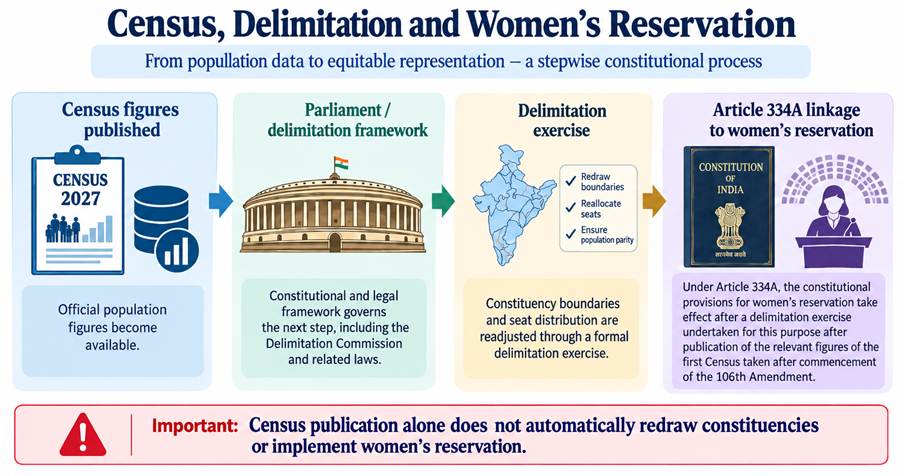
Probable Mains Question
“Census data are not merely demographic statistics but a foundational infrastructure for governance and political representation.” Discuss with reference to Census 2027, digital enumeration, welfare planning and delimitation.
Prelims
MCQ 1
With reference to the Census of India, consider the following statements:
- Census is a subject in the Union List of the Seventh Schedule.
- Census 2027 is India’s first Census to provide digital self-enumeration.
- Self-enumeration completely replaces house-to-house visits by enumerators.
Which of the statements given above are correct?
A. 1 only
B. 1 and 2 only
C. 2 and 3 only
D. 1, 2 and 3
Correct Answer: B
Explanation: Census is a Union subject, and Census 2027 introduces digital self-enumeration. However, enumerators continue house-to-house field visits and verification.
MCQ 2
Consider the following statements:
- Article 82 relates to readjustment of Lok Sabha constituencies following a Census.
- Publication of Census 2027 figures will by itself automatically redraw constituency boundaries.
- The constitutional provisions for reservation of seats for women are linked to a delimitation exercise undertaken after publication of relevant figures from the first Census following the 106th Constitutional Amendment.
Which of the statements given above are correct?
A. 1 only
B. 1 and 3 only
C. 2 and 3 only
D. 1, 2 and 3
Correct Answer: B
Explanation: Article 82 provides the constitutional basis for readjustment after a Census, but delimitation requires a separate legal and institutional process. Article 334A links commencement of women’s reservation to delimitation following publication of the relevant post-amendment Census figures.
More Current Affairs - Daily
- Election Commission of India: Constitutional Design and Evolution into a Three-Member Body 12 Oct 2026
- Loknayak Jayaprakash Narayan: Total Revolution and Contribution to Democracy 12 Oct 2026
- India’s Russia-Ukraine Initiative: From Black Sea Security to Strategic Autonomy 12 Oct 2026
- Jayaprakash Narayan: Architect of Total Revolution and Defender of Democracy 12 Oct 2026