
Black Mass: From Battery Waste to Critical Mineral Security
Black mass is a critical-mineral-rich material obtained after shredding spent lithium-ion batteries. India’s export ban seeks to retain this feedstock for domestic recycling and refining, reduce import dependence and strengthen the circular economy.
- Syllabus Mapping: GS Paper III — Science and Technology, Energy Security, Critical Minerals, Environmental Management, Circular Economy and Industrial Policy.
- Source & Date: The Indian Express, 17 November 2026.
Why in News?
The Directorate General of Foreign Trade has prohibited the export of lithium-ion battery black mass with immediate effect under Notification No. 49/2026-27 dated November 10, 2026.
The export policy for the relevant category has been changed from “Free” to “Prohibited”, with the objective of retaining battery waste inside India for domestic recycling and critical-mineral recovery.
What Is Black Mass?
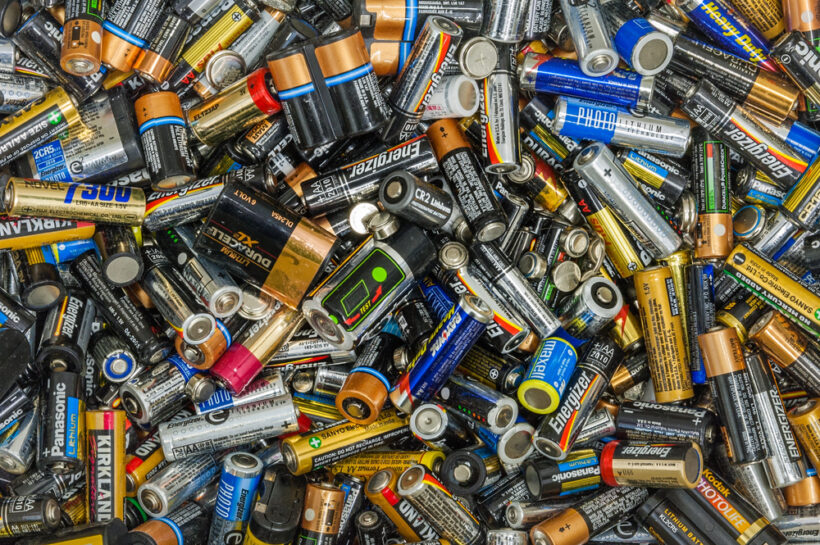
Black mass is the dark, powder-like material produced after spent lithium-ion batteries and battery-manufacturing waste are dismantled and shredded.
It contains valuable materials such as:
- lithium;
- cobalt;
- nickel;
- manganese;
- graphite.
These materials can be chemically separated and refined for use in new batteries and other advanced technologies.
Thus, black mass is not merely waste. It is also a secondary source of critical minerals.
How Is Black Mass Produced?
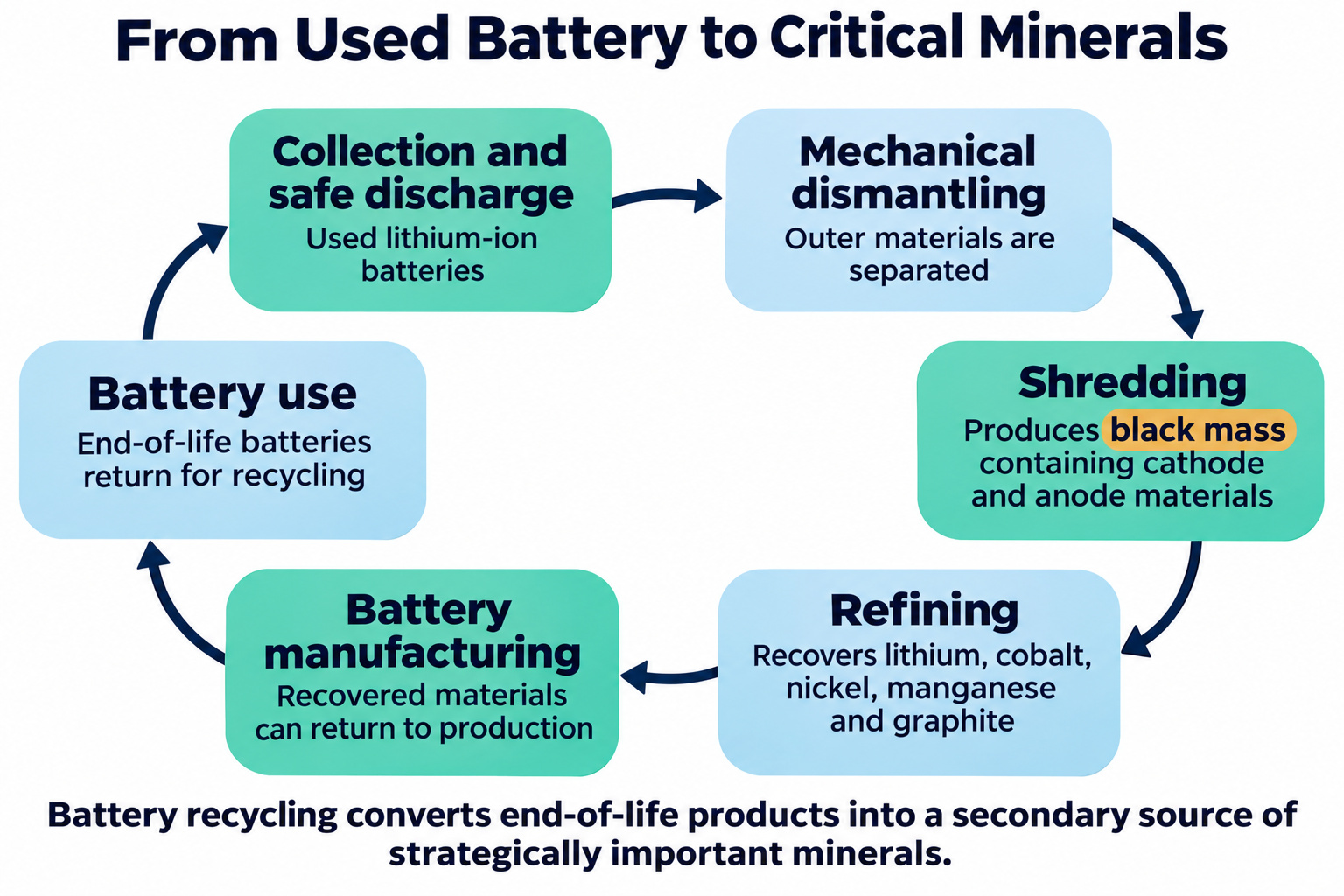
A typical battery-recycling chain begins with collection of end-of-life batteries.
They are discharged, dismantled and mechanically processed.
Plastic, steel, aluminium and copper components are separated, while the electrode materials become a fine powder known as black mass.
This powder then undergoes further refining through processes such as hydrometallurgy or pyrometallurgy to recover usable mineral compounds.
Why Has India Banned Its Export?
The main concern is feedstock security.
India is expanding domestic battery-recycling and mineral-refining capacity, but these units need sufficient black mass to operate efficiently.
If black mass is exported soon after basic shredding, higher-value refining takes place abroad.
The government therefore wants domestic firms to move beyond low-value dismantling towards mineral recovery and refining inside India.
The official objective is to improve capacity utilisation, encourage investment, generate employment and retain valuable critical minerals within the domestic economy.
What Is Urban Mining?
The policy also illustrates the concept of urban mining.
Traditional mining extracts minerals from geological deposits.
Urban mining recovers metals and minerals from already-used products such as batteries, electronics and electrical equipment.
For countries with limited domestic mineral reserves, discarded products can become a strategic resource.
Battery waste can therefore function as an above-ground mineral stock.
Why Are Critical Minerals Strategically Important?
Critical minerals are essential for technologies such as:
- electric vehicles;
- advanced batteries;
- renewable-energy systems;
- electronics;
- defence technologies;
- grid-scale energy storage.
Supply is often concentrated geographically, while processing capacity is even more concentrated.
This makes critical minerals vulnerable to export restrictions, geopolitical tensions and supply disruptions.
For India, recycling provides one way to reduce exposure to these external risks.
India’s Import Dependence
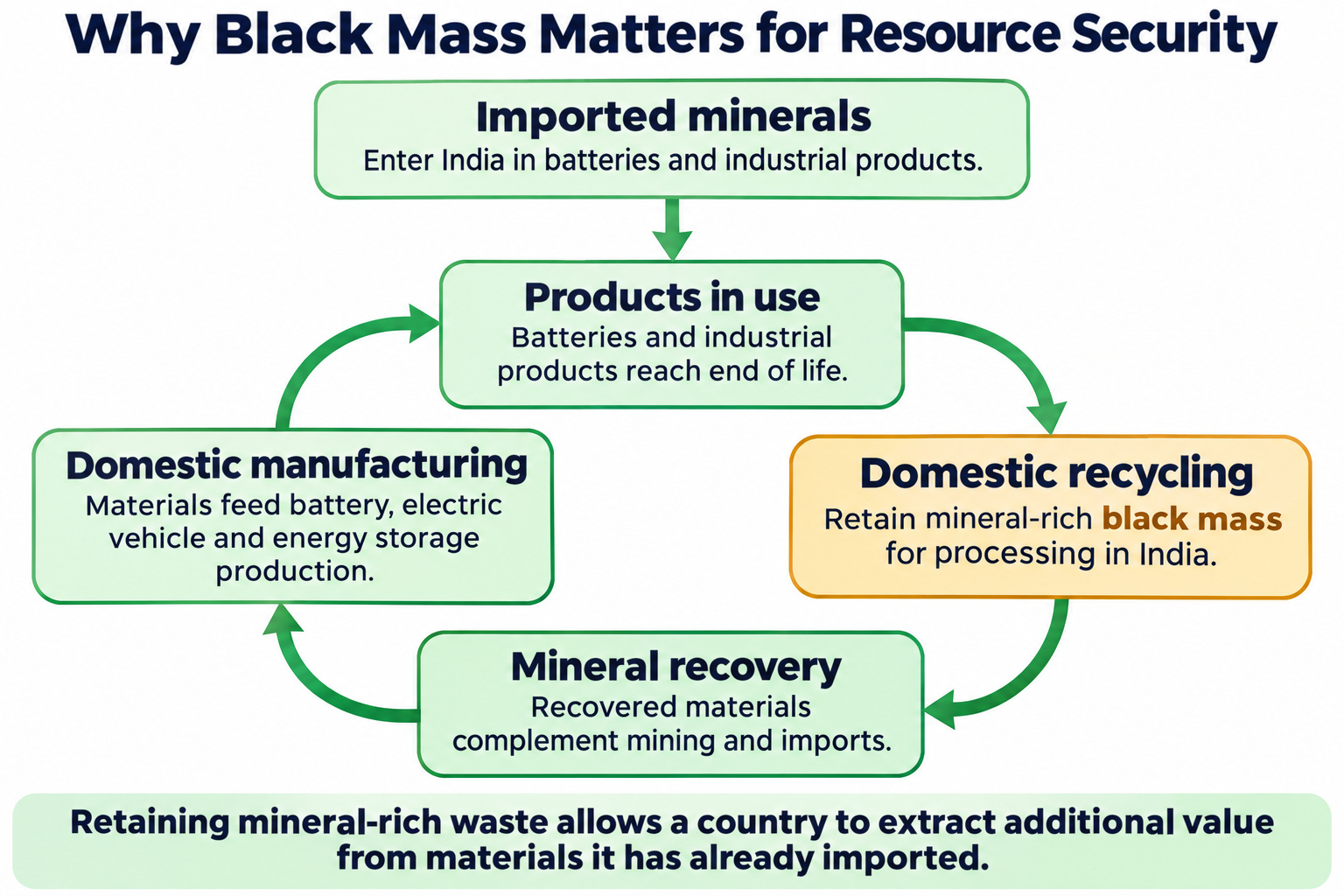
India remains substantially dependent on external sources for several minerals required in advanced batteries and clean-energy technologies.
This makes domestic recycling strategically important even if recycled material cannot completely replace primary mining or imports.
Recovered minerals can supplement imported supplies and reduce the amount of valuable material permanently leaving the economy.
Why Is Black Mass Also a Hazardous-Waste Issue?
Black mass is not treated only as a commercial commodity.
Its handling can fall under the Hazardous and Other Wastes (Management and Transboundary Movement) Rules, 2016.
A Ministry of Environment technical review noted that black mass processed within the same premises may be treated as an intermediate material, but when transported or sold to another processing unit it can be treated as hazardous waste under the applicable framework.
This means its movement requires environmental safeguards in addition to trade regulation.
What Is the Economic Logic of the Ban?
Battery recycling has different stages of value addition.
Simply dismantling batteries and exporting black mass captures relatively little value.
Recovering lithium, nickel or cobalt compounds requires greater technological capability but creates more domestic value.
The export ban therefore tries to shift India from waste processing towards mineral refining.
This can support:
- higher-value manufacturing;
- specialised recycling technology;
- domestic battery supply chains;
- investment in refining capacity;
- skilled employment.
Link with National Critical Mineral Mission
The measure complements India's wider National Critical Mineral Mission.
The government has also approved incentives to develop recycling capacity for recovery of critical minerals from secondary sources such as battery waste and e-waste.
The official rationale is that retaining black mass domestically ensures that new recycling and refining capacity has adequate material to process.
Why Are Countries Restricting Mineral-Rich Waste Exports?
Critical-mineral policy is increasingly becoming part of industrial and geopolitical strategy.
Countries seek not only access to mines but also control over:
- processing;
- refining;
- recycling;
- technology;
- mineral-bearing waste.
A country that exports raw or partially processed mineral-bearing material may lose both strategic resources and higher-value industrial activity.
Therefore, battery waste is increasingly viewed as part of the critical-mineral supply chain, not merely as an environmental disposal problem.
Possible Challenges
The export ban can strengthen domestic refiners, but it also creates implementation challenges.
If domestic refining capacity or purchasing competition remains inadequate, firms that only dismantle batteries may receive lower prices.
Environmental enforcement is also essential because poor recycling practices can create pollution and occupational hazards.
The policy will therefore work best when export restrictions are combined with efficient collection, formal recycling, technological capability and strong environmental regulation.
Core Policy Lesson
India's black-mass export ban represents a shift from waste management to resource security.
Spent lithium-ion batteries contain strategically valuable minerals that can be recovered and reused.
By retaining black mass domestically, India aims to build a circular battery economy, strengthen local refining, reduce import vulnerability and capture more value from materials already present within the country.
The larger lesson is that in the clean-energy transition, recycling infrastructure is becoming as strategically important as access to mines.
---
Probable Mains Question
“Critical-mineral security increasingly depends not only on access to mines but also on the ability to retain, recycle and refine mineral-bearing waste.” Discuss with reference to India’s ban on the export of lithium-ion battery black mass.
Prelims Drill
MCQ 1
With reference to lithium-ion battery black mass, consider the following statements:
1. It is produced during mechanical processing of spent lithium-ion batteries.
2. It can contain recoverable lithium, cobalt, nickel and manganese.
3. It is itself a naturally occurring geological ore deposit.
Which of the statements given above are correct?
A. 1 only
B. 1 and 2 only
C. 2 and 3 only
D. 1, 2 and 3
Correct Answer: B
Explanation: Black mass is a processed material obtained from spent batteries. It contains valuable recoverable minerals but is not a naturally occurring ore deposit.
MCQ 2
Consider the following statements regarding battery recycling and critical-mineral security:
1. Urban mining refers to recovering useful minerals from discarded products and waste streams.
2. Recycling can reduce, though not necessarily eliminate, dependence on imported primary minerals.
3. Exporting black mass after shredding always results in greater domestic value addition than refining it domestically.
Which of the statements given above are correct?
A. 1 only
B. 1 and 2 only
C. 2 and 3 only
D. 1, 2 and 3
Correct Answer: B
Explanation: Urban mining recovers minerals from used products, and recycling can supplement primary supplies. Greater value is generally captured when mineral recovery and refining occur domestically rather than when only partially processed material is exported.
More Current Affairs - Daily
- India’s State Capacity Stagnation: The Missing Link in Reform 21 Nov 2026
- Holding Two Offices: What Does the Constitution Say About an Office of Profit? 21 Nov 2026
- The Price of War: West Asia Crisis Is Raising India’s Energy Import Bill 21 Nov 2026
- Surveillance Pricing : How Is Personal Data Used to Set Prices? 21 Nov 2026