
Current Affairs - Daily
26 November 2026
Bisleri Case and FSSAI Action on Packaged Drinking Water
The Bisleri Case and the Regulation of Packaged Drinking Water
The Food Safety and Standards Authority of India (FSSAI) authorised the prosecution of Bisleri International Pvt. Ltd. over a batch of packaged drinking water manufactured at its Goa plant in September 2025.
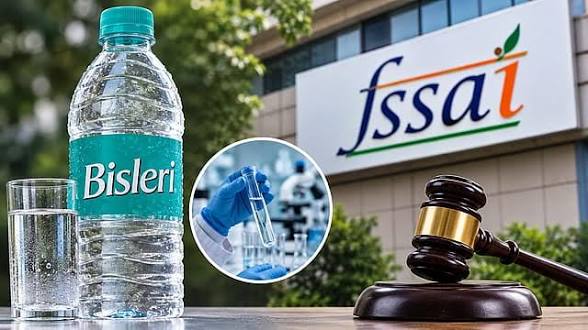
- On 23 November, FSSAI clarified that the sale prohibition applied only to the affected batch, GO 270. The authorisation allows criminal proceedings to begin. The competent court determines whether the company is guilty.
What did the tests find?
- According to Bisleri, five of the six samples collected from its Goa plant on 30 September 2025 met the prescribed standards. The sixth contained 12 micrograms of bromate per litre, above the permissible limit of 10 micrograms per litre.
- Following the company’s appeal, the National Food Laboratory in Navi Mumbai retested the sample. The bromate concentration was within the permissible limit, but the laboratory detected polycyclic aromatic hydrocarbons (PAHs) at 0.144 micrograms per litre. The referral laboratory declared the sample unsafe.
How do the two contaminants differ?
- Bromate is an inorganic ion. It can form when ozone used to disinfect water reacts with bromide naturally present in the source water. The World Health Organization’s provisional guideline value for bromate in drinking water is 10 micrograms per litre.
- PAHs are a group of organic compounds formed during the incomplete combustion of materials such as coal, oil and wood. The International Agency for Research on Cancer classifies benzo[a]pyrene, a member of this group, as carcinogenic to humans (Group 1).
Legal framework and oversight.
- Section 3(1)(j) of the Food Safety and Standards Act, 2006 expressly includes packaged drinking water in the definition of ‘food’. Under the 2011 food product standards, Regulation 2.10.8 covers packaged drinking water, while Regulation 2.10.7 covers natural mineral water.
- Packaged drinking water may be produced by treating surface water or groundwater through processes such as filtration and reverse osmosis. Natural mineral water comes from a protected underground source and has a relatively stable mineral composition.
- In October 2024, the mandatory Bureau of Indian Standards (BIS) certification requirement was removed for both categories. On 29 November 2024, FSSAI classified both as high-risk food products. Manufacturers must undergo inspection before obtaining a licence or registration. Centrally licensed manufacturers must also undergo an annual food safety audit by a recognised third-party agency.
- Under the testing scheme effective from 1 January 2026, packaged drinking water must be tested for all prescribed parameters every six months. If a sample fails any parameter, that parameter must be tested monthly until three consecutive batches meet the standard.
- According to figures presented in the Rajya Sabha, 650 of the 1,776 packaged drinking water samples tested for enforcement purposes in 2022–23 failed to meet the prescribed standards. In 2023–24, 333 of the 1,300 samples tested failed to meet the standards.
Practice Question
Question : Consider the following statements about the safety of packaged drinking water.
- Bromate can form when water containing bromide is disinfected with ozone.
- Regulation 2.10.8 prescribes the standards for both natural mineral water and packaged drinking water.
- If a sample fails a parameter during six-monthly testing, that parameter must be tested monthly until three consecutive batches meet the standard.
Which of the statements given above are correct?
(a) 1 and 2 only
(b) 1 and 3 only
(c) 2 and 3 only
(d) 1, 2 and 3
Answer : (b)