
Bioluminescence in Forests: How Do Fireflies Glow?
Bioluminescence in Forests: Fireflies and Other Light-Producing Organisms
- Bioluminescence is the process by which certain organisms produce light through biochemical reactions within their bodies.
It occurs in fireflies, some fungi, bacteria and marine organisms. In this process, chemical energy is converted into light energy, with very little heat produced.
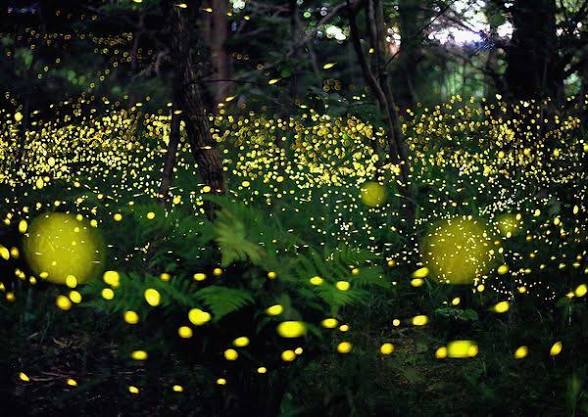
Fireflies and Their Main Characteristics
- Fireflies are insects belonging to the family Lampyridae and the order Coleoptera.
- They have specialised light-producing organs in their abdomens.
- These organs produce light through a reaction involving luciferin, the enzyme luciferase, oxygen and adenosine triphosphate (ATP).
- Fireflies use light primarily to communicate, attract mates during breeding and warn predators.
- Their life cycle has four stages: egg, larva, pupa and adult.
Bioluminescence in India
- Various species of fireflies are found in the Western Ghats, the north-eastern states and other moist forest regions of India. Bhandardara, Purushwadi and Radhanagari in Maharashtra are known for their fireflies.
- Light-producing fungi are also found in the forests of the Western Ghats and Meghalaya. In marine ecosystems, microorganisms such as Noctiluca scintillans are known for their bioluminescence.
Ecological and Scientific Significance
- The presence and diversity of fireflies can help assess the health of local ecosystems. Their larvae feed on snails and other small invertebrates.
- Bioluminescence is also used in biotechnology, medical research, studies of gene expression and drug testing.
Major Threats and Conservation
- The main threats to fireflies include habitat destruction, excessive pesticide use, light pollution, climate change and unregulated tourism.
- Artificial light interferes with their natural mating signals. Protecting their habitats, reducing light pollution at night and promoting responsible ecotourism are essential to their conservation.
Question - What is the main energy conversion that occurs during bioluminescence in fireflies?
A) Light energy is converted into chemical energy.
B) Chemical energy is converted into light energy.
C) Thermal energy is converted into chemical energy.
D) Mechanical energy is converted into light energy.
Answer - (B)
Explanation - During bioluminescence, biochemical reactions within an organism convert chemical energy into light energy and produce very little heat. This process occurs in fireflies as well as in some fungi, bacteria and marine organisms.
More Current Affairs - Daily
- MINDMAP - Delimitation: Why Use the 2011 Census Instead of 2027? 28 Nov 2026
- Left-Wing Politics in India: History, Ideology and Today 28 Nov 2026
- Dalai Lama’s Escape: From Nehru’s Dilemma to India-China Tensions 28 Nov 2026
- Cash Transfer Schemes: Welfare, Fiscal Trade-Offs and Accountability 28 Nov 2026