
Balance and Bargain Strategy in Great-Power Politics
Contemporary great-power politics combines coalition-building with direct bargaining among rivals. States increasingly cooperate, compete and hedge simultaneously to preserve strategic flexibility.
- Syllabus Mapping: GS Paper II — International Relations, Bilateral and Multilateral Groupings, Global Power Politics and India’s Strategic Interests.
- Source & Date: The Indian Express, 16 November 2026.
Why in News?
Two major diplomatic meetings scheduled in Asia highlight a changing pattern in great-power politics.
The Quad leaders of India, Australia, Japan and the United States are set to meet in Manila, while the leaders of the United States, Russia and China are expected to meet separately in Shenzhen.
Together, these meetings illustrate a broader trend: major powers are increasingly balancing and bargaining at the same time.
What Does “Balance and Bargain” Mean?
Traditional alliance politics often imagined relatively fixed camps.
Contemporary diplomacy is more flexible.
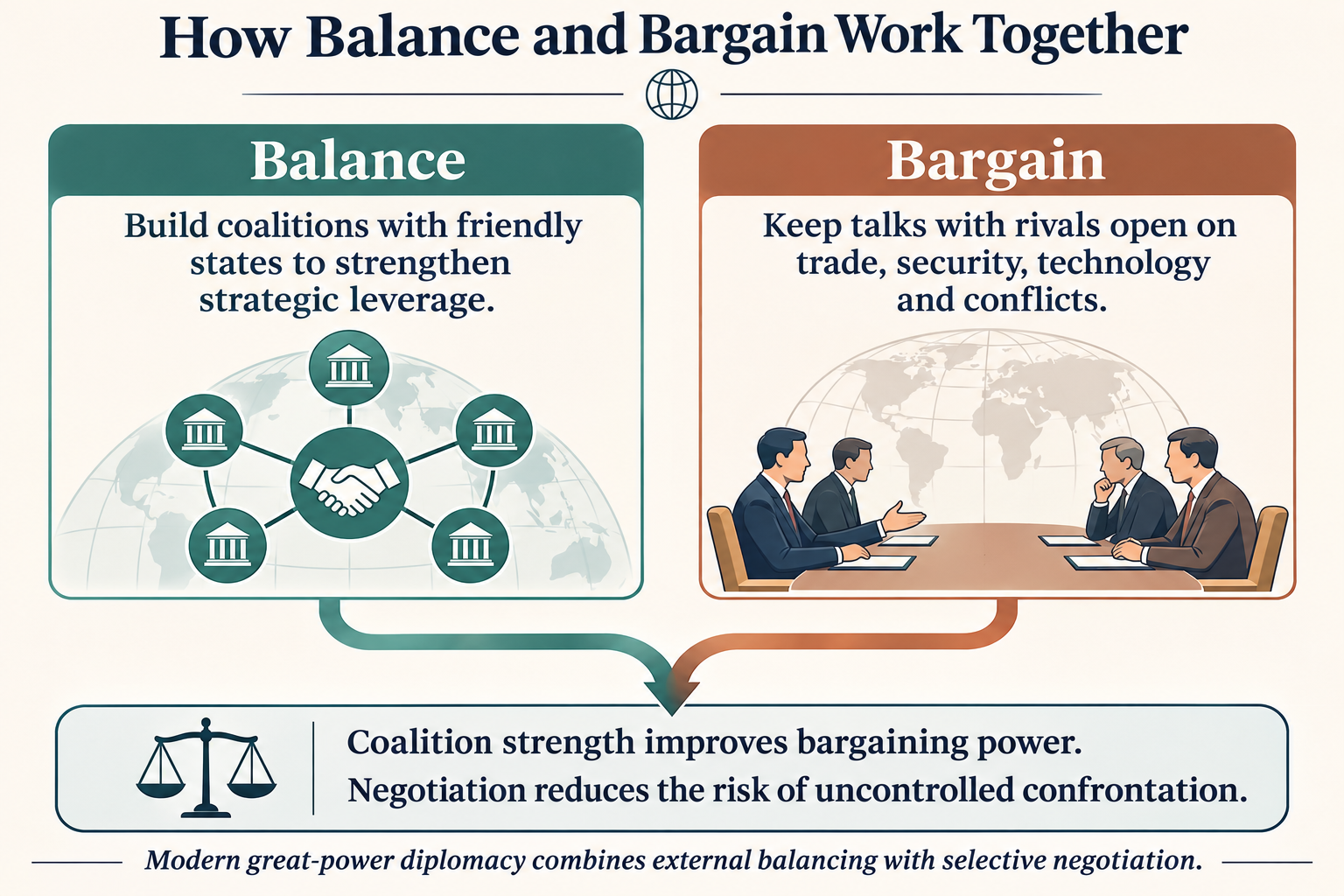
A state may strengthen coalitions against a rival in one domain while simultaneously negotiating with that rival in another.
For example, countries may cooperate on maritime security or supply chains while continuing dialogue on trade, nuclear stability or conflict management.
This produces a system based on competition without complete disengagement.
What Is Balancing?
Balancing refers to efforts by states to prevent another power from becoming overwhelmingly dominant.
This can involve:
- strengthening military and economic capabilities;
- forming partnerships or coalitions;
- diversifying supply chains;
- increasing technological resilience;
- expanding diplomatic ties with other powers.
The Quad can be understood partly through this logic.
Its members cooperate on issues such as maritime security, critical technologies, resilient supply chains and critical minerals in the Indo-Pacific.
What Is Bargaining?
Bargaining involves direct engagement with competitors to obtain favourable outcomes.
Even adversarial powers may negotiate over:
- arms control;
- regional conflicts;
- trade and tariffs;
- energy security;
- technology;
- crisis management.
The key point is that rivalry does not eliminate negotiation.
In fact, greater rivalry may increase the need for communication to prevent uncontrolled escalation.
Why the Quad Still Matters
The Quad brings together India, Australia, Japan and the United States.
Rather than functioning as a formal military alliance, it has increasingly focused on practical cooperation.
Its agenda includes maritime security, critical minerals, resilient supply chains, emerging technologies, energy security and protection of commercial shipping.
This makes the Quad useful not only as a strategic signal but also as a platform for building economic and technological resilience.
Why a U.S.-Russia-China Meeting Is Different
A possible trilateral meeting among the United States, Russia and China would represent a different form of diplomacy.
It would not necessarily create a stable institutional grouping.
The three powers have deep disagreements over security, trade, technology and the international order.
Their engagement would therefore be better understood as issue-based bargaining among competitors rather than the creation of a durable alliance.
Why the “New Yalta” Comparison Is Limited
The 1945 Yalta Conference took place among wartime allies who had cooperated against Nazi Germany.
The United States, Russia and China today are not comparable allies.
They compete over influence, security structures, technology and regional order.
A modern trilateral meeting would therefore be less about dividing the world into fixed spheres and more about exploring limited accommodation in specific areas.
Hedging: The Middle Strategy
Between balancing and alignment lies hedging.
Hedging means avoiding excessive dependence on any one power while maintaining multiple relationships.
A country may strengthen ties with one partner without fully closing the door to another.
This is particularly relevant in a world where alliances are less predictable and economic interdependence remains high.
What Does This Mean for India?
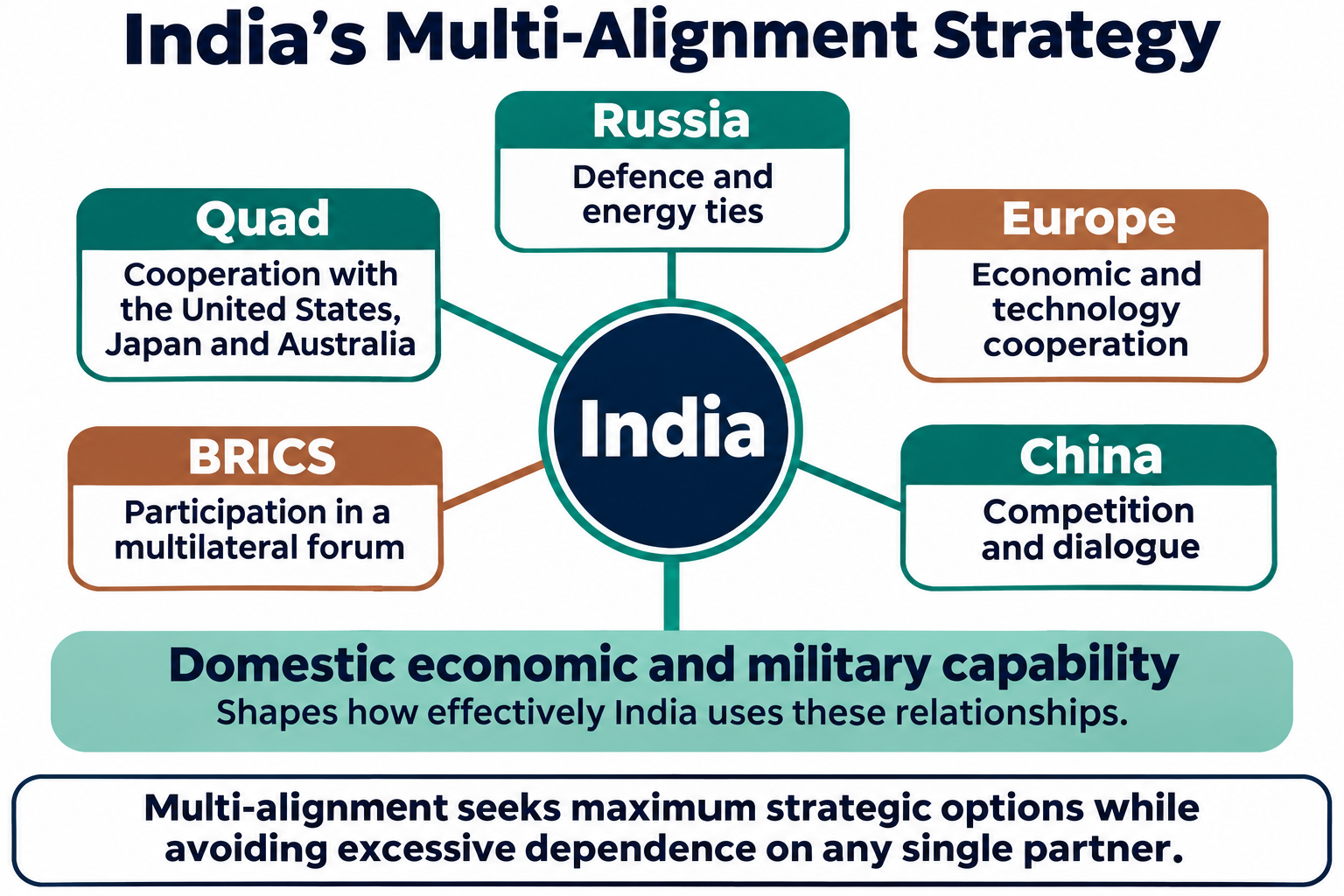
India already follows a form of multi-alignment.
It works with the United States, Japan and Australia in the Quad while maintaining important relations with Russia.
It participates in BRICS while also deepening ties with Europe and other Indo-Pacific partners.
At the same time, it seeks to manage structural competition with China through a combination of deterrence and dialogue.
This approach is increasingly consistent with wider global behaviour rather than being an exception.
Strategic Autonomy Is Not Neutrality
Strategic autonomy does not mean remaining equally distant from every major power.
It means retaining sufficient political, economic and military capacity to make independent choices.
India can therefore cooperate closely with the Quad in areas where interests converge without converting that cooperation into automatic alignment on every geopolitical issue.
Why National Capability Matters
Diplomatic flexibility has value only when backed by domestic strength.
A country that depends heavily on others for defence equipment, energy, technology or critical minerals has less freedom to manoeuvre.
Therefore, strategic autonomy requires:
- stronger domestic defence capability;
- technological depth;
- resilient supply chains;
- diversified energy sources;
- economic competitiveness;
- political and institutional stability.
Foreign policy choices ultimately depend on the material capabilities available to the state.
Risks of Multi-Alignment
Multi-alignment also has limitations.
Too much flexibility can create uncertainty among partners.
Different relationships may generate conflicting expectations.
Balancing Russia, the United States and China can become difficult during major crises.
Strategic flexibility must therefore be guided by clear national priorities rather than becoming an end in itself.
Core Policy Lesson
The emerging international system is neither a rigid bipolar order nor a fully cooperative multipolar system.
Major powers increasingly build coalitions, hedge against partners and bargain with adversaries simultaneously.
For India, this environment creates opportunities because it legitimises strategic flexibility.
But diplomatic manoeuvrability cannot substitute for national capability.
India’s multi-alignment strategy will be effective only when diversified partnerships are combined with economic strength, technological capacity, military modernisation and resilient domestic institutions.
---
Probable Mains Question
“Contemporary great-power politics is increasingly characterised by simultaneous balancing, hedging and bargaining.” Explain this trend and assess its implications for India’s strategy of multi-alignment and strategic autonomy.
---
Prelims Drill
MCQ 1
With reference to international relations, consider the following statements:
1. Balancing involves attempts to prevent another state from becoming overwhelmingly dominant.
2. Hedging necessarily requires complete neutrality between competing major powers.
3. Bargaining may take place even between geopolitical rivals.
Which of the statements given above are correct?
A. 1 only
B. 1 and 3 only
C. 2 and 3 only
D. 1, 2 and 3
Correct Answer: B
Explanation: Balancing seeks to counter excessive concentration of power, while bargaining can occur between rivals. Hedging does not require strict neutrality; it involves preserving options and avoiding excessive dependence.
MCQ 2
Consider the following statements regarding the Quad:
1. It comprises India, Australia, Japan and the United States.
2. It is a treaty-based collective defence organisation comparable to NATO.
3. Its cooperation includes areas such as maritime security, critical technologies and resilient supply chains.
Which of the statements given above are correct?
A. 1 only
B. 1 and 3 only
C. 2 and 3 only
D. 1, 2 and 3
Correct Answer: B
Explanation: The Quad is not a formal collective defence alliance. It is a flexible strategic grouping whose agenda includes maritime security, technology, infrastructure and supply-chain resilience.
More Current Affairs - Daily
- India’s State Capacity Stagnation: The Missing Link in Reform 21 Nov 2026
- Holding Two Offices: What Does the Constitution Say About an Office of Profit? 21 Nov 2026
- The Price of War: West Asia Crisis Is Raising India’s Energy Import Bill 21 Nov 2026
- Surveillance Pricing : How Is Personal Data Used to Set Prices? 21 Nov 2026