
AI, Productivity and Jobs: Does Higher Productivity Create More Employment?
AI may sharply raise labour productivity, but its employment impact depends on whether aggregate demand grows faster or slower than productivity. This lies at the heart of the difference between neoclassical and demand-side growth frameworks.

- Syllabus Mapping: GS Paper III — Indian Economy, Employment, Growth, Technology, Artificial Intelligence and Labour Markets.
- Source & Date: The Hindu, 19 November 2026.
Why in News?
Artificial intelligence is increasingly being compared with earlier general-purpose technologies because of its potential to sharply increase labour productivity.
Recent data from AI-adopting sectors in the United States suggest a notable rise in output per worker. The central economic question, however, is not merely whether AI raises productivity, but what happens to output, employment and wages when productivity rises.
What Is Labour Productivity?
Labour productivity can be expressed as:
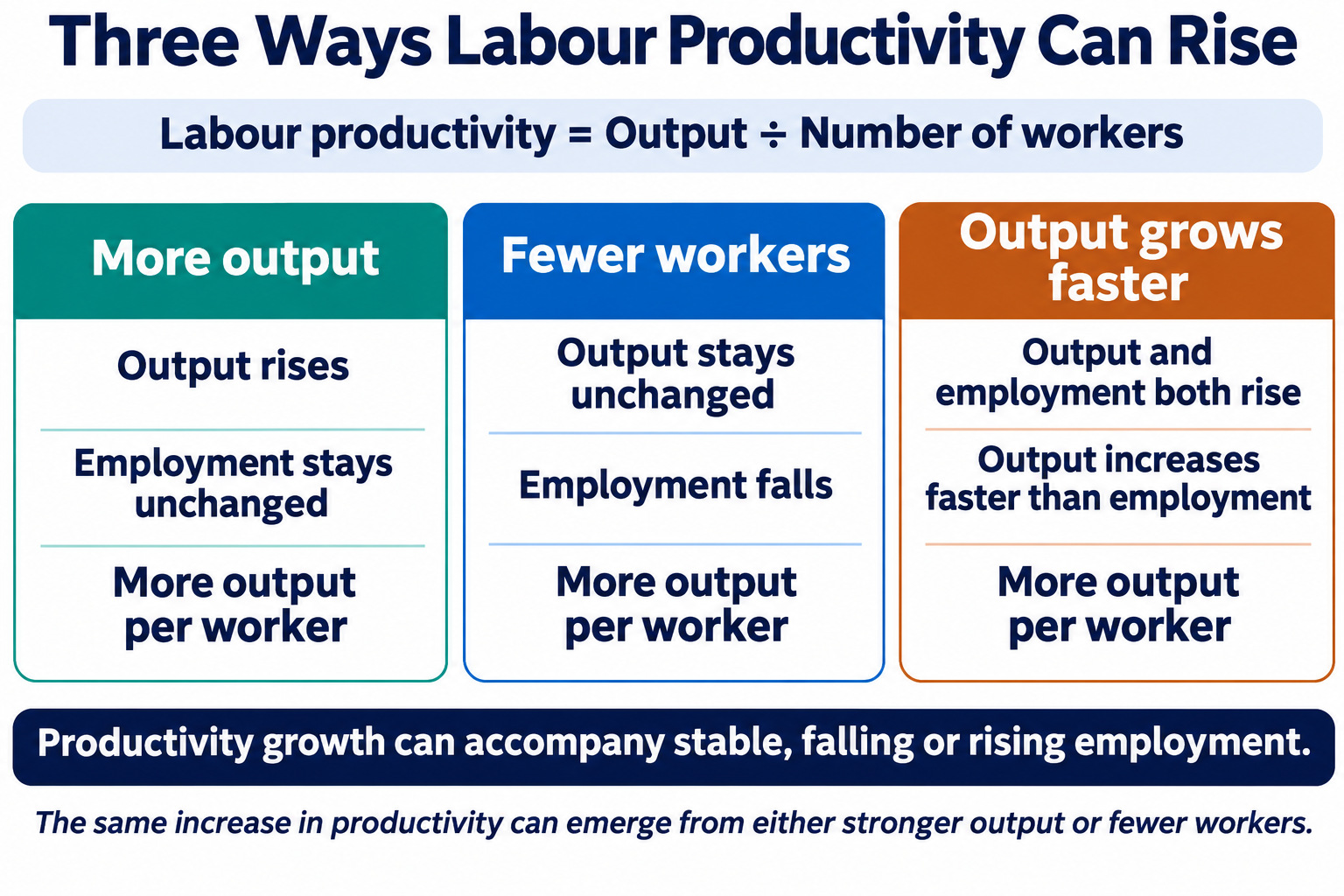
Labour productivity = Output ÷ Number of workers employed
This ratio can rise in three ways:
- output increases while employment remains unchanged;
- employment falls while output remains unchanged;
- both output and employment rise, but output grows faster.
The third outcome is generally the most desirable because productivity improves without necessarily reducing employment.
Why AI Matters
AI can increase the amount of output produced by each worker by automating tasks, accelerating analysis, improving decision-making and reducing the time needed for routine work.
Sectors such as information technology, finance and professional services are especially exposed because many of their tasks are information-intensive.
But productivity growth by itself does not tell us whether total employment will increase or decrease.
That depends on how the rest of the economy responds.
Neoclassical View: Productivity Raises Growth
The neoclassical growth framework treats output growth as depending on the growth of the workforce and its productivity.
In simplified form:
Output growth ≈ Workforce growth + Productivity growth
If the labour force grows by 2% and productivity rises by 4%, output could grow by about 6%.
In this framework, stronger productivity directly raises the economy's potential rate of growth.
The adjustment therefore occurs mainly through higher output.
The Solow Growth Framework
Robert Solow's growth model emphasised how capital accumulation and productivity influence long-run output.
Later endogenous growth theories attempted to explain where productivity improvement itself comes from.
They highlighted factors such as:
- human capital;
- research and development;
- innovation;
- technological knowledge;
- institutions and intellectual-property systems.
From this perspective, AI can raise long-run growth if it becomes a broad productivity-enhancing technology.
Demand-Side View: Productivity Does Not Guarantee Demand
A demand-side or heterodox framework begins with a different question:
Even if the economy can produce more, will consumers, firms and governments actually demand that additional output?
Under capitalism, firms do not continuously produce goods and services that cannot be sold.
Therefore, higher productive capacity does not automatically translate into higher actual output.
This makes aggregate demand central to the employment effect of AI.
Demand Growth vs Productivity Growth
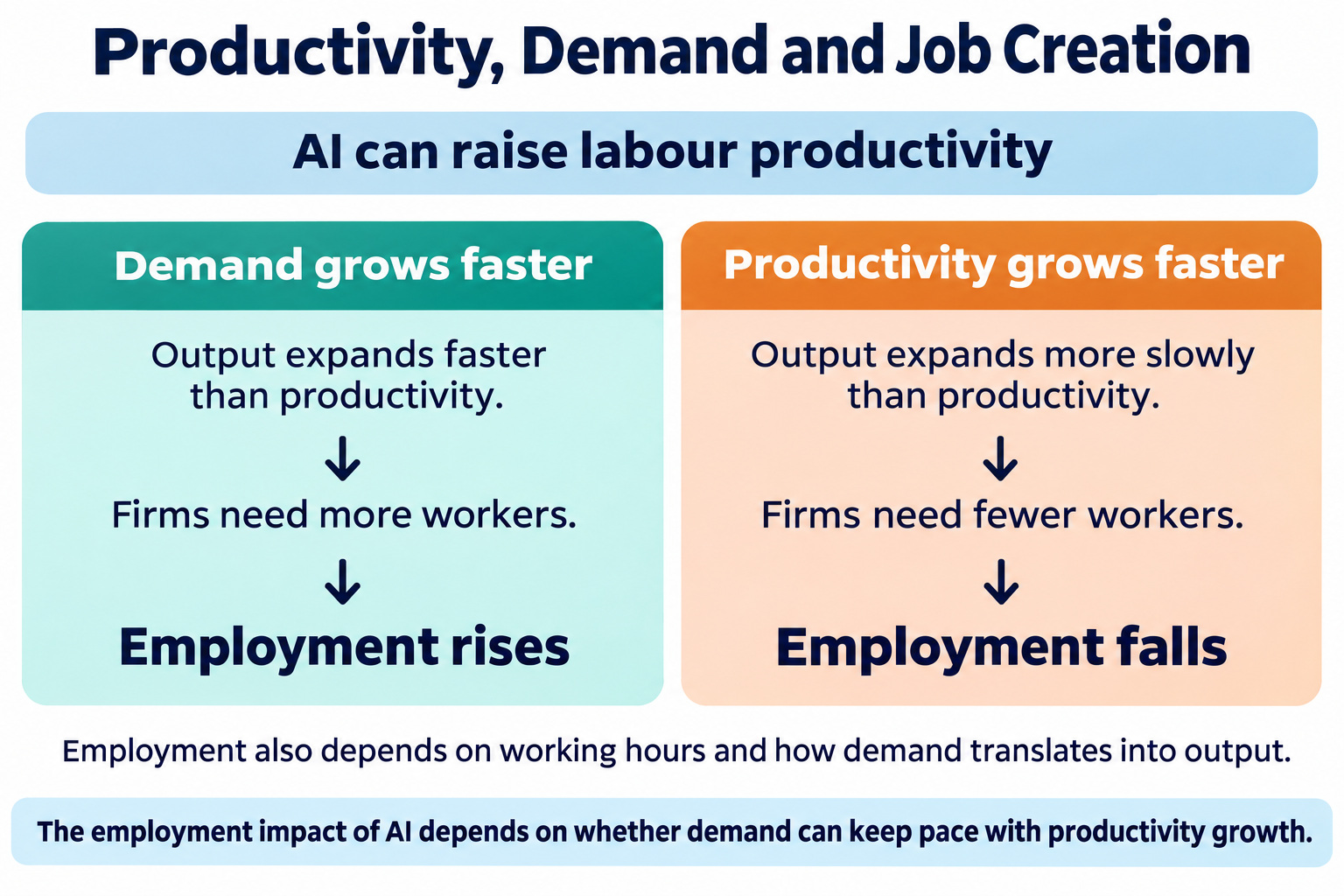
Suppose productivity rises by 4%, but demand for output grows by only 3%.
Firms can satisfy the larger demand with fewer workers.
Employment can therefore decline by roughly 1%.
But if demand grows by 6% while productivity rises by 4%, firms must still expand employment to meet the additional demand.
The central employment relationship becomes:
Job growth ≈ Demand growth − Productivity growth
This is the key distinction in the productivity debate.
Why the Two Frameworks Differ
The two approaches assign different variables the role of adjustment.
In the neoclassical framework, output growth adjusts upward when productivity increases.
In the demand-side framework, if demand does not rise sufficiently, employment adjusts downward.
Thus, the disagreement is not over whether AI can raise productivity. It is over whether markets automatically generate enough additional demand to absorb the extra productive capacity.
Does Labour Supply Limit Growth?
The demand-side framework also argues that labour availability is often more flexible than simple national workforce numbers suggest.
Historically, labour has moved across regions and countries in response to employment demand.
Within India, higher-growth States often attract migrant workers from poorer States.
Globally, immigration rules may also loosen when labour demand is strong and tighten when unemployment rises.
Thus, labour supply itself can adjust through migration.
AI Can Displace Some Jobs and Create Others
AI may replace some white-collar tasks while increasing demand for other occupations.
Possible new demand can arise in:
- AI infrastructure;
- data centres;
- hardware;
- maintenance;
- logistics;
- construction;
- energy;
- complementary services.
Therefore, the correct question is not whether one occupation disappears, but whether the economy as a whole creates enough new demand and employment to offset displaced jobs.
Productivity Gains Can Raise Profits Before Jobs
A rise in output per worker can immediately reduce unit labour costs and improve profit margins.
But whether those higher profits translate into broader employment depends on what firms do next.
If profits generate new investment, lower prices, higher wages or stronger consumption, demand may rise.
If gains remain concentrated without generating sufficient additional spending, employment growth may remain weak.
Distribution Therefore Matters
The productivity debate is also a distribution debate.
If AI-driven gains flow mainly to owners of capital, aggregate demand may not rise as strongly as it would if income gains were broadly distributed.
Policies affecting wages, social protection, taxation, public investment and worker bargaining power can therefore influence whether productivity gains translate into wider economic growth.
Why the Current Evidence Is Still Incomplete
Strong productivity growth in AI-intensive sectors is important, but it does not prove that the same effect will spread uniformly across the economy.
Different sectors vary in:
- ability to adopt AI;
- capital intensity;
- worker skills;
- task structure;
- demand conditions.
The macroeconomic effect will therefore depend on how widely AI diffusion occurs and how consumers, firms and labour markets respond.
Core Policy Lesson
AI-driven productivity growth should not automatically be equated with either mass unemployment or guaranteed economic prosperity.
Higher productivity expands what the economy can produce.
But employment ultimately depends on whether demand expands sufficiently to absorb that additional productive capacity.
The policy challenge is therefore not merely to maximise AI adoption, but to ensure that productivity gains are accompanied by investment, rising demand, worker reskilling, income growth and creation of new economic activities.
The central question for the AI era is not simply “How much more can each worker produce?” but also “Will the economy generate enough demand to employ workers productively?”
---
Probable Mains Question
“The employment impact of artificial intelligence depends not only on productivity growth but also on the growth of aggregate demand.” Explain the statement with reference to the neoclassical and demand-side approaches to economic growth.
---
Prelims Drill
MCQ 1
With reference to labour productivity, consider the following statements:
1. Labour productivity may increase even when employment falls.
2. Labour productivity can rise when output and employment both increase, provided output grows faster.
3. A rise in labour productivity necessarily implies a rise in total employment.
Which of the statements given above are correct?
A. 1 only
B. 1 and 2 only
C. 2 and 3 only
D. 1, 2 and 3
Correct Answer: B
Explanation: Labour productivity is output per worker. It can rise because output increases, employment falls, or output grows faster than employment. It does not by itself reveal the direction of employment.
MCQ 2
Consider the following statements:
1. In a simplified neoclassical framework, higher labour productivity can raise potential output growth.
2. In a demand-side framework, employment can decline if productivity grows faster than aggregate demand.
3. Both frameworks necessarily assume that employment must rise whenever productivity increases.
Which of the statements given above are correct?
A. 1 only
B. 1 and 2 only
C. 2 and 3 only
D. 1, 2 and 3
Correct Answer: B
Explanation: The neoclassical framework emphasises productivity as a driver of output growth, while the demand-side framework stresses that if demand fails to keep pace with productivity, employment may fall.
More Current Affairs - Daily
- India’s State Capacity Stagnation: The Missing Link in Reform 21 Nov 2026
- Holding Two Offices: What Does the Constitution Say About an Office of Profit? 21 Nov 2026
- The Price of War: West Asia Crisis Is Raising India’s Energy Import Bill 21 Nov 2026
- Surveillance Pricing : How Is Personal Data Used to Set Prices? 21 Nov 2026