
AI in Examinations: Where Assistance Ends and Academic Misconduct Begins
Generative AI requires examination systems to distinguish legitimate learning assistance from technological substitution of the competence being assessed.
AI in Examinations: Where Assistance Ends and Academic Misconduct Begins
Why AI Changes the Examination Problem
Calculators assist computation and search engines retrieve information. Generative AI can generate arguments, code, calculations and complete answers, directly participating in the reasoning process.
The central question is therefore:
Did AI assist the candidate, or did it perform the competence the candidate was supposed to demonstrate?
This can be called the Competency Substitution Test.
If an assessment tests independent essay writing, AI-generated prose may defeat its purpose. If the examination asks a candidate to critique an AI-generated answer, however, AI itself becomes part of the competency being assessed.
Assistance, Augmentation and Substitution
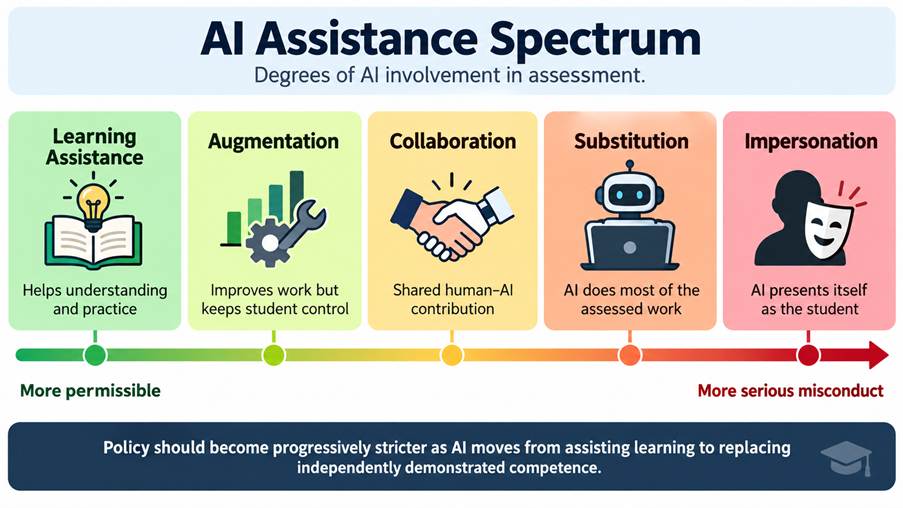
AI use exists on a continuum:
Learning Assistance → Augmentation → Collaboration → Substitution → Impersonation
India’s Existing Framework
Ordinary university examinations are primarily governed by institutional examination rules and academic-integrity procedures. Existing provisions against unauthorised outside assistance or prohibited devices may apply even if they do not explicitly mention ChatGPT.
The UGC Academic Integrity Regulations, 2018 provide an integrity and plagiarism framework but pre-date widespread generative AI.
The Public Examinations (Prevention of Unfair Means) Act, 2024 applies to specified public examinations such as those conducted by UPSC, SSC, Railway Recruitment Boards, IBPS and NTA. An ordinary university semester examination does not automatically become a “public examination” merely because the institution is publicly funded.
Rights and Fairness
Unauthorised AI can violate Article 14-type fairness concerns by giving some candidates an advantage. Yet AI access itself is unequal, creating an “intelligence-assistance divide” between students with different levels of technological access.
AI-based proctoring raises Article 21-related privacy and dignity concerns, because systems may process facial data, eye movements, voice, keystrokes and screen activity.
Hence:
Examination integrity must not become unlimited surveillance.
AI Detectors Cannot Be Digital Judges
AI-detection tools estimate patterns; they do not directly establish authorship.
A misconduct finding should therefore not rest solely on an automated score. Supporting evidence can include:
Drafts + version history + metadata + examination logs + oral explanation + source records
The principle should be:
Automated detection triggers investigation; it does not establish guilt.
A Future-Ready Framework
A practical model could classify assessments as:
🔴 AI-Closed — independent unaided competence required
🟠 AI-Transparent — limited AI permitted with disclosure
🟢 AI-Integrated — AI use deliberately forms part of the assessment
Institutions should also adopt “Disclose and Defend”, combining disclosure of material AI use with viva, demonstrations, drafts or process evidence where necessary.
The long-term shift should be:
From producing answers → to demonstrating judgment over answers
Future assessments can ask students to critique AI-generated legal opinions, engineering designs, policy briefs or medical recommendations rather than simply reproduce information.
The Core Policy Principle
Neither a blanket AI ban nor unrestricted AI use is sustainable.
India needs:
AI-literate education + independently verifiable human competence + procedural fairness
The durable regulatory principle is to regulate unauthorised cognitive substitution rather than individual tools or devices.
Probable Mains Question
“Generative AI has blurred the traditional boundary between legitimate academic assistance and unfair means.” Discuss why India needs to redesign examination systems around verification of human competence rather than blanket technological prohibition.
Prelims Drill
MCQ 1
With reference to AI use in examinations, consider the following statements:
- Every use of generative AI in academic work necessarily constitutes misconduct.
- The legitimacy of AI assistance can depend upon the competency that the examination seeks to assess.
- AI-generated work presented as independent student work may raise academic-integrity concerns.
Which of the statements given above are correct?
A. 1 only
B. 2 and 3 only
C. 1 and 3 only
D. 1, 2 and 3
Correct Answer: B
Explanation: AI may legitimately support learning or even form part of an assessment when expressly permitted. The crucial issue is whether it substitutes for the competency the student must independently demonstrate.
MCQ 2
Consider the following statements:
- Every examination conducted by a publicly funded university automatically falls under the Public Examinations (Prevention of Unfair Means) Act, 2024.
- An AI-detection score should not by itself be treated as conclusive proof of academic misconduct.
- AI-enabled proctoring may raise concerns relating to privacy, proportionality and human oversight.
Which of the statements given above are correct?
A. 1 only
B. 1 and 2 only
C. 2 and 3 only
D. 1, 2 and 3
Correct Answer: C
Explanation: Ordinary university examinations do not automatically become covered public examinations merely because the institution is publicly funded. AI detection should be corroborative, while automated proctoring raises significant privacy and procedural-fairness questions.
More Current Affairs - Daily
- Election Commission of India: Constitutional Design and Evolution into a Three-Member Body 12 Oct 2026
- Loknayak Jayaprakash Narayan: Total Revolution and Contribution to Democracy 12 Oct 2026
- India’s Russia-Ukraine Initiative: From Black Sea Security to Strategic Autonomy 12 Oct 2026
- Jayaprakash Narayan: Architect of Total Revolution and Defender of Democracy 12 Oct 2026