
Productivity Declines Despite Agentic AI Adoption: Causes and Way Forward
In McKinsey’s May 2026 survey, 30% of surveyed product and engineering leaders reported declining team productivity despite AI adoption. The study highlights that technology adoption alone is not sufficient to achieve productivity gains; workflow redesign, role transformation, verification systems, workforce upskilling and effective AI governance are also required.
Artificial Intelligence (AI) is no longer limited to generating information or answering user queries. Beyond Generative AI, Agentic AI is enabling digital agents that can understand a goal, plan tasks, use different digital tools and complete multi-step activities with a degree of autonomy.
This has created expectations that Agentic AI could significantly transform workplace productivity. However, emerging evidence suggests that the relationship between AI adoption and productivity is more complex.
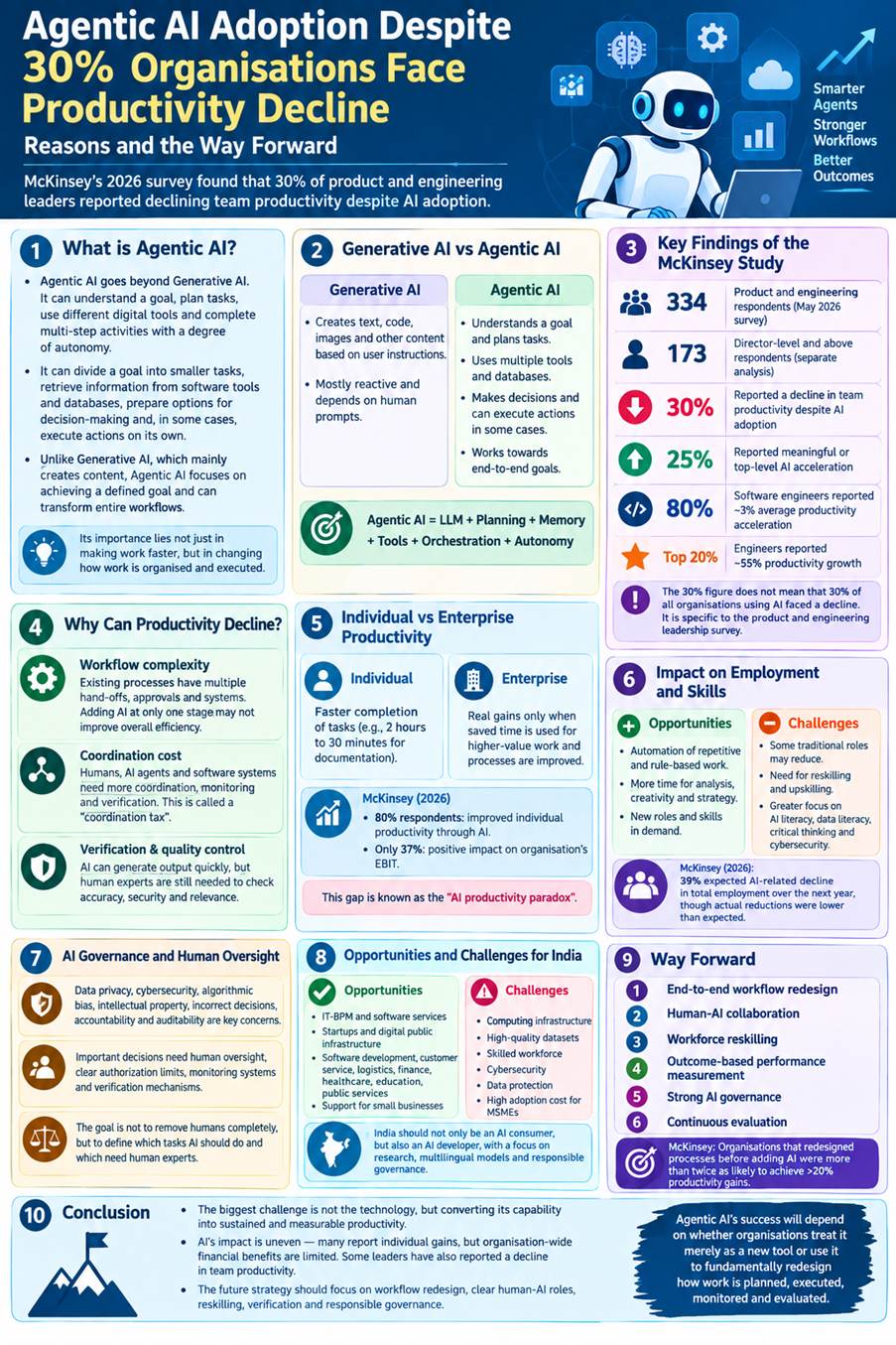
According to McKinsey’s May 2026 survey of 334 product and engineering respondents, 30% of respondents at director level and above reported that their team productivity had declined despite AI adoption.
Only 25% reported meaningful or top-level AI acceleration. The findings indicate that simply making AI tools available does not automatically translate into higher organisational productivity.
What is Agentic AI?
Generative AI primarily creates text, code, images and other content based on user instructions.
Agentic AI goes beyond content generation and focuses on achieving a defined goal.
AI agents can divide a goal into smaller tasks, retrieve information from software tools and databases, prepare options for decision-making and, in some circumstances, execute actions autonomously.
Agentic AI therefore has the potential to transform not just individual tasks but entire workflows.
Its significance lies not merely in making existing work faster, but in changing how work is organised and executed.
Key Findings of the McKinsey Study
McKinsey’s May 2026 Agentic Product Development Life Cycle/Software Development Life Cycle Survey covered 334 product and engineering respondents.
A separate analysis was conducted for 173 respondents at director level or above.
Among this group, 30% reported a decline in team productivity, while only 25% reported meaningful or top-level AI acceleration.
At the same time, around 80% of surveyed software engineers reported an average AI productivity acceleration of approximately 3%, while the top 20% of engineers reported average productivity growth of about 55%.
This indicates that the impact of AI varies significantly across individuals and organisations.
Therefore, the 30% figure should not be interpreted as meaning that 30% of all companies using AI experienced a productivity decline.
It represents a specific finding from McKinsey’s product and engineering leadership survey.
Why Can Productivity Decline?
The lack of expected productivity gains from Agentic AI is not necessarily due to limitations in the technology itself.
One major challenge is that organisations may introduce AI into existing workflows without redesigning the overall process.
The first factor is workflow complexity. If an existing process involves multiple human handoffs, approval stages and software systems, adding AI to only one stage may notimprove the efficiency of the entire process.
The second factor is coordination cost. When humans, AI agents and different software systems work together, new requirements emerge for information transfer, monitoring and verification.
McKinsey describes this as a “coordination tax”. Its latest global survey found that 80% of respondents reported improved individual productivity through AI, while only 37% attributed at least some positive EBIT impact to AI use at the organisational level.
The third factor is verification and quality control. AI can generate code, documents and analysis rapidly, but human experts may still be required to check accuracy, security and relevance. If verification systems do not develop at the same pace as AI-generated output, additional work and risks can emerge.
Individual Productivity vs Enterprise Productivity
Understanding the difference between individual and enterprise productivity is essential for evaluating AI’s economic impact.
For example, if an employee can complete documentation in 30 minutes instead of two hours, individual productivity has improved.
However, this does not automatically mean that the organisation has become more productive.
The saved time must be redirected towards higher-value activities, while organisational processes must also improve.
McKinsey’s 2026 Global Survey found that 80% of respondents reported improved individual productivity through AI, but only 37% reported that AI had contributed positively to their organisation’s EBIT.
This gap reflects an emerging “AI productivity paradox”: the use of AI is expanding rapidly, but organisation-wide financial gains have not increased at the same pace.
Impact on Employment and Skills
The expansion of Agentic AI could transform the nature of employment. Repetitive and rule-based activities can increasingly be handled by AI agents, potentially allowing employees to devote more time to analysis, creativity, strategic decision-making and human interaction.
At the same time, some existing roles may undergo significant changes, while demand for new technical and analytical skills may increase.
Therefore, the impact of AI should be viewed not only as automation but also as job redesign.
AI literacy, data literacy, critical thinking, cybersecurity and human-AI collaboration are likely to become increasingly important. Organisations will need to invest not only in AI tools but also in workforce reskilling and change management.
McKinsey’s 2026 global survey found that 39% of respondents expected AI-related declines in their organisations’ total employment over the following year, although reported actual workforce reductions were considerably lower than the previous year’s expectations.
AI Governance and Human Oversight
Governance becomes increasingly important with Agentic AI because AI agents can potentially move beyond generating content to executing actions.
This raises concerns relating to data privacy, cybersecurity, algorithmic bias, intellectual property, incorrect decisions, accountability and auditability.
Important decisions therefore require appropriate human oversight, clearly defined permissions, monitoring systems and verification mechanisms.
The objective should not be to eliminate human involvement completely, but to establish a clear division of responsibilities between humans and AI. Routine activities may be automated, while high-impact decisions, risk assessment and final accountability can remain with human experts.
Opportunities and Challenges for India
Agentic AI has significant potential for India. The country’s IT-BPM sector, software services ecosystem, startups and digital public infrastructure provide a foundation for AI-enabled transformation.
Agentic AI can be applied in software development, customer service, logistics, financial services, healthcare, education and public-service delivery. It could also help small businesses automate selected administrative and knowledge-based activities.
However, India also faces challenges related to computing infrastructure, high-quality datasets, skilled manpower, cybersecurity, data protection and the cost of AI adoption for small and medium enterprises.
India therefore needs to strengthen its capabilities not only as an AI consumer but also in AI research, development, multilingual models and responsible AI governance. This can help translate AI-driven productivity gains into wider economic and social benefits.
Way Forward
The first requirement for achieving meaningful benefits from Agentic AI is end-to-end workflow redesign. McKinsey found that organisations that redesigned processes before incorporating AI were more than twice as likely to report productivity gains above 20% compared with organisations that simply layered AI onto existing ways of working.
Organisations should also focus on human-AI collaboration, workforce reskilling, outcome-based performance measurement and effective AI governance.
Instead of measuring success only through the number of AI tools deployed or employees using them, organisations should measure changes in cost, quality, time, innovation and actual business outcomes.
McKinsey’s research identifies four broad areas associated with stronger AI impact: redesigning end-to-end workflows, changing roles and responsibilities, building verification and control systems, and investing in hands-on upskilling and change management.
Conclusion
The major challenge before Agentic AI is not simply its technical capability but the ability to convert that capability into sustained and measurable productivity.
Current McKinsey evidence shows that the impact of AI is uneven. While many employees report individual productivity gains, organisation-wide financial benefits remain more limited. At the same time, some product and engineering leaders have reported declining team productivity following AI adoption.
Therefore, the future strategy should not focus merely on deploying more AI tools. Sustainable transformation requires workflow redesign, clearly defined human-AI responsibilities, workforce reskilling, robust verification and responsible AI governance.
The success of Agentic AI will ultimately depend on whether organisations treat it merely as another technology tool or use it to fundamentally redesign how work is planned, executed, monitored and evaluated.
MCQ English
Q. Which of the following statements regarding the McKinsey 2026 study on Agentic AI is/are correct?
The survey covered 334 product and engineering respondents.
Among director-level and above respondents, 30% reported a decline in team productivity.
Around 80% of surveyed software engineers reported an average AI productivity acceleration of approximately 3%.
The study concluded that 30% of all organisations using AI experienced productivity decline.
Select the correct answer using the code given below:
A. 1, 2 and 3 only
B. 1 and 4 only
C. 2 and 3 only
D. 1, 2, 3 and 4
Answer: (A)
Explanation: McKinsey’s May 2026 survey covered 334 product and engineering respondents. Among the 173 director-level and above respondents, 30% reported a decline in team productivity. Around 80% of surveyed software engineers reported average AI productivity acceleration of approximately 3%. However, the 30% figure does not represent all organisations using AI; it relates specifically to the surveyed product and engineering leadership group.
More Current Affairs - Daily
- Election Commission of India: Constitutional Design and Evolution into a Three-Member Body 12 Oct 2026
- Loknayak Jayaprakash Narayan: Total Revolution and Contribution to Democracy 12 Oct 2026
- India’s Russia-Ukraine Initiative: From Black Sea Security to Strategic Autonomy 12 Oct 2026
- Jayaprakash Narayan: Architect of Total Revolution and Defender of Democracy 12 Oct 2026