
Africa’s Rift Is Advancing Faster Than Expected: How a New Ocean May Form
New seismic evidence from the Turkana Rift shows crust only about 13 km thick, revealing active continental necking and suggesting eastern Africa is further along the path toward eventual breakup than previously recognised.
Africa’s Rift Is Advancing Faster Than Expected: How a New Ocean May Form
- Syllabus Mapping: GS Paper I — Physical Geography; Distribution of Key Natural Features; Earthquakes, Volcanism and Geophysical Phenomena.
- Source & Date: Nature Communications, 23 April 2026; Columbia Climate School; USGS. The study found that the Turkana Rift Zone is undergoing active crustal necking.
What Has the New Study Found?
- Researchers studying the Turkana Rift Zone in Kenya found that crystalline continental crust along the rift axis has thinned to about 13 km, compared with more than 35 km farther from the rift centre.
- This places Turkana in the necking phase of continental rifting, when extension becomes concentrated and the crust thins dramatically.
- The major finding is therefore not that Africa will split immediately, but that part of the East African Rift System has progressed further toward continental breakup than previously recognised.
How Does a Continent Split?
The process is explained by Plate Tectonics.
Where tectonic plates diverge:
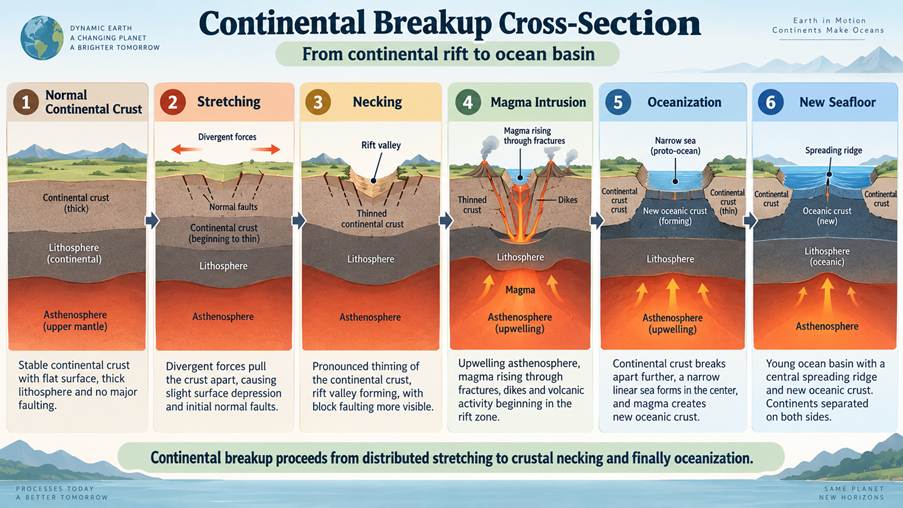
Crust stretches → faults develop → crust thins → magma rises → continental crust breaks → new oceanic crust forms
The main stages are:
Stretching → Necking → Oceanization → Seafloor spreading
During the necking stage, continental crust may thin from above 15 km toward roughly 10–15 km, weakening it further and concentrating deformation. Turkana’s ~13 km crust therefore represents a major transition toward late-stage rifting.
East African Rift System
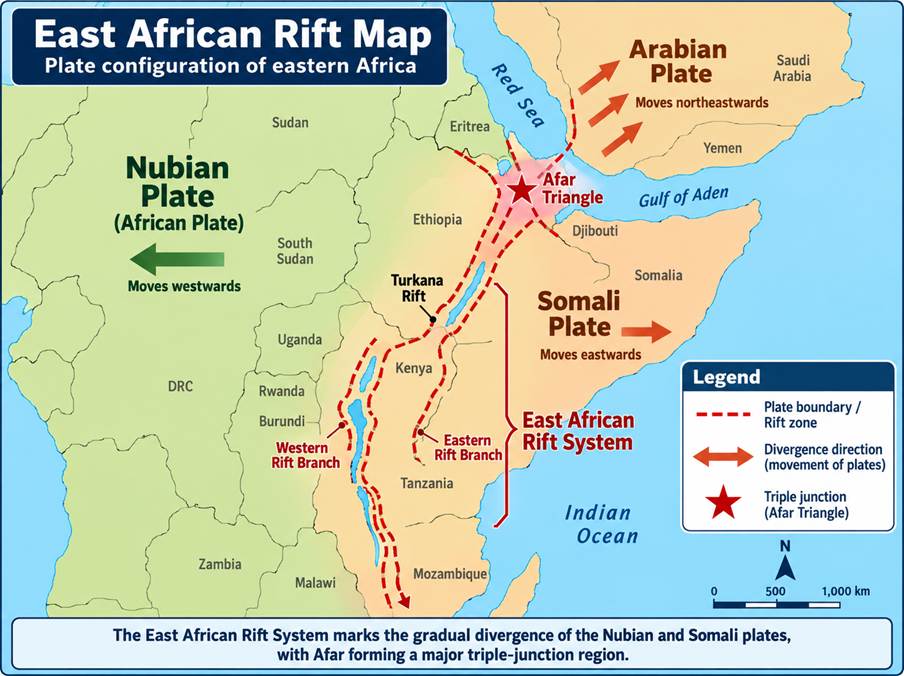
The East African Rift System (EARS) is one of the world’s major active continental rifts. USGS describes it as extending roughly 3,000 km from the Afar region to western Mozambique.
It is associated with the gradual separation of the Nubian Plate from the Somali Plate.
Nubian Plate - Larger western portion of Africa |
Somali Plate - Eastern part of the African plate system
This separation occurs at only millimetres per year, so continental breakup still operates over millions of years.
Why Is Turkana Important?
The Turkana Rift is unusual because the new study identifies it as the first known active continental rift clearly undergoing necking.
Researchers estimate necking began around 4 million years ago, after volcanism and earlier episodes of crustal weakening. Nearly half of the reconstructed upper-crustal extension identified by the study occurred since that transition.
This suggests that pre-existing weak zones can make some parts of a rift mature faster than simple models based only on present-day plate-motion rates would predict.
Afar: Where Oceanization Is Already Beginning
Farther north lies the Afar Triple Junction, where the Red Sea Rift, Gulf of Aden Rift and East African Rift interact.
USGS identifies Afar as a triple-junction region involving the Arabian, Nubian and Somali plates.
The 2026 study notes that Afar has already reached an early oceanization stage, while Turkana has entered advanced necking. Together, these indicate that different parts of the East African Rift are at different stages of continental breakup.
How Would a New Ocean Form?
If rifting continues:
Crust becomes extremely thin → continental lithosphere breaks → magma creates new oceanic crust → seafloor spreading begins → marine water enters the developing basin
Over geological time, this could create a new ocean basin separating parts of eastern Africa from the rest of the continent.
However, precise future coastlines are not established by the study. Lists claiming that entire present-day countries will neatly form two specific future landmasses should therefore be treated as speculative rather than as a confirmed scientific projection.
Link with Human Evolution
- Turkana is famous for early hominin fossils.
- The study proposes that crustal necking accelerated subsidence and sediment accumulation, improving conditions for fossil preservation. Thus, Turkana’s exceptionally rich fossil record may partly reflect favourable geology, not necessarily uniquely high concentrations of ancient hominins.
Probable Mains Question
Explain the geological processes through which continental rifting can evolve into a new ocean basin. Discuss with reference to recent findings from the East African Rift System.
Prelims Drill
MCQ 1
With reference to the East African Rift System, consider the following statements:
- It involves divergence between the Nubian and Somali plates.
- The Turkana Rift has been identified as undergoing active crustal necking.
- Necking signifies that seafloor spreading and fully developed oceanic crust have already formed.
Which of the statements given above are correct?
A. 1 only
B. 1 and 2 only
C. 2 and 3 only
D. 1, 2 and 3
Correct Answer: B
Explanation: Statements 1 and 2 are correct. Necking is an advanced stage of continental thinning that precedes full oceanization and seafloor spreading.
Trap Identified: Necking ≠ oceanization.
MCQ 2
D. 1, 2 and 3
Correct Answer: D
Explanation: The Afar region lies at the interaction of the Red Sea, Gulf of Aden and East African rift systemsConsider the following rift systems:
- Red Sea Rift
- Gulf of Aden Rift
- East African Rift
Which of the above meet in the broader Afar triple-junction region?
A. 1 and 2 only
B. 2 and 3 only
C. 1 and 3 only
and is associated with divergence involving the Arabian, Nubian and Somali plates.
Trap Identified: Afar is not merely part of the East African Rift; it is a triple-junction setting.
More Current Affairs - Daily
- Election Commission of India: Constitutional Design and Evolution into a Three-Member Body 12 Oct 2026
- Loknayak Jayaprakash Narayan: Total Revolution and Contribution to Democracy 12 Oct 2026
- India’s Russia-Ukraine Initiative: From Black Sea Security to Strategic Autonomy 12 Oct 2026
- Jayaprakash Narayan: Architect of Total Revolution and Defender of Democracy 12 Oct 2026