
M. Visvesvaraya: His Contributions to Engineering and Nation Building
Know about M. Visvesvaraya’s life, engineering achievements. administrative contributions, honours and his vision of economic planning for India.
- M. Visvesvaraya was a distinguished Indian engineer, administrator and statesman whose contributions to irrigation, water management, flood control, industrial development and economic planning played an important role in India’s development. Engineers’ Day is observed in India on September 15 to commemorate his birth anniversary.
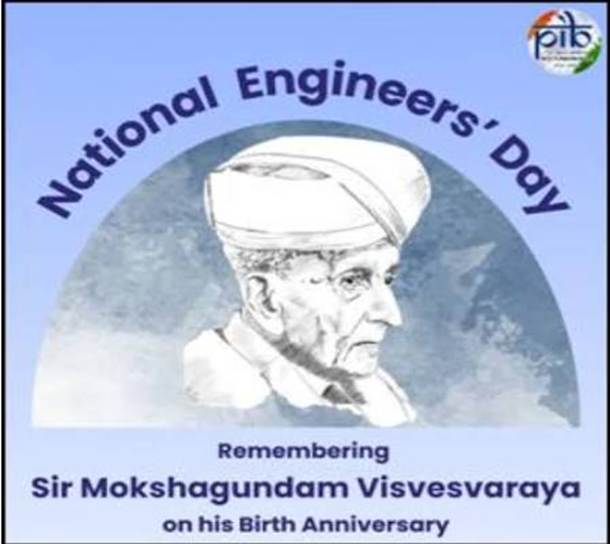
Key Points:
- Mokshagundam Visvesvaraya, popularly known as Sir M. Visvesvaraya, was a pioneering Indian civil engineer, administrator and statesman.
- He was born on September 15, 1861, in Muddenahalli, Karnataka.
- He studied at the University of Madras and later completed civil engineering at the College of Science in Pune.
- He began his professional career with the Public Works Department (PWD) in the Bombay Presidency.
- His engineering work focused on irrigation, water supply, drainage and flood control.
- He introduced the block system of irrigation and developed patented automatic water floodgates, which were first installed at the Khadakwasla reservoir in Pune in 1903.
- He contributed to water-management and flood-protection projects in Hyderabad and Visakhapatnam and worked on water-supply and drainage projects in Aden.
- He was later appointed Chief Engineer of Mysore State.
- Visvesvaraya served as the Diwan of Mysore from 1912 to 1918, promoting industrialisation, technical education and infrastructure development.
- During his tenure, institutions and industries such as the State Bank of Mysore, Mysore Soap Factory and Mysore Iron and Steel Works were established or developed.
- He also played an important role in the establishment of the University of Mysore and the Government Engineering College in Bengaluru.
- He was an early advocate of economic planning in India and presented his ideas in Reconstructing India (1920) and Planned Economy for India (1934).
- He was awarded the KCIE in 1915 for his contributions to public service.
- In 1955, he received the Bharat Ratna, India’s highest civilian honour.
- Engineers’ Day is observed in India on September 15 every year to commemorate his birth anniversary.
- Visvesvaraya passed away on April 14, 1962, at the age of 100.
Practice Question
Q. With reference to Sir M. Visvesvaraya, consider the following statements:
Visvesvaraya introduced the block system of irrigation with the objective of extending irrigation benefits across a larger number of villages.
His patented automatic water floodgates were first installed at the Krishna Raja Sagara Dam in Mysore.
During his tenure as Diwan of Mysore, he promoted industrial development, technical education and infrastructure creation.
His advocacy of economic planning was reflected in his works Reconstructing India and Planned Economy for India.
Which of the statements given above are correct?
A. 1, 3 and 4 only
B. 1 and 2 only
C. 2, 3 and 4 only
D. 1, 2, 3 and 4
Answer: A. 1, 3 and 4 only
Explanation:
Statements 1, 3 and 4 are correct. Visvesvaraya introduced the block system of irrigation to extend irrigation benefits across villages. He served as Diwan of Mysore from 1912 to 1918, promoting industrialisation, technical education and infrastructure. His economic ideas were expressed in Reconstructing India and Planned Economy for India. Statement 2 is incorrect: the automatic floodgates were first installed at Khadakwasla Reservoir in Pune in 1903, not Krishna Raja Sagara Dam.
More Current Affairs - Daily
- Election Commission of India: Constitutional Design and Evolution into a Three-Member Body 12 Oct 2026
- Loknayak Jayaprakash Narayan: Total Revolution and Contribution to Democracy 12 Oct 2026
- India’s Russia-Ukraine Initiative: From Black Sea Security to Strategic Autonomy 12 Oct 2026
- Jayaprakash Narayan: Architect of Total Revolution and Defender of Democracy 12 Oct 2026