
Youth Unemployment and the Neoliberal Economic Model
Youth unemployment cannot be understood only through skills or wage levels. Aggregate demand, private investment, public expenditure, labour income and technological change also shape employment creation.
Youth Unemployment and the Neoliberal Economic Model
- Syllabus Mapping: GS Paper III — Employment, Inclusive Growth, Fiscal Policy, Labour Markets and Economic Reforms.
- Source & Date: The Hindu, 29 October 2026.
Why in News?
Youth-led protests across several countries have brought renewed attention to unemployment, declining real incomes, rising living costs and weakening access to public services.
The economic debate goes beyond whether young workers possess adequate skills. A deeper question is whether modern economies are generating enough investment and aggregate demand to create stable employment for new entrants to the labour force.
Why Youth Unemployment Can Stay High
Young people usually face greater difficulty entering the labour market than experienced workers.
During weak economic growth, firms may postpone hiring, reduce recruitment or substitute technology for entry-level jobs. Young workers therefore often absorb a disproportionate share of an economic slowdown.
This means youth unemployment can remain high even when the number of young people entering the labour force is falling.
Two Views of Unemployment
The orthodox labour-market approach often explains unemployment through factors such as wages above market-clearing levels, skill mismatches, labour regulations and weak worker mobility.
From this perspective, greater flexibility, appropriate skills and wage adjustment can improve employment.
Keynesian and heterodox approaches place greater emphasis on insufficient aggregate demand. Firms employ workers primarily when they expect that additional production can be sold profitably.
If consumption and investment are weak, lower wages alone may not generate enough new employment.
Why Investment Matters
In Keynesian economics, employment depends heavily on effective demand.
Firms invest when they expect future sales and profits to justify expanding capacity. If expected demand is weak, businesses may prefer to hold cash or financial assets instead of building factories and hiring workers.
A fall in investment therefore reduces income and employment directly and can trigger further declines in consumption.
This explains why an economy can remain below full employment without wages automatically restoring equilibrium.
Can Government Fill the Demand Gap?
Keynesian policy argues that the government can support employment when private demand is weak.
Higher public investment, transfers and social expenditure can increase income and consumption, encouraging firms to increase production and employment.
However, permanent full-employment policy also has political and fiscal implications. Economist Michał Kalecki argued that sustained full employment changes bargaining power between workers and employers because the threat of unemployment becomes less effective as a workplace discipline mechanism.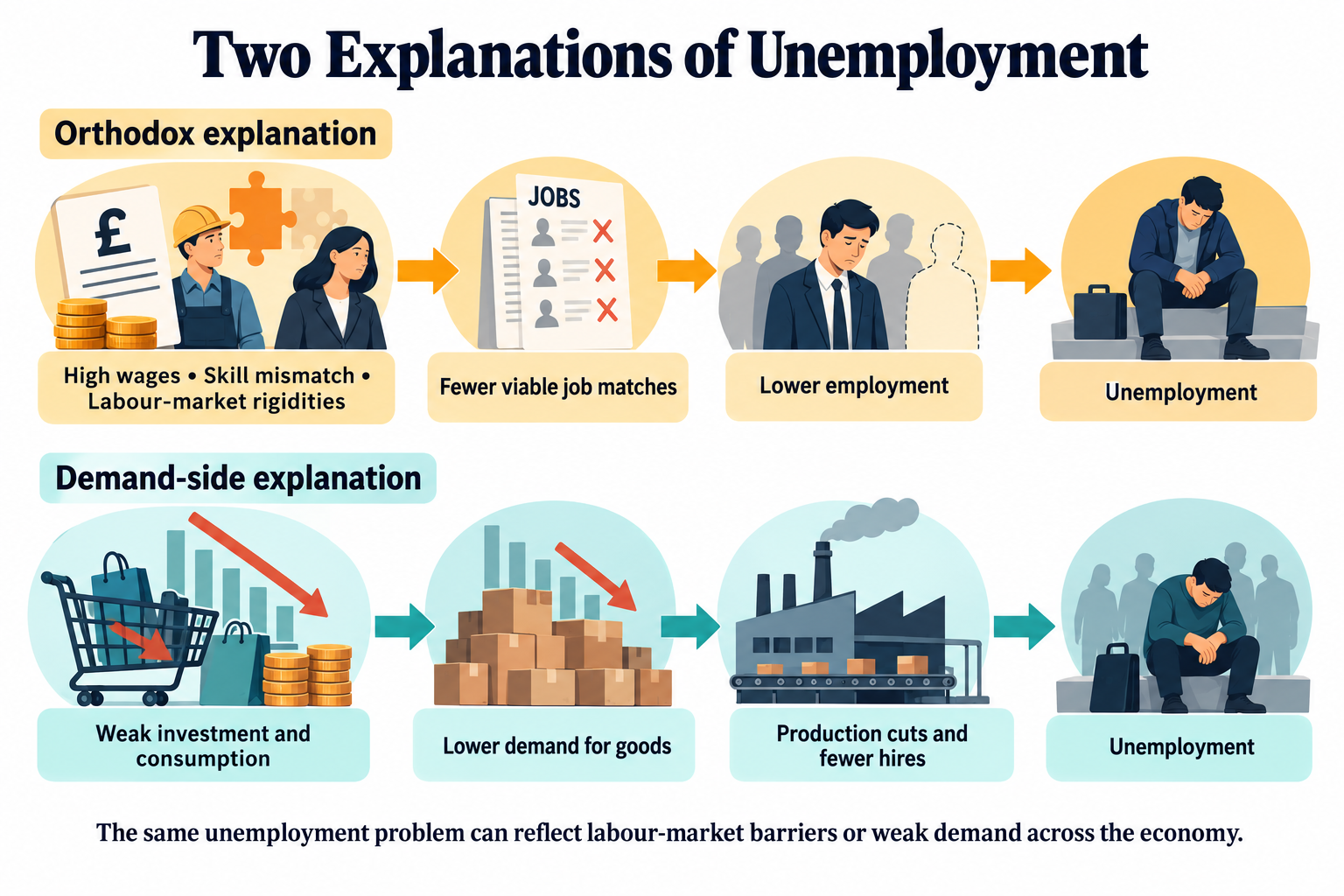
What is Neoliberalism?
Neoliberalism broadly refers to economic reforms that give a larger role to markets and a smaller direct role to the State.
Policies commonly associated with it include privatisation, deregulation, trade and financial liberalisation, tighter welfare spending and more flexible labour markets.
From the late 1970s and 1980s, such policies gained influence after high inflation, slower growth and the breakdown of the earlier post-war economic model.
Supporters argue that they improve efficiency, competition and incentives. Critics argue that excessive reliance on markets can weaken labour bargaining power, public investment and income security.
The Underconsumption Argument
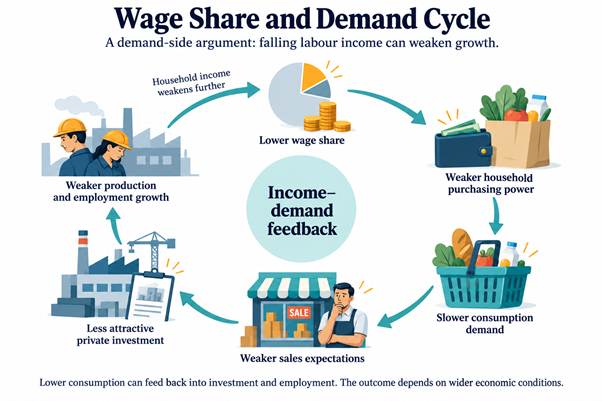
A major heterodox concern is that a persistent fall in the wage share of income can weaken consumption.
Individual firms may benefit from cutting labour costs, but if wages fall across the economy, households may have less purchasing power. Businesses may then face weaker demand and reduce investment.
This is sometimes described as an underconsumption or demand-deficiency problem.
However, its actual effect depends on other forces such as household borrowing, exports, government spending, wealth effects and investment conditions.
Automation Adds Another Layer
Technological change can increase productivity while reducing demand for particular types of labour.
Automation has historically destroyed some occupations while creating others. The policy concern today is whether artificial intelligence and automation can displace entry-level and routine jobs faster than new employment opportunities emerge.
For young workers, this strengthens the importance of education, reskilling and an economy capable of generating new sectors and occupations.
Education Alone Cannot Solve the Problem
Skills matter, but increasing qualifications cannot by itself guarantee employment if the economy does not create enough suitable jobs.
If large numbers of workers pursue additional education while employment creation remains weak, societies may experience educated unemployment, credential inflation and rising student debt.
Employment policy therefore needs both supply-side measures such as skills and demand-side measures such as investment and economic expansion.
Core Policy Lesson
Youth unemployment should not be treated only as an individual failure of skills or employability.
It is also a macroeconomic problem involving investment, aggregate demand, income distribution, technological change and public policy.
A balanced employment strategy therefore requires productive private investment, strong public infrastructure, accessible education, social protection, labour-market adaptability and fiscal policy capable of supporting demand during prolonged slowdowns.
Probable Mains Question
“Persistent youth unemployment cannot be explained solely through skill mismatch or labour-market rigidities.” Examine the role of aggregate demand, investment, income distribution and technological change in determining employment.
Prelims Drill
MCQ 1
Consider the following statements regarding Keynesian unemployment:
- An economy can remain below full employment because aggregate demand is insufficient.
- Lower wages necessarily restore full employment immediately.
- Government expenditure can increase aggregate demand when private investment is weak.
Which of the statements given above are correct?
A. 1 only
B. 1 and 3 only
C. 2 and 3 only
D. 1, 2 and 3
Correct Answer: B
Explanation: Keynesian analysis allows for persistent involuntary unemployment when aggregate demand is inadequate. Fiscal expansion can support demand, while wage reductions do not necessarily guarantee full employment.
MCQ 2
With reference to the wage share of national income, consider the following statements:
- It refers broadly to the share of income accruing to labour through wages and related compensation.
- A decline in wage share may weaken household consumption if not offset by other sources of demand.
- A decline in wage share necessarily causes an economic recession in every circumstance.
Which of the statements given above are correct?
A. 1 only
B. 1 and 2 only
C. 2 and 3 only
D. 1, 2 and 3
Correct Answer: B
Explanation: A lower wage share can weaken consumption because wage earners typically spend a large proportion of their income, but the overall macroeconomic outcome also depends on investment, exports, credit conditions and government spending.

More Current Affairs - Daily
- Salt Marshes: Nature’s Living Defence Against Coastal Erosion 30 Oct 2026
- Disinvestment of Public Assets: Ethical Questions of Efficiency, Transparency and Public Interest 30 Oct 2026
- Gene Editing and the Next Crop Revolution in India 30 Oct 2026
- Buddhist Diplomacy: Sustaining Dialogue When Political Negotiations Stall 29 Oct 2026