
Gene Editing and the Next Crop Revolution in India
New gene-editing tools can help India develop more productive, climate-resilient and resource-efficient rice and wheat, while apomixis could allow farmers to preserve hybrid vigour across generations.
Gene Editing and the Next Crop Revolution in India
- Syllabus Mapping: GS Paper III — Biotechnology, Agriculture, Food Security, Climate-Resilient Farming and Science & Technology.
- Source & Date: The Hindu, 29 October 2026.
Why in News?
India is increasingly using gene-editing tools such as CRISPR to improve staple crops, especially rice, while research on newer technologies such as apomixis could further transform seed production.
The larger policy issue is that rice and wheat remain central to India's food security, but climate change, water stress, soil degradation and the need to reduce fertiliser and pesticide use require a new generation of crop varieties.
Gene Editing Is Not the Same as Transgenic GM
Gene editing allows scientists to make targeted changes in a plant's own DNA.
Unlike traditional transgenic genetic modification, some CRISPR-edited plants do not retain foreign genetic material in the final variety. The article notes that in India's new rice strains, residues of the editing tools were not detected, making the final genetic changes comparable to mutations that could arise through conventional breeding, but achieved much faster and with greater precision.
This distinction matters for regulation, public acceptance and the speed with which improved crops can reach farmers.
India’s Gene-Edited Rice Breakthrough
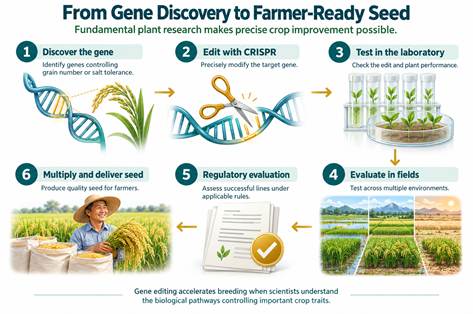
India took a major step in 2025 by allowing cultivation of gene-edited rice varieties.
Two important examples are DRR Dhan 100 and Pusa DST Rice 1. The first was developed to mature earlier and raise grain productivity, while the second was designed to perform better in saline and alkaline soils.
The edited varieties were associated with higher yields, lower water requirements and potential reductions in fertiliser use and greenhouse-gas emissions.
Why Fundamental Research Still Matters
CRISPR is a tool, not a substitute for basic science.
The rice examples described in the study were possible because researchers had already identified genes affecting spikelet formation, grain number and salt tolerance through earlier work in plant genetics and development.
Without long-term research in areas such as flowering, physiology, host-pathogen interactions and stress biology, precise gene editing has little useful target to act upon.
What is Apomixis?
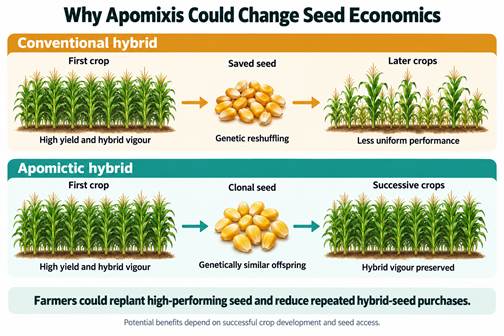
Apomixis is a form of asexual seed production in which plants reproduce without the normal process of sexual fertilisation.
Its agricultural significance is enormous because it could preserve hybrid vigour, or heterosis, across generations. Normally, farmers cannot save hybrid seed and expect the next generation to retain the same performance.
With apomixis, a high-performing hybrid could effectively reproduce itself through seed.
Research first demonstrated this approach successfully in rice in 2018, and efficiencies have since improved considerably. Research groups are also exploring the technology in crops such as maize and sorghum.
Why India’s Public Seed System Matters
India has a strong public-sector presence in rice and wheat breeding.
Institutions such as ICAR laboratories, State agricultural universities and the National Seeds Corporation play major roles in developing breeder seed and multiplying improved varieties. Private firms also participate, especially in hybrid rice and increasingly in wheat.
This institutional structure matters because publicly developed gene-edited varieties can potentially be distributed widely without restrictive licensing arrangements.
Wheat Is the Next Challenge
India has not yet released a gene-edited wheat variety.
Wheat is biologically more difficult to hybridise than crops such as rice or maize, but research is advancing globally. The study points to ongoing work on drought-tolerant genetically engineered wheat and CRISPR-edited wheat varieties in countries such as Australia and the United States.
For India, the strategic opportunity is to combine its strong public breeding network with new gene-editing tools.
Core Policy Lesson
The next phase of agricultural biotechnology is not simply about producing “GM crops”.
It is about using precise gene editing, fundamental plant science, climate-resilient breeding and innovative reproductive technologies such as apomixis to improve productivity while reducing water, fertiliser and pesticide intensity.
India's advantage lies in its large public research and seed-distribution system. But that advantage will matter only if fundamental plant-science research remains attractive to young scientists and if laboratory discoveries can move efficiently through field trials, regulation and seed multiplication.
Probable Mains Question
“The future of food security will depend not only on biotechnology tools but also on the strength of fundamental plant science and public breeding institutions.” Discuss with reference to gene editing and apomixis in Indian agriculture.
Prelims Drill
MCQ 1
With reference to gene editing in crops, consider the following statements:
- CRISPR can be used to make targeted changes in a plant's own genome.
- Every gene-edited crop necessarily contains a foreign gene in its final form.
- Gene editing can reproduce useful mutations that might otherwise take much longer to obtain through conventional breeding.
Which of the statements given above are correct?
A. 1 only
B. 1 and 3 only
C. 2 and 3 only
D. 1, 2 and 3
Correct Answer: B
Explanation: Gene editing can precisely alter native genes, and some edited crops contain no foreign genetic material in the final variety. It can therefore reproduce useful mutations much faster than conventional breeding.
MCQ 2
Consider the following statements regarding apomixis:
- It allows seed formation without the normal process of sexual fertilisation.
- It can potentially preserve hybrid vigour across generations.
- It necessarily requires farmers to purchase new hybrid seed every season.
Which of the statements given above are correct?
A. 1 only
B. 1 and 2 only
C. 2 and 3 only
D. 1, 2 and 3
Correct Answer: B
Explanation: Apomixis can allow a plant to reproduce genetically similar seed without ordinary fertilisation. If successfully deployed in crops, it could preserve hybrid vigour and reduce the need for repeated purchase of hybrid seed.
More Current Affairs - Daily
- Salt Marshes: Nature’s Living Defence Against Coastal Erosion 30 Oct 2026
- Disinvestment of Public Assets: Ethical Questions of Efficiency, Transparency and Public Interest 30 Oct 2026
- Youth Unemployment and the Neoliberal Economic Model 30 Oct 2026
- Buddhist Diplomacy: Sustaining Dialogue When Political Negotiations Stall 29 Oct 2026