
Women’s Rights and the Wider Struggle for an Equal India
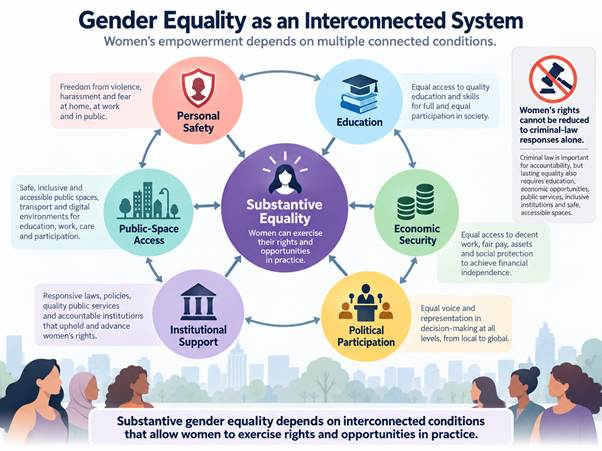
Women’s rights extend beyond protection from sexual violence and are closely connected with economic opportunity, public participation, digital safety, climate justice, institutional protection and equal citizenship.
Women’s Rights and the Wider Struggle for an Equal India
- Syllabus Mapping: GS Paper I — Role of Women, Social Empowerment and Indian Society; GS Paper II — Fundamental Rights, Vulnerable Sections and Governance; GS Paper IV — Equality, Dignity and Social Ethics.
- Source & Date: The Hindu, 8 October 2026.
Why in News?
Recent public protests have renewed debate over whether concerns relating to women’s safety and sexual violence should be treated as separate issues or integrated into wider movements seeking social and political change.
The central argument is that violence against women is not an isolated “women’s issue”. Women’s ability to participate in education, employment, protest, politics and public life depends on broader structures of safety, economic independence, social equality and institutional protection.
The larger framework is:
Personal safety + economic security + public participation + digital dignity + social equality = substantive gender justice
Women’s Rights Are a Structural Equality Issue
Gender-based violence is often discussed primarily through individual crimes and criminal-law responses.
However, its consequences extend much further. Fear of violence can restrict women’s mobility, education, employment, political participation and access to public spaces.
Therefore:
Violence → restricted mobility → reduced opportunity → economic dependence → weaker public participation
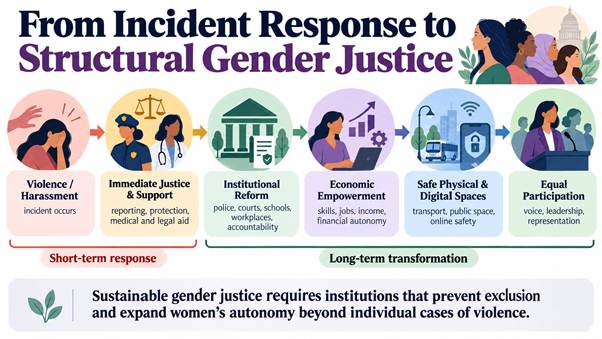
Gender justice requires addressing this entire chain rather than only responding after violence occurs.
Economic Independence Expands Real Freedom
Legal equality has limited practical value when individuals lack the economic resources required to exercise choice.
Employment and livelihood security can strengthen women’s ability to make decisions relating to residence, education, marriage, healthcare and participation in public life.
The relationship is:
Education → employment → income → bargaining power → greater autonomy
This makes women’s labour-force participation, equal wages, safe workplaces and social protection central elements of gender equality rather than purely economic questions.
Safe Public Spaces Enable Equal Citizenship
Women’s presence in streets, universities, transport systems, workplaces and political movements is a measure of their ability to exercise citizenship in practice.
If fear or harassment pushes women out of public spaces, formally equal rights do not translate into equal participation.
The policy objective must therefore move from simply protecting women toward enabling women to exercise independent and equal access to public life.
Climate Change Has a Gendered Social Impact
Climate change is not gender-neutral.
Heat stress, water scarcity, livelihood disruption, migration and resource shortages can affect household responsibilities and economic opportunities differently across social groups.
Where women already carry disproportionate burdens of unpaid care work or have weaker control over assets, climate shocks may deepen existing inequalities.
The chain can be understood as:
Climate stress → resource scarcity → livelihood pressure → greater care burden and insecurity → wider gender inequality
This makes gender-responsive climate adaptation an important component of social policy.
Digital Spaces Have Become a New Gender Frontier
Women increasingly participate in public life through digital platforms, but online spaces can reproduce and amplify offline discrimination.
Threats include:
- doxxing, or malicious disclosure of personal information;
- non-consensual deepfakes and manipulated sexual imagery;
- coordinated harassment and abuse;
- threats intended to silence women in public debate.
Digital violence can create a chilling effect on participation even when no physical violence occurs.
The challenge is therefore:
Online abuse → fear and reputational harm → self-censorship → reduced digital participation
Social Media Can Also Reinforce Misogynistic Networks
Digital platforms allow communities to form across geographical boundaries, but the same architecture can facilitate echo chambers based on hostility, resentment or misogyny.
Online communities can normalise harassment and create social rewards for degrading vulnerable groups.
This demonstrates that gender equality requires not only criminal enforcement but also digital literacy, platform accountability, healthier models of masculinity and social support networks.
Allyship Broadens the Gender-Justice Coalition
Gender inequality cannot be addressed exclusively by those who directly experience it.
Men, institutions, families, employers and wider civil society also shape the social norms within which gender discrimination occurs.
Effective allyship requires more than symbolic support. It includes:
challenging discriminatory norms + sharing care responsibilities + supporting equal opportunities + opposing harassment + respecting autonomy
The objective is not to make gender justice a competition between groups, but to recognise that more equal institutions benefit society more broadly.
Constitutional Foundations of Gender Equality
The Constitution provides a durable framework for gender justice.
Article 14 guarantees equality before law and equal protection of laws, while Article 15 prohibits discrimination on grounds including sex.
Importantly, Article 15(3) permits the State to make special provisions for women and children, recognising that formal equality may sometimes require targeted interventions.
Article 16 guarantees equality of opportunity in public employment, while Article 21 protects life and personal liberty, which constitutional jurisprudence has linked closely with dignity and autonomy.
Thus:
Formal equality + protective measures + dignity + equal opportunity → substantive equality
Institutional Support Must Extend Beyond Individual Crises
A major challenge is that public attention often peaks following major incidents of violence and then declines.
Durable change requires institutions that function even when an issue is no longer at the centre of public attention.
These include:
accessible justice + workplace safeguards + counselling and support systems + responsive policing + digital-harm remedies + community networks
Gender Justice Requires Intersectional Governance
Women do not experience discrimination in identical ways.
Gender can intersect with class, caste, disability, sexuality, geography and economic vulnerability, producing different barriers for different groups.
Policy therefore needs to move beyond viewing women as a homogeneous category.
An intersectional approach asks:
Who faces the barrier? → what other disadvantages reinforce it? → what institutional response is required?
The Core Policy Lesson
Women’s rights should not be treated as a separate social concern that can be postponed while supposedly larger questions are addressed.
Gender inequality interacts with economic insecurity, climate vulnerability, digital harms, public-space exclusion and unequal social power.
The wider transition required is:
Protection from violence → autonomy → economic security → equal participation → substantive citizenship
A more equal society therefore requires women’s rights to be integrated into economic, environmental, technological and democratic governance rather than confined to isolated debates over safety.
Probable Mains Question
“Women’s safety cannot be separated from questions of economic security, public participation, digital dignity and social equality.” Discuss the need for an integrated approach to gender justice in India.
Prelims Drill
MCQ 1
With reference to constitutional provisions relating to women in India, consider the following statements:
- Article 15 prohibits discrimination on grounds including sex.
- Article 15 permits the State to make special provisions for women and children.
- Article 16 provides for equality of opportunity in matters of public employment.
Which of the statements given above are correct?
A. 1 only
B. 1 and 2 only
C. 2 and 3 only
D. 1, 2 and 3
Correct Answer: D
Explanation: Article 15(1) prohibits discrimination on specified grounds including sex, while Article 15(3) explicitly permits special provisions for women and children. Article 16 guarantees equality of opportunity in public employment.
More Current Affairs - Daily
- Election Commission of India: Constitutional Design and Evolution into a Three-Member Body 12 Oct 2026
- Loknayak Jayaprakash Narayan: Total Revolution and Contribution to Democracy 12 Oct 2026
- India’s Russia-Ukraine Initiative: From Black Sea Security to Strategic Autonomy 12 Oct 2026
- Jayaprakash Narayan: Architect of Total Revolution and Defender of Democracy 12 Oct 2026