
Western Ghats Biodiversity
How the Monsoon and Mountains Shape the Biodiversity of the Western Ghats
- Wildflowers bloom on Maharashtra’s Kaas Plateau after the rains, while patches of forest dot the high grasslands farther south.
These mountains are also home to a frog that spends most of the year underground and emerges to breed at the start of the monsoon. Together, these examples show why understanding the biodiversity of the Western Ghats means looking at its plateaus, grasslands, swamps and mountain streams alongside its forests.
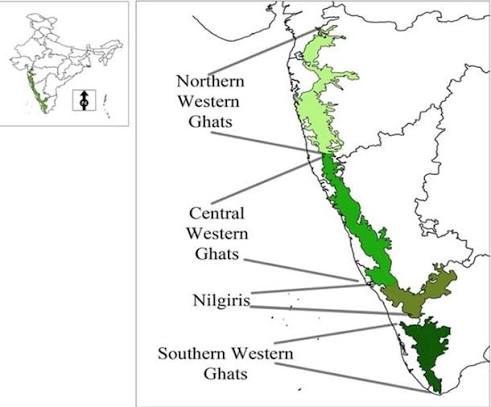
How Did So Many Different Habitats Form in One Mountain Range?
- Also known as the Sahyadri, the Western Ghats run parallel to India’s western coast for about 1,600 kilometres.
- The range extends across Gujarat, Maharashtra, Goa, Karnataka, Kerala and Tamil Nadu. Moist monsoon winds from the Arabian Sea rise along the western slopes, bringing heavy rainfall.
- Vegetation changes as rainfall decreases eastward. Evergreen forests grow on the wetter western slopes, while moist and dry deciduous forests occur in many areas farther east.
- In the higher parts of the southern Western Ghats, shola forests typically grow in valleys and depressions surrounded by natural mountain grasslands. Some low-lying valleys also contain Myristica swamps, where trees adapted to prolonged waterlogging thrive. These differences in elevation, rainfall and waterlogging create distinct habitats for different species.
Endemic Species and River Sources
- The rocky slopes of the Western Ghats are home to the Nilgiri tahr, the dense evergreen forests to the lion-tailed macaque, and the moist forest habitats to the purple frog.
- All three are endemic to the Western Ghats, meaning their natural ranges are confined to this region. The Western Ghats and Sri Lanka together form a global biodiversity hotspot. In 2012, UNESCO inscribed 39 selected sites in the Western Ghats as a single natural World Heritage property.
- The range is also an important source of water. Major east-flowing rivers such as the Godavari, Krishna and Kaveri originate here. Rivers such as the Periyar flow westward. Changes in land use in these river catchments can affect areas far downstream.
Why Does Habitat Connectivity Matter for Conservation?
- Roads, dams and changes in land use can break up natural habitats into smaller, isolated patches.
- The spread of invasive alien plants is also a challenge in some of the high-altitude grasslands of the Nilgiris. Conservation efforts therefore need to include wildlife corridors, natural grasslands, swamps and river headwaters.
- Before planting trees on a grassland, it is important to determine whether it is a natural grassland or a degraded former forest. The two serve different ecological functions and require different conservation approaches.
Question: Consider the following statements regarding the Western Ghats.
- The Nilgiri tahr, lion-tailed macaque and purple frog are endemic to the Western Ghats.
- In 2012, UNESCO inscribed 39 selected component sites of the Western Ghats as a single natural World Heritage property.
- The Godavari, Krishna, Kaveri and Periyar all originate in the Western Ghats and flow eastward.
Which of the statements given above are correct?
(A) 1 and 2 only (B) 2 and 3 only (C) 1 and 3 only (D) 1, 2 and 3
Answer: (A)
Explanation: The natural ranges of all three species are confined to the Western Ghats. In 2012, UNESCO inscribed 39 selected component sites in the region as a natural World Heritage property. The Godavari, Krishna and Kaveri flow eastward, while the Periyar flows westward.