
Valid Visa Does Not Guarantee Entry into India: Delhi High Court
The Delhi High Court has held that possession of a valid visa does not create an absolute or enforceable right of entry into India because admission remains subject to immigration law and admissibility checks.
Valid Visa Does Not Guarantee Entry into India: Delhi High Court
- Syllabus Mapping: GS Paper II — Fundamental Rights, Judiciary, Immigration, Citizenship and Government Powers.
- Source & Date: The Hindu, 2 October 2026, based on the Delhi High Court judgment delivered on 30 September 2026.
What Did the Delhi High Court Hold?
The Delhi High Court held that a foreign national possessing a valid visa does not acquire an inherent or legally enforceable right to enter India.
The case involved a Turkmenistan citizen who held a valid business visa but was denied entry at Delhi airport, while her husband was permitted to enter. Authorities relied on specific adverse inputs and discrepancies concerning her travel and business details.
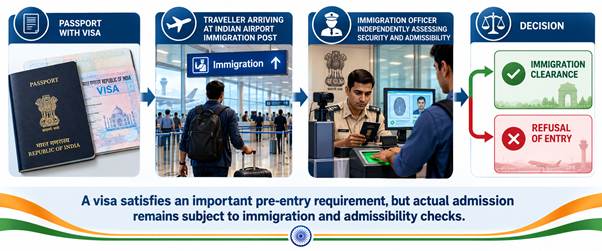
The court distinguished two separate stages:
- Grant of visa → permission to travel towards India
- Immigration clearance → actual permission to enter India
Therefore: Valid passport + valid visa ≠ automatic right of admission
What Does the Immigration and Foreigners Act, 2025 Provide?
The Immigration and Foreigners Act, 2025 has consolidated the principal statutory framework dealing with foreigners, visas, entry, stay and exit. It came into force on 1 September 2025.
Under Section 3, a foreigner seeking entry must possess a valid passport or travel document and a valid visa. However, even a person satisfying these requirements may be treated as inadmissible on grounds including national security, sovereignty and integrity of India, relations with foreign States, public health or other notified grounds. The Immigration Officer may also examine travel documents and seek additional information.
Thus: Visa eligibility → documentary compliance → immigration scrutiny → admissibility decision
What Fundamental Rights Do Foreigners Enjoy?
The Constitution distinguishes between rights available to all persons and rights reserved specifically for citizens.
Articles such as Article 14 and Article 21 use the expression “person”, so their protections are not confined exclusively to Indian citizens.
By contrast, several freedoms under Article 19 are expressly guaranteed only to citizens.
This distinction became important in Louis De Raedt v. Union of India (1991), where the Supreme Court held that foreigners enjoy Article 21 protection but cannot claim the citizen-specific right under Article 19(1)(e) to reside and settle in India.
The static constitutional distinction is therefore:
- Article 14 → persons
- Article 21 → persons
- Article 19 → citizens
What Did Earlier Supreme Court Judgments Establish?
In Hans Muller of Nurenburg v. Superintendent, Presidency Jail (1955), the Supreme Court recognised the broad sovereign authority of the Indian State in regulating and expelling foreigners under the then-existing legal framework.
Later, Louis De Raedt reaffirmed that a foreigner cannot claim the fundamental right to reside and settle in India under Article 19(1)(e).
Together, these judgments establish the broader principle that: Protection of life and liberty ≠ unrestricted right to enter or permanently reside in India
Why Did the Article 14 Argument Fail?
The petitioner argued that denying her entry while admitting her husband amounted to unequal treatment.
However, Article 14 requires similarly situated persons to be treated alike. Mere similarity in visa category does not necessarily establish identical factual circumstances.
The authorities stated that adverse information related specifically to the petitioner. Therefore, the court did not accept the argument that her husband’s admission automatically established discriminatory treatment.
This illustrates the classic Article 14 principle: Equality does not mean identical treatment irrespective of relevant factual differences.
Why Was Article 226 Relevant?
Under Article 226, High Courts can issue writs for enforcement of fundamental rights and “for any other purpose”.
However, writ jurisdiction ordinarily requires the petitioner to establish a legal or constitutional right capable of enforcement against the authority concerned.
Since the court concluded that possession of a visa did not create an enforceable right to enter India, it found no basis for directing immigration authorities to admit the petitioner.
Sovereignty and Judicial Review
Immigration decisions involve sensitive considerations such as national security, public order, foreign relations and public health.
This gives the executive significant discretion, but it does not mean that every immigration decision is automatically beyond constitutional scrutiny.
The institutional balance is:
Sovereign immigration power + statutory discretion + constitutional limitations + judicial review
The Core Legal Lesson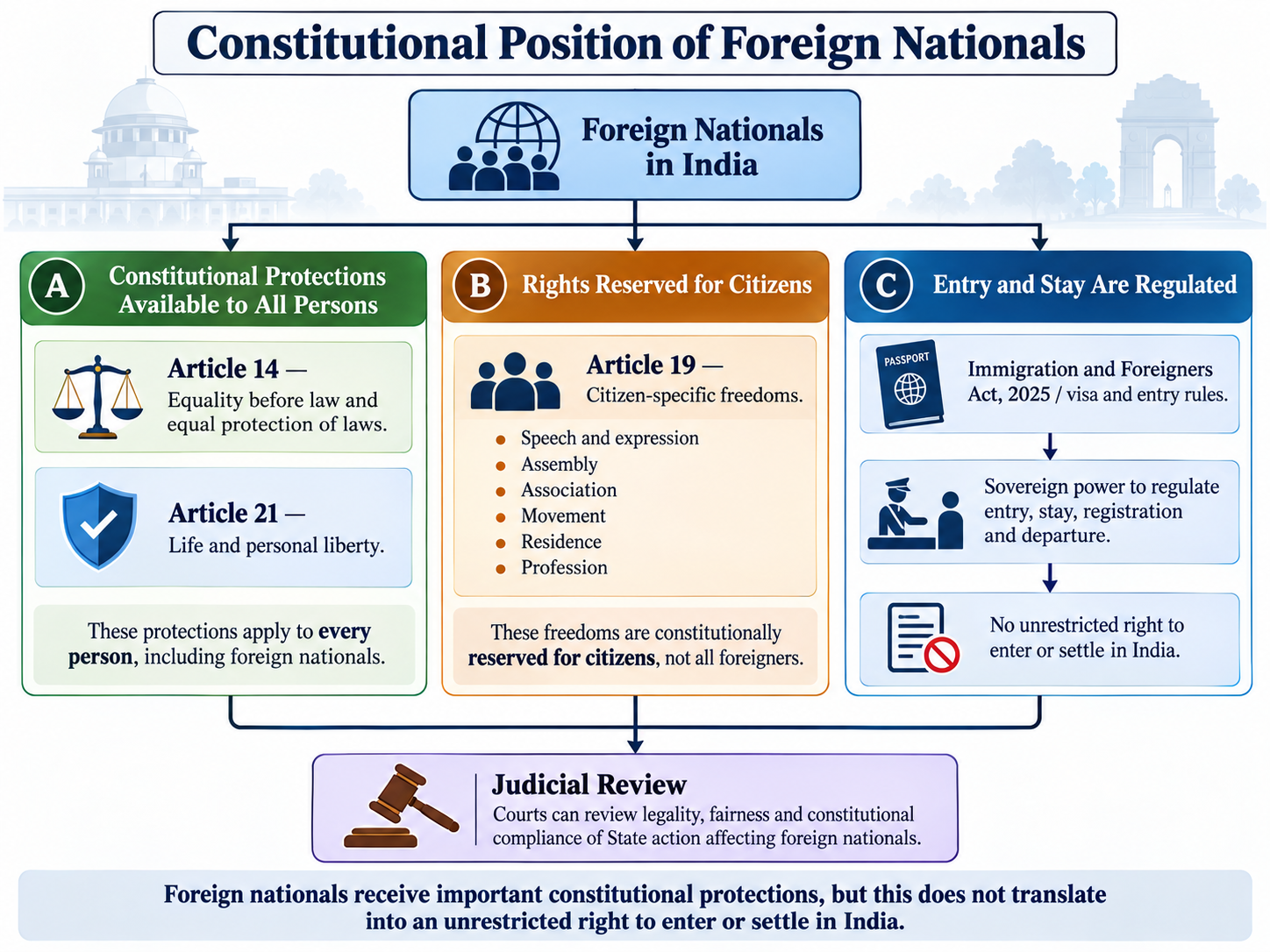
A visa should be understood as authorisation relevant to travel and immigration processing, not an unconditional guarantee of admission.
India’s legal framework separates the documentation required to seek entry from the sovereign decision on admissibility.
The central principle is:
Valid visa → eligibility to seek entry → immigration scrutiny → admissibility decision
For UPSC, the larger constitutional lesson is equally important: some fundamental rights protect every person, while others are constitutionally reserved for citizens.
Probable Mains Question
“The constitutional protection available to foreign nationals in India does not imply an unrestricted right to enter, reside or settle in the country.” Examine with reference to fundamental rights, immigration law and judicial review.
Prelims Drill
MCQ 1
With reference to Fundamental Rights under the Constitution of India, consider the following statements:
- Equality before law under Article 14 is available to citizens as well as foreigners.
- Protection of life and personal liberty under Article 21 is available to foreigners.
- The right to reside and settle in any part of India under Article 19(1)(e) is available to every person irrespective of citizenship.
Which of the statements given above are correct?
A. 1 only
B. 1 and 2 only
C. 2 and 3 only
D. 1, 2 and 3
Correct Answer: B
Explanation: Articles 14 and 21 use the term “person” and therefore extend beyond citizens, whereas the freedoms under Article 19, including the right to reside and settle in India, are constitutionally guaranteed to citizens. The Supreme Court reiterated this distinction in Louis De Raedt v. Union of India.
MCQ 2
With reference to the writ jurisdiction of High Courts, consider the following statements:
- Article 226 empowers High Courts to issue writs for enforcement of Fundamental Rights.
- The jurisdiction under Article 226 extends beyond Fundamental Rights and may be exercised “for any other purpose”.
- The writ jurisdiction of High Courts is constitutionally narrower than the Supreme Court’s jurisdiction under Article 32 because it can be invoked only for Fundamental Rights.
Which of the statements given above are correct?
A. 1 only
B. 1 and 2 only
C. 2 and 3 only
D. 1, 2 and 3
Correct Answer: B
Explanation: Article 226 is wider in subject matter than Article 32 because High Courts can issue writs not only for enforcement of Fundamental Rights but also “for any other purpose”. This static constitutional distinction remains important independently of the present immigration case.

More Current Affairs - Daily
- Election Commission of India: Constitutional Design and Evolution into a Three-Member Body 12 Oct 2026
- Loknayak Jayaprakash Narayan: Total Revolution and Contribution to Democracy 12 Oct 2026
- India’s Russia-Ukraine Initiative: From Black Sea Security to Strategic Autonomy 12 Oct 2026
- Jayaprakash Narayan: Architect of Total Revolution and Defender of Democracy 12 Oct 2026