
US-China Strategic Stability and Its Impact on Asia
The September 2026 Trump-Xi summit did not end US-China competition but strengthened mechanisms for managing rivalry through trade, AI and military crisis-management channels.
US-China Strategic Stability and Its Impact on Asia
- Syllabus Mapping: GS Paper II — International Relations, India and Major Powers, Indo-Pacific and Regional Groupings; GS Paper III — Artificial Intelligence, Semiconductors, Critical Minerals and Economic Security.
- Source & Date: The Hindu international newsletter, 28 September 2026, supplemented by recent reporting on the September Trump-Xi summit.
Why Are US-China Relations in Focus?
Chinese President Xi Jinping visited Washington from 23–25 September 2026 for talks with U.S. President Donald Trump as both sides sought to prevent renewed escalation in a relationship shaped simultaneously by economic interdependence and strategic competition.
The summit produced no comprehensive settlement, but both sides attempted to extend the existing truce, maintain dialogue on trade and technology, and strengthen crisis-management mechanisms.
The emerging relationship can therefore be understood as:
Strategic rivalry → controlled competition → crisis communication → limited cooperation → continued deterrence
What Is “Constructive Strategic Stability”?
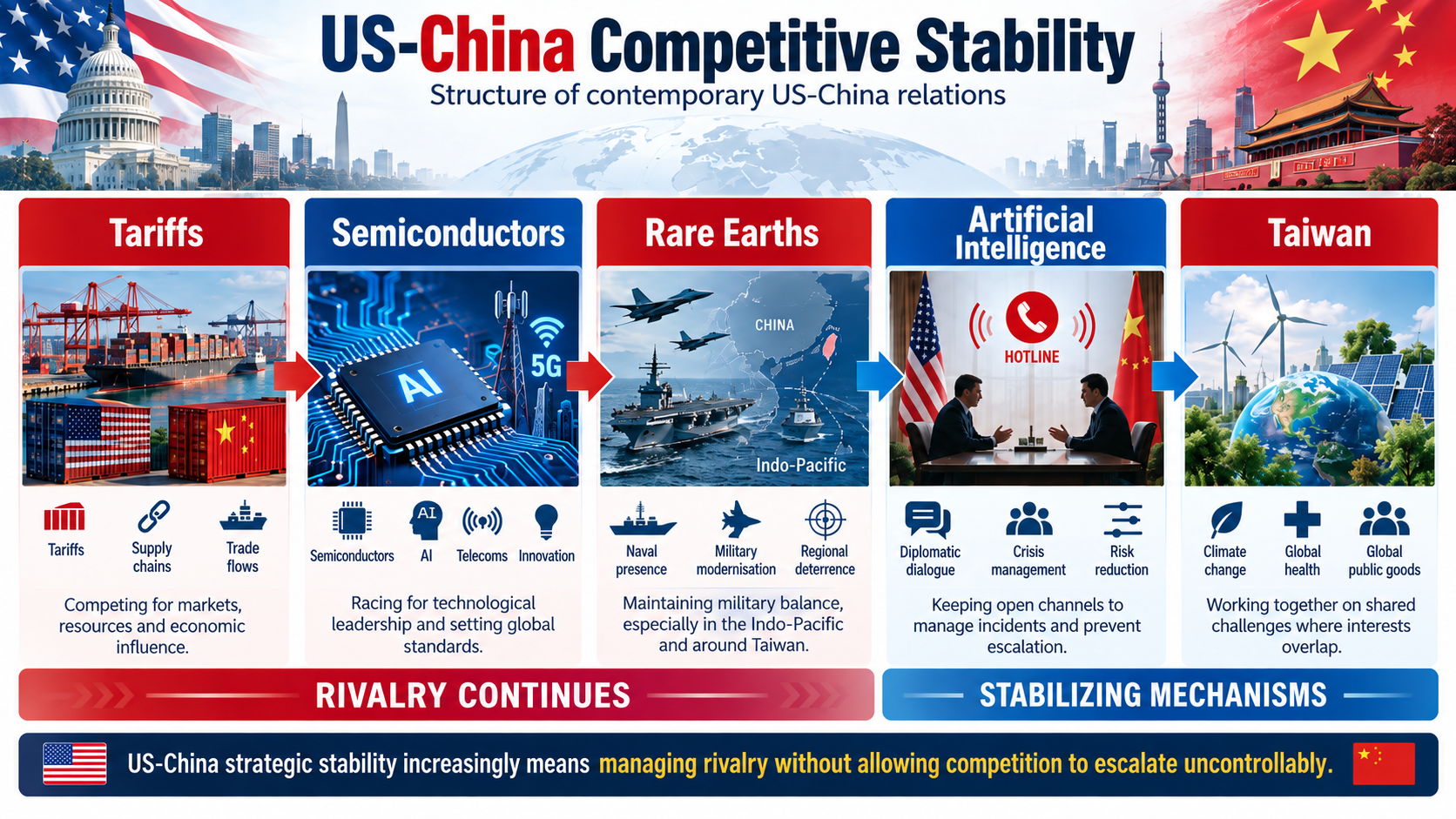
The idea of a “constructive relationship of strategic stability” reflects an attempt to prevent persistent competition from becoming uncontrolled confrontation.
This does not imply a return to strategic partnership. Both countries continue to compete across trade, technology, military power and regional influence, but they also recognise that complete economic or technological disengagement would impose substantial costs.
The basic objective is therefore: Competition without uncontrolled escalation.
Where Does Competition Continue?
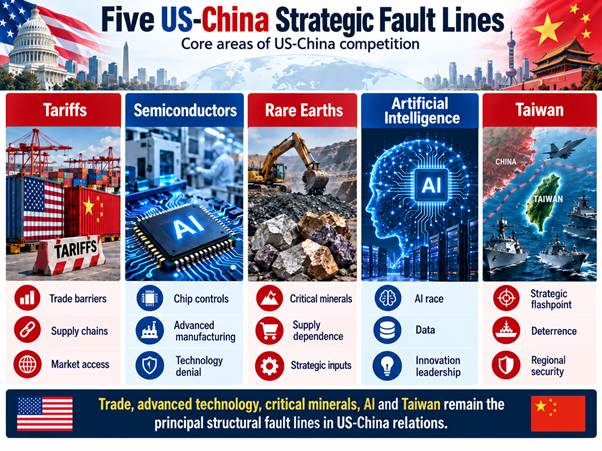
The major fault lines remain concentrated in five areas:
Trade: Tariffs and market-access disputes remain unresolved despite temporary arrangements designed to reduce immediate pressure.
Semiconductors: The United States continues to restrict Chinese access to advanced technologies, while China is accelerating technological self-reliance.
Rare earths: China’s strong position in mining, refining and processing gives it considerable leverage over supply chains important for defence, electronics and clean technologies.
Artificial Intelligence: Both countries are competing for technological leadership while exploring mechanisms that could reduce the risk of AI-related escalation.
Taiwan: China continues to oppose U.S. arms sales and strategic support for Taiwan, while Washington retains its existing policy framework towards the island.
Why Is Asia Central to the Rivalry?
The US-China relationship increasingly shapes the wider Asian security order because the region contains major U.S. alliances, Chinese economic networks, critical sea lanes and several unresolved territorial disputes.
Some Chinese strategic thinkers have promoted the idea of “Asian solutions to Asian problems”, emphasising greater regional ownership of security issues and reduced dependence on external powers.
This should not be treated as an agreed Asian doctrine because several countries continue to maintain strong security partnerships with the United States.
The regional contest therefore involves competing approaches:
U.S.-centred alliance architecture ↔ China-backed regional autonomy ↔ multi-alignment by middle powers
What Does This Mean for India?
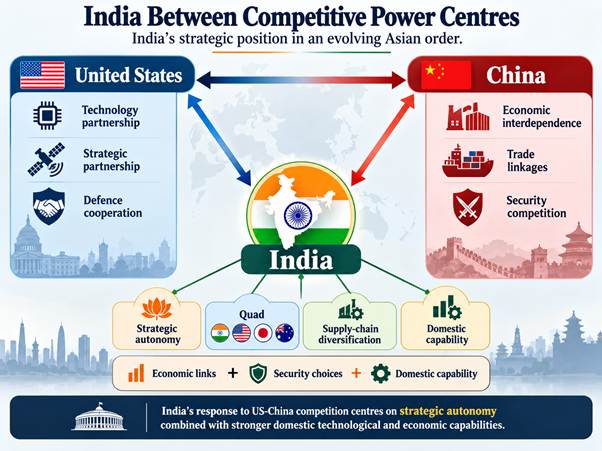
India is affected through both security and economic channels.
A relatively stable US-China relationship can reduce the risk of major disruption to Asian trade and supply chains, while continued competition can accelerate diversification in manufacturing, semiconductor production, critical-mineral networks and advanced technologies.
For India, strategically important sectors include AI, semiconductor manufacturing, rare-earth processing, telecommunications and defence technologies.
India must also navigate an Asian order in which it has a continuing border dispute with China while expanding strategic cooperation with the United States, Japan and Australia through mechanisms such as the Quad.
This makes strategic autonomy especially important because India seeks partnerships without accepting a binary choice between competing power blocs.
Technology Is Becoming Geopolitics
The rivalry increasingly demonstrates that economic policy and national security can no longer be treated separately.
Semiconductors + AI models + critical minerals + advanced manufacturing + data infrastructure = strategic power
Export controls, industrial subsidies and supply-chain diversification are therefore becoming instruments of foreign policy as well as economic policy.
Technological capacity now influences military capability, industrial competitiveness, intelligence systems, digital infrastructure and control over global supply chains.
Why Does Taiwan Remain a Major Flashpoint?
Taiwan remains one of the most sensitive issues in the bilateral relationship because Beijing considers it part of China and opposes external military support to Taipei.
The United States, meanwhile, continues to maintain political and security links with Taiwan within its existing legal and strategic framework.
Any military escalation in the Taiwan Strait could affect semiconductor supply chains, maritime trade routes and the wider security environment of East Asia.
This makes Taiwan both a regional security issue and a global economic risk.
The Larger Asian Significance
The emerging phase of US-China relations points towards competitive coexistence rather than geopolitical reconciliation.
Both powers have incentives to prevent individual disputes from destabilising the entire relationship, but neither side appears willing to abandon its strategic objectives in technology, security or regional influence.
For Asian countries, this creates pressure to strengthen economic resilience, diversify supply chains and preserve strategic flexibility.
For India, the priority is to maintain strategic space while strengthening domestic capabilities in technology, manufacturing, defence and critical minerals.
US-China rivalry → Asian power transition → supply-chain restructuring → strategic opportunities and risks for India
The Core Strategic Takeaway
Strategic stability does not mean strategic friendship.
It means creating mechanisms that allow two competing major powers to manage disagreements without allowing every trade, technology or security dispute to escalate into a wider confrontation.
For India, the most sustainable response lies in strategic autonomy, stronger partnerships, domestic technological capacity, supply-chain resilience and a stable balance of power in the Indo-Pacific.
Probable Mains Question
“The emerging phase of US-China relations is characterised less by reconciliation than by competitive strategic stability.” Discuss its implications for the Asian security order and India’s strategic interests.
Prelims Drill
MCQ 1
With reference to contemporary US-China relations, consider the following statements:
- Artificial Intelligence has emerged as both an area of strategic competition and limited risk-management cooperation.
- Rare-earth supply chains have become an important component of bilateral economic security.
- Strategic stability implies that the dispute over Taiwan has been resolved.
Which of the statements given above are correct?
A. 1 only
B. 1 and 2 only
C. 2 and 3 only
D. 1, 2 and 3
Correct Answer: B
Explanation: Artificial Intelligence and rare-earth supply chains are important components of US-China competition, while fundamental differences over Taiwan remain unresolved.
MCQ 2
Consider the following statements:
- The Quad includes India, the United States, Japan and Australia.
- Semiconductor supply chains can have both economic and national-security significance.
- Strategic stability between rival powers necessarily implies the end of strategic competition.
Which of the statements given above are correct?
A. 1 only
B. 1 and 2 only
C. 2 and 3 only
D. 1, 2 and 3
Correct Answer: B
Explanation: Strategic stability can coexist with intense economic, technological and military competition because its primary purpose is to reduce the risk that rivalry escalates into uncontrolled confrontation.
More Current Affairs - Daily
- Election Commission of India: Constitutional Design and Evolution into a Three-Member Body 12 Oct 2026
- Loknayak Jayaprakash Narayan: Total Revolution and Contribution to Democracy 12 Oct 2026
- India’s Russia-Ukraine Initiative: From Black Sea Security to Strategic Autonomy 12 Oct 2026
- Jayaprakash Narayan: Architect of Total Revolution and Defender of Democracy 12 Oct 2026