
UPI MDR Framework: Who Pays, Who Is Exempt and Why It Matters
India’s revised UPI MDR framework keeps P2P payments free while introducing a limited charge on larger merchant transactions, with special protection for small vendors and essential sectors.
UPI MDR Framework: Who Pays, Who Is Exempt and Why It Matters
What Has Changed?
The government has introduced a revised Merchant Discount Rate (MDR) framework for UPI.
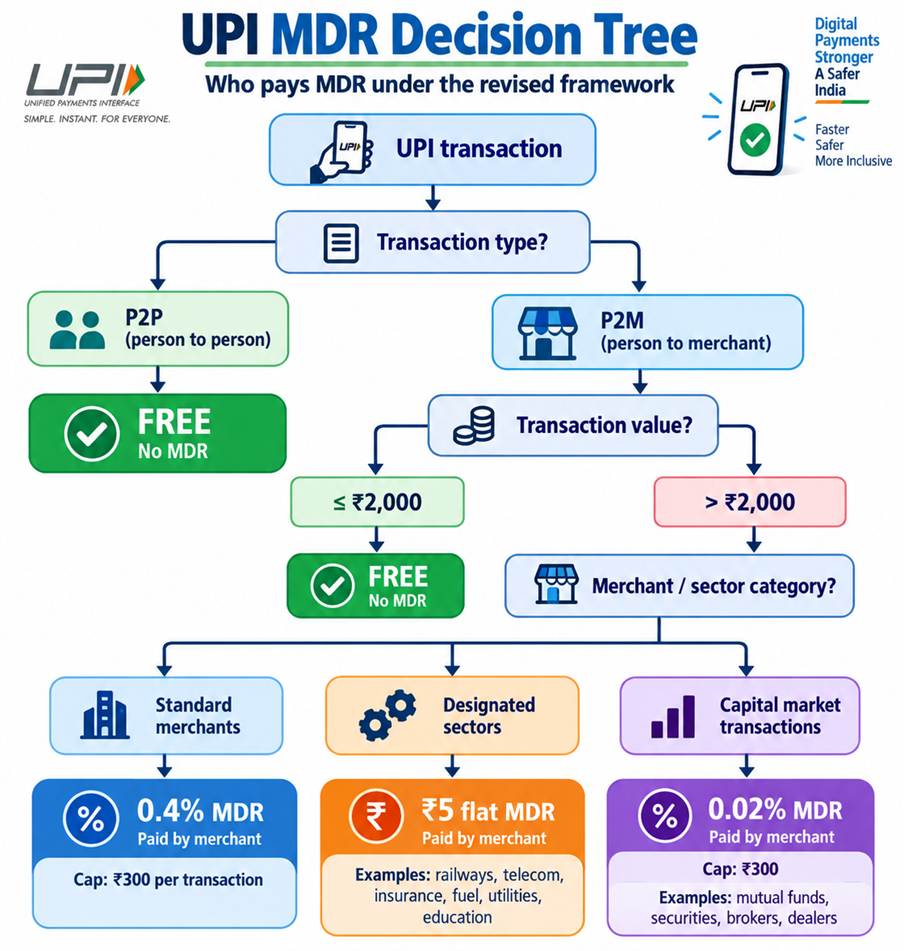
Person-to-person (P2P) UPI transfers remain completely free irrespective of amount. Merchant payments, or P2M transactions, up to ₹2,000 also remain free. Above ₹2,000, specified merchant payments attract 0.4% MDR, subject to a ₹300 cap for transactions of ₹75,000 or more.
The government says nearly 96% of merchant UPI transactions will remain unaffected because they fall below the threshold or under exempt categories.
What Exactly Is MDR?
Merchant Discount Rate is the fee charged within the payment ecosystem for processing a merchant transaction.
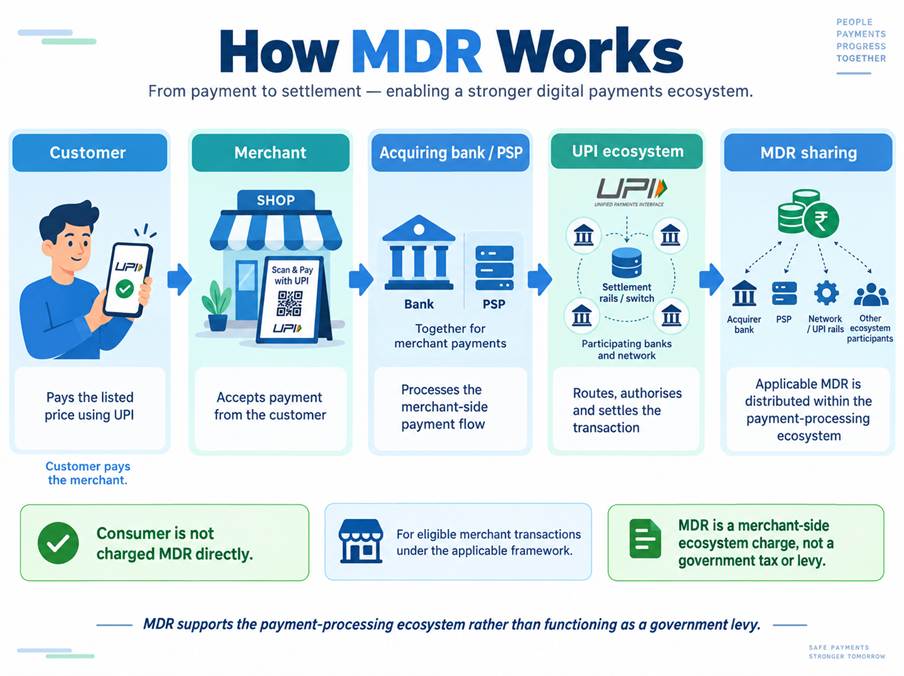
It is not a tax and is not collected by the government or NPCI. It is shared among participants such as banks, payment service providers and UPI application providers to support payment infrastructure.
The intended incidence is:
Customer pays merchant → payment processed through UPI → eligible merchant bears MDR → ecosystem participants share fee
The government has advised banks to ensure merchants do not pass the MDR directly to customers.
Who Pays How Much?
Transaction | MDR Treatment |
P2P transfer | No MDR |
P2M up to ₹2,000 | No MDR |
Regular P2M above ₹2,000 | 0.4% |
P2M ₹75,000 or above | Maximum ₹300 |
Essential sectors above ₹2,000 | ₹5 flat MDR |
Capital-market payments | 0.02%, capped at ₹300 |
Eligible small merchants | Zero-MDR framework |
Essential sectors include areas such as railways, telecom, insurance, fuel and agricultural inputs. Capital-market transactions include payments connected with mutual funds, securities, stockbrokers and dealers.
Protection for Small Merchants
Small merchants receiving up to ₹1 lakh per month through UPI QR into personal accounts remain within a special zero-MDR category.
If aggregate UPI inflows exceed ₹1 lakh per month for three consecutive months, such a merchant may move into the regular P2M category.
This protects street vendors and micro-enterprises from recurring acceptance costs while allowing larger merchants to contribute toward payment infrastructure.
 Why Introduce MDR Now?
UPI operates at massive scale and requires continuous investment in:
Cybersecurity + server capacity + fraud prevention + dispute resolution + innovation + customer support
The policy therefore attempts to balance two objectives:
Keep everyday digital payments affordable while creating a sustainable revenue stream for the payment ecosystem
The government’s design uses thresholds and exemptions so that the charge falls mainly on relatively higher-value merchant transactions.
Why It Matters for Financial Inclusion
Zero-cost acceptance helped UPI spread rapidly among small merchants.
A high or universal MDR could discourage digital acceptance, especially among low-margin businesses. Conversely, permanently zero pricing may weaken incentives for banks and payment companies to invest in resilient infrastructure.
The framework therefore represents a shift from universal zero-MDR treatment toward targeted subsidisation and differentiated pricing.
Probable Mains Question
“The challenge in digital payments is to balance universal accessibility with the financial sustainability of payment infrastructure.” Examine the revised UPI MDR framework in this context.
Prelims Readiness Drill
MCQ 1
With reference to the revised UPI MDR framework, consider the following statements:
- Person-to-person UPI transactions remain free irrespective of transaction value.
- Every person-to-merchant transaction above ₹2,000 attracts a uniform MDR of 0.4%.
- MDR is a government tax imposed on digital payments.
Which of the statements given above is/are correct?
A. 1 only
B. 1 and 2 only
C. 2 and 3 only
D. 1, 2 and 3
Correct Answer: A
Explanation: P2P payments remain free. Not every P2M payment above ₹2,000 attracts 0.4%, because special categories have different rates. MDR is not a government tax.
Trap Identified: Standard rate ≠ universal rate.
MCQ 2
Consider the following pairs:
Category | MDR Treatment |
Essential-sector UPI payments | ₹5 flat MDR |
Capital-market UPI payments | 0.02%, subject to cap |
P2P UPI transfers | 0.4% above ₹2,000 |
How many of the above pairs are correctly matched?
A. Only one
B. Only two
C. All three
D. None
Correct Answer: B
Explanation: The first two pairs are correct. P2P UPI transactions remain free irrespective of amount.
Trap Identified: The ₹2,000 MDR threshold applies to merchant payments, not P2P transfers.
More Current Affairs - Daily
- Election Commission of India: Constitutional Design and Evolution into a Three-Member Body 12 Oct 2026
- Loknayak Jayaprakash Narayan: Total Revolution and Contribution to Democracy 12 Oct 2026
- India’s Russia-Ukraine Initiative: From Black Sea Security to Strategic Autonomy 12 Oct 2026
- Jayaprakash Narayan: Architect of Total Revolution and Defender of Democracy 12 Oct 2026