
Supreme Court on Re-Arrest After Illegal Detention: Article 22 Safeguards Strengthened
The Supreme Court has clarified that release following violation of Article 22 is release from unconstitutional detention, not bail, and any subsequent re-arrest must satisfy strict judicial safeguards.
Supreme Court on Re-Arrest After Illegal Detention: Article 22 Safeguards Strengthened
What Did the Supreme Court Hold?
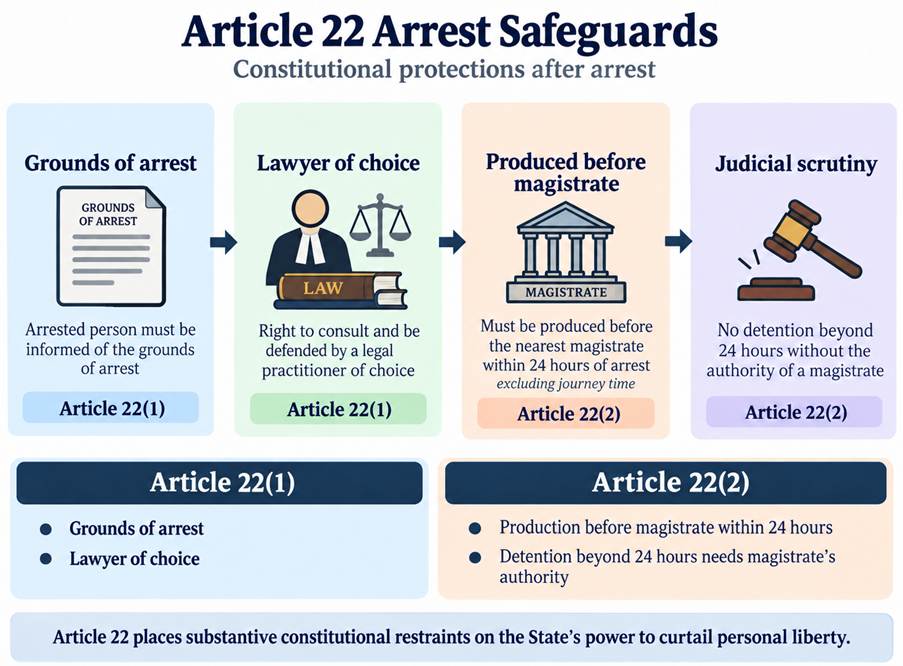
The Supreme Court held that safeguards under Article 22(1) and Article 22(2) are fundamental principles governing personal liberty, not mere procedural requirements.
Article 22(1) requires an arrested person to be:
- informed of the grounds of arrest, and
- allowed to consult and be defended by a lawyer of choice.
Article 22(2) requires production before the nearest magistrate within 24 hours, excluding journey time.
The Court held that violation of these safeguards makes the arrest unconstitutional, requiring immediate release.
Release for Illegal Arrest Is Not Bail
The Court drew an important distinction:
Release due to constitutional violation ≠ enlargement on bail
The accused is instead being released from illegal and unconstitutional detention.
This matters because the State cannot simply treat the release as an ordinary bail situation and mechanically arrest the person again.
What Must Happen Before Re-Arrest?
Where police seek to re-arrest the same person for the same offence after an Article 22 violation, the Court prescribed a structured process:
Written grounds supplied → fresh application before magistrate → reasons for earlier failure explained → necessity of re-arrest justified → superior officer endorsement → judicial decision
The magistrate may permit re-arrest only if satisfied that:
- the earlier failure occurred for bona fide reasons,
- written grounds have subsequently been supplied, and
- custody is genuinely necessary.
The application must be decided within one week.
Police Accountability Is Built into the Process
The Court refused to leave re-arrest to the discretion of the same authority that violated the Constitution.
The immediate superior officer must:
- endorse the fresh application,
- transfer the investigation to another officer, and
- order a departmental inquiry into the earlier lapse.
An adverse finding may lead to disciplinary consequences and an entry in the officer’s service record.
Written Grounds of Arrest Are Mandatory
The Court reaffirmed that grounds of arrest must be:
in writing + furnished at the earliest + in a language understood by the accused
This requirement applies across offences under the BNS and special statutes; it is not confined to one law such as the PMLA.
The Court also linked the constitutional safeguard with Section 47 of the Bharatiya Nagarik Suraksha Sanhita, 2023, governing communication of grounds of arrest.
Judicial Evolution
Case | Principle |
Pankaj Bansal v. Union of India (2023) | Written grounds required in PMLA arrests |
Prabir Purkayastha v. State (NCT of Delhi) (2024) | Written grounds requirement reinforced |
Mihir Rajesh Shah v. State of Maharashtra (2025) | Written grounds across offences/statutes and in language understood |
Jaskaran Jeet Singh Deol (2026) | Judicially supervised re-arrest mechanism added |
The 2026 ruling therefore shifts the law from merely declaring an arrest illegal to imposing institutional consequences and safeguards against repeat illegality.
Compensation for Constitutional Violations
The Supreme Court also directed High Courts to award suitable mandatory compensation where constitutional arrest safeguards are violated.
This reinforces the principle of public law compensation for unlawful deprivation of liberty and strengthens accountability beyond mere release of the accused.
Why the Judgment Matters
The ruling establishes that the seriousness of an alleged offence does not dilute constitutional safeguards.
The core principle is:
Gravity of offence cannot cure illegality of arrest.
The judgment therefore strengthens:
Personal liberty + judicial oversight + police accountability + procedural fairness
Probable Mains Question
“Procedural safeguards governing arrest are substantive guarantees of personal liberty rather than technical formalities.” Discuss in light of the Supreme Court’s 2026 ruling on re-arrest following violation of Article 22.
Prelims Drill
MCQ 1
With reference to Article 22 of the Constitution, consider the following statements:
- An arrested person must be informed of the grounds of arrest.
- An arrested person has the right to consult and be defended by a legal practitioner of choice.
- Every arrested person must ordinarily be produced before the nearest magistrate within 24 hours, excluding journey time.
Which of the statements given above are correct?
A. 1 and 2 only
B. 2 and 3 only
C. 1 and 3 only
D. 1, 2 and 3
Correct Answer: D
Explanation: Article 22(1) protects the right to know the grounds of arrest and to legal representation, while Article 22(2) requires production before a magistrate within 24 hours subject to the constitutional exception for journey time.
MCQ 2
With reference to the Supreme Court’s 2026 ruling in Jaskaran Jeet Singh Deol v. State of Punjab, consider the following statements:
- Re-arrest after release for violation of Article 22 is absolutely prohibited.
- A magistrate’s approval is required before such re-arrest.
- The investigation should be transferred from the officer responsible for the earlier constitutional violation.
Which of the statements given above are correct?
A. 1 only
B. 2 only
C. 2 and 3 only
D. 1, 2 and 3
Correct Answer: C
Explanation: The Court did not prohibit re-arrest altogether. It required a fresh, judicially supervised process and accountability measures, including transfer of investigation and departmental inquiry.
More Current Affairs - Daily
- Election Commission of India: Constitutional Design and Evolution into a Three-Member Body 12 Oct 2026
- Loknayak Jayaprakash Narayan: Total Revolution and Contribution to Democracy 12 Oct 2026
- India’s Russia-Ukraine Initiative: From Black Sea Security to Strategic Autonomy 12 Oct 2026
- Jayaprakash Narayan: Architect of Total Revolution and Defender of Democracy 12 Oct 2026