
Beyond Income: What Really Determines the Standard of Living?
Beyond Income: What Really Determines the Standard of Living?
- Two families earn the same monthly income. One lives near a government school, a health centre and a bus route. The other has to travel farther for medical care and spend more on its children’s education. On paper, their incomes are equal.
In practice, the first family may have more money to save and more time for other activities. Understanding this difference brings out the human side of economics.
What Is the Standard of Living?
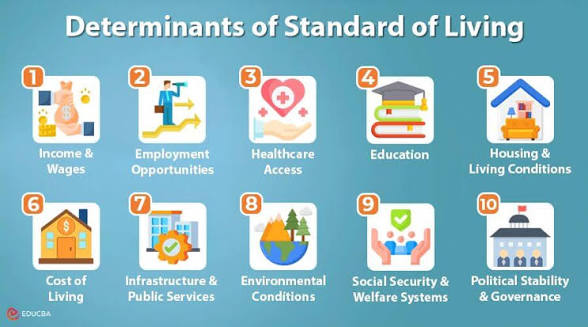
- The standard of living reflects the resources and services available to individuals and families to meet their needs. Alongside income and consumption, it includes access to adequate food, safe housing, clean water, education, healthcare and transport.
- Quality of life is broader still. It also encompasses personal safety, social relationships, environmental conditions and the time people have for themselves outside work.
Why Can Living Standards Fall Even When Income Rises?
- Suppose an employee’s salary rises by 5 per cent in a year, while the cost of the goods and services their family regularly buys rises by 8 per cent. More money goes into the bank account, yet the family can afford less than before. Its real purchasing power has fallen.
- The regularity of income also matters. Two people may earn the same amount over a year and still face different circumstances if one receives a monthly salary and the other earns only during certain months.
- A family with irregular income may have to borrow to pay school fees, cover the rent or meet an unexpected medical expense.
What Do the Figures Tell Us, and What Do They Miss?
- India’s Household Consumption Expenditure Survey 2023–24 estimated average monthly per capita consumption expenditure at ₹4,122 in rural areas and ₹6,996 in urban areas. These figures exclude the estimated value of items received free of charge through welfare schemes.
- To understand this gap, it helps to look at local prices and what households spend their money on. Higher urban rents, for example, can raise a family’s total expenditure even if it lives in a smaller home. An average also tells us little about the circumstances of households at the lower end of the spending distribution.
- The Human Development Index (HDI) offers a broader view. It measures health through life expectancy at birth, education through mean and expected years of schooling, and the standard of living through gross national income per capita. This helps explain how countries with similar average incomes can have different outcomes in health and education.
What Does a Better Standard of Living Look Like in Everyday Life?
- Reliable public transport brings better jobs within a worker’s reach. A nearby health centre makes timely treatment possible and reduces travel costs. A regular supply of water at home saves time for family members who would otherwise fetch it every day. They can use that time to study, work or rest.
- A higher standard of living is felt when a family can afford nutritious food, medical care and its children’s education, set aside savings for unexpected expenses, and choose better opportunities for work or study. These changes show how far economic progress has reached into people’s lives.
Question: Consider the following statements regarding the standard of living and quality of life.
- A household’s standard of living is determined solely by its income.
- Quality of life is broader than the standard of living and also includes personal safety, social relationships, environmental conditions and time available for oneself outside work.
Which of the statements given above is correct?
(A) 1 only (B) 2 only (C) Both 1 and 2 (D) Neither 1 nor 2
Answer: (B)
Explanation: The standard of living reflects income and consumption as well as access to food, housing, clean water, education, healthcare and transport. Quality of life also takes into account factors such as safety, social relationships, environmental conditions and personal time.