Russian Oil Waiver and India
The U.S. has temporarily waived key penalties linked to purchases of Russian energy. India gains short-term relief, but long-term energy security still depends on diversification and policy flexibility.
Russian Oil Waiver and India
- Syllabus Mapping: GS Paper II — India-U.S. Relations and Strategic Autonomy; GS Paper III — Energy Security, External Sector and International Trade.
- Source & Date: The Indian Express, 17 October 2026.
Why in News?
U.S. President Donald Trump has temporarily waived key provisions of the Lindsey O. Graham Sanctioning Russia and Iran Act of 2026, which authorised tariffs of up to 100% on major buyers of Russian oil and gas. The waiver was issued on national-interest grounds and remains in force until the U.S. administration decides further action is necessary.
For India, this removes the immediate risk that large purchases of Russian crude could trigger fresh U.S. trade penalties.
Why Russian Oil Matters
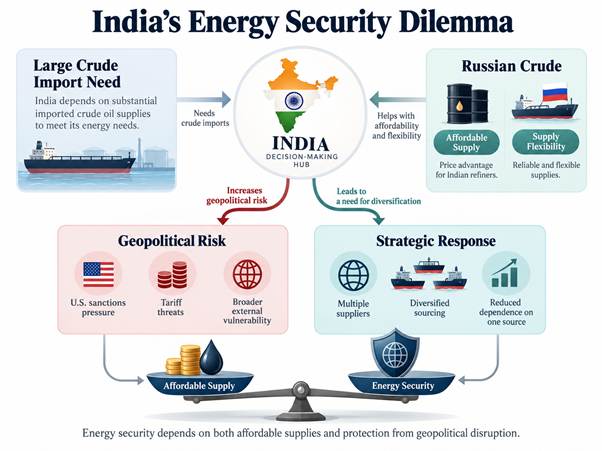
India imports more than 88% of its crude oil requirement and is therefore highly exposed to international supply disruptions and price shocks.
Russia became a major supplier after 2022 because discounted crude offered Indian refiners an additional source outside traditional West Asian suppliers. Russian barrels also became more important as disruptions in West Asia affected flows through the Strait of Hormuz, a route that normally carries a large share of India’s crude imports.
For India, the issue is not only price. It is also about availability, freight costs, refinery compatibility and supply security.
What the Waiver Changes
The waiver gives Indian refiners greater freedom to assess Russian cargoes on commercial grounds instead of immediately worrying about a possible U.S. tariff penalty.
It also reduces uncertainty in India-U.S. trade negotiations, because the threatened tariff could have created a direct conflict between India’s energy needs and its export interests in the American market.
However, the relief is temporary. The White House order requires U.S. agencies to continue monitoring purchases of Russian energy and allows the administration to reconsider the waiver later. Existing Russia-related sanctions issued under separate executive orders remain unaffected.
Diversification Remains Essential
The waiver should not encourage greater dependence on Russia.
India has already expanded purchases from Africa, North America and South America as disruptions reduced some Gulf supplies. A diversified import basket gives refiners more options when sanctions, wars or shipping disruptions suddenly alter global oil flows.
The key objective is to avoid replacing one dependency with another.
Energy and Trade Are Now Linked
The episode shows how energy policy has become closely connected with trade diplomacy.
If the U.S. had imposed additional duties on Indian exports because of Russian oil purchases, India would have faced a difficult choice between maintaining competitively priced energy imports and protecting access to one of its major export markets.
The waiver postpones that dilemma, but Washington retains significant leverage through future sanctions and tariff measures.
Strategic Autonomy Is the Broader Issue
India’s response reflects the logic of strategic autonomy. It seeks to maintain energy ties with Russia while also deepening economic relations with the United States and expanding alternative sources of crude.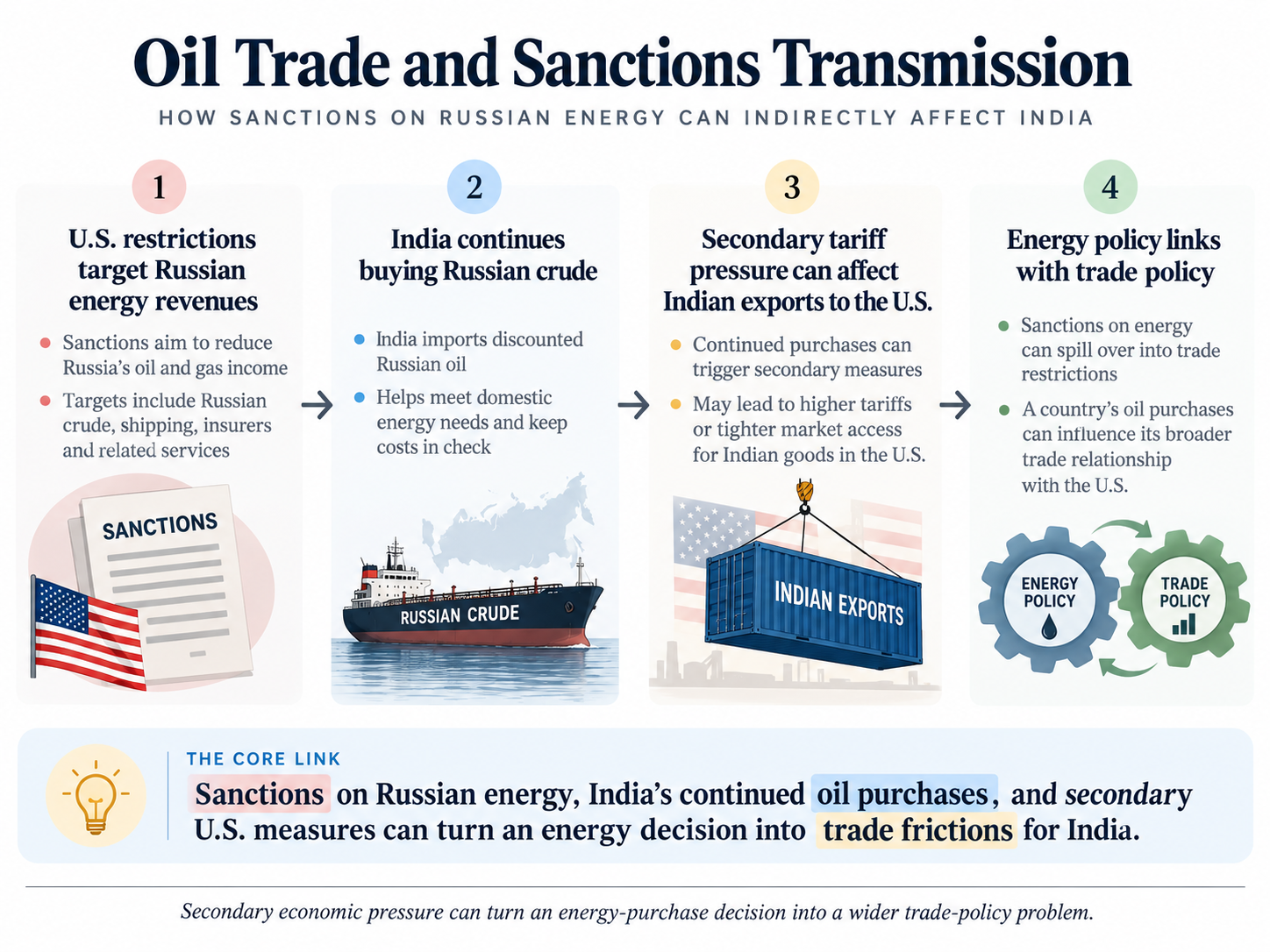
The long-term goal is not alignment with one supplier or one bloc. It has greater flexibility in responding to changing market and geopolitical conditions.
Core Policy Lesson
The U.S. waiver gives India short-term relief, but it does not remove the underlying uncertainty.
India’s stronger position will come from diversified suppliers, resilient shipping routes, flexible refineries and continued diplomatic engagement. The main lesson is that energy security depends not only on obtaining cheaper crude, but also on reducing exposure to sudden political and trade shocks.
Probable Mains Question
“Energy security increasingly depends on managing geopolitical and trade risks, not merely securing adequate supplies.” Discuss with reference to India’s crude oil import strategy.
Prelims Drill
MCQ 1
With reference to India’s crude oil security, consider the following statements:
- Diversification of crude suppliers can reduce exposure to sanctions and regional conflicts.
- A refinery’s technical configuration can influence which grades of crude it can process efficiently.
- Import dependence necessarily falls whenever a country increases the number of foreign suppliers.
Which of the statements given above are correct?
A. 1 only
B. 1 and 2 only
C. 2 and 3 only
D. 1, 2 and 3
Correct Answer: B
Explanation: Diversification reduces concentration risk, while refinery configuration affects crude compatibility. Import dependence refers to the share of demand met through imports, so adding more foreign suppliers does not by itself reduce dependence.
MCQ 2
Consider the following statements regarding economic sanctions and third countries:
- Secondary sanctions or tariff measures can target entities or countries that continue specified transactions with a sanctioned country.
- Such measures can create trade effects even when the third country itself is not the original target of the sanctions.
- A waiver issued under a sanctions law necessarily repeals the underlying law permanently.
Which of the statements given above are correct?
A. 1 and 2 only
B. 1 and 3 only
C. 2 and 3 only
D. 1, 2 and 3
Correct Answer: A
Explanation: Secondary measures can affect third-country buyers and create wider trade consequences. A waiver suspends or relaxes application under specified conditions; it does not automatically repeal the underlying statute.