
River Interlinking and Invasive Species: India’s Hidden Ecological Risk
India’s river interlinking programme seeks to redistribute water between basins, but artificial connectivity can also create pathways for invasive species, pathogens and ecological disruption.
River Interlinking and Invasive Species
Syllabus Mapping: GS Paper III — Environment and Biodiversity, Water Resources, Infrastructure, Climate Change and Environmental Impact Assessment.
Source & Date: The Hindu, 30 September 2026, based on research published in Scientific Reports by researchers from the Ashoka Trust for Research in Ecology and the Environment.
Why Is River Interlinking in Focus?
India’s National River-Linking Project proposes to connect 37 major river basins through around 30 links, potentially redistributing about 174 billion cubic metres of water and generating around 34,000 MW of power.
The project is intended to transfer water from basins considered relatively “surplus” to those considered “deficit”, but such connections can also move biological organisms between river systems that have remained naturally separated.
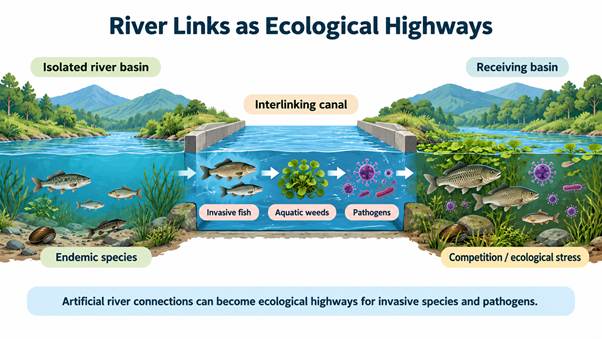
Recent ecological research highlights the possibility that canals and reservoirs could become “ecological highways” for invasive alien species.
The basic risk pathway is:
Isolated river basins → artificial water connection → movement of invasive organisms → competition with native species → ecosystem disruption → biodiversity loss
 .
.
Why Does Basin Isolation Matter?
River basins are distinct ecological systems rather than interchangeable channels carrying water. Geographic separation allows fish, aquatic plants, microorganisms and other organisms to evolve under different ecological conditions.
Many freshwater organisms are endemic, meaning they occur naturally only within a limited region or basin.
Artificially connecting two basins can therefore expose native species to competitors, predators and diseases that would not have reached them through natural river networks.
The ecological principle is:
Hydrological connectivity → biological connectivity
Greater water connectivity does not necessarily produce greater ecological health.
Which River Basins Are Particularly Vulnerable?
The research identifies northeastern and peninsular river basins as relatively vulnerable to biological invasion, with ecologically important systems such as the Southwestern Ghats, Kaveri, Krishna, Lower Ganga and Brahmaputra requiring particular attention.
These basins contain complex ecological niches supporting native species, threatened species and already established invasive organisms.
The Lower Ganga, for example, hosts several invasive alien species and could become a source of invasives for the Mahanadi basin, which supports numerous threatened species.
Thus, biodiversity hotspots can potentially become invasion hotspots when artificial connectivity introduces organisms into ecosystems where native species have not evolved alongside them.
Invasive Species Are Not the Only Biological Risk
River transfers can also move parasites, microorganisms and aquatic pathogens.
Fish populations in one basin may possess some resistance to locally occurring pathogens, while species in another basin may lack similar immunity.
The transmission chain may therefore become:
Water transfer → pathogen movement → vulnerable fish population → disease spread → ecological stress
This makes aquatic biosecurity an important part of river-infrastructure planning.
What Happens to the Donor River?
Ecological impacts are not confined to the basin receiving transferred water.
Removing substantial quantities of water from a donor river can reduce downstream flow, change sediment transport, affect floodplains and modify habitats used by fish and other aquatic species.
The process can be understood as:
Water diversion → reduced downstream discharge → altered sediment transport → habitat degradation → biodiversity stress
The Ken-Betwa link illustrates this wider concern because changes in the Ken River’s flow could affect sediment dynamics and downstream ecology even before transferred water reaches the Betwa basin.
Why Is the “Surplus-Deficit” Concept Complicated?
River-linking plans depend partly on identifying some basins as having surplus water available for transfer.
However, river flows vary across seasons and years, while climate change is altering rainfall intensity, monsoon distribution, drought frequency and extreme flood events.
A basin classified as surplus using historical hydrological data may therefore not possess the same dependable surplus several decades later.
The planning challenge is:
Historical river-flow data + climate change ≠ guaranteed future surplus water
This means long-term projects require dynamic climate modelling rather than fixed assumptions based only on historical averages.
Why Can River Interlinking Cause Ecological Homogenisation?
Each naturally isolated river basin contains a distinctive biological community.
When artificial connections repeatedly move organisms between basins, ecological differences may gradually decline as widespread invasive species expand while specialised endemic species retreat.
This process is called biotic homogenisation, where ecosystems that were once biologically distinct become increasingly similar.
Such homogenisation can reduce ecological resilience because diverse local communities are replaced by a smaller number of highly adaptable species.
Why Does This Matter Beyond Biodiversity?
River ecology directly supports economic and social systems.
Changes in fish populations, water quality, sediment movement and aquatic disease can affect fisheries, agriculture, wetlands, rural livelihoods and food security.
Some river systems also cross international boundaries, meaning major alterations in downstream water quantity or ecological condition may have transboundary implications.
River-linking decisions must therefore consider:
Water security + biodiversity + fisheries + agriculture + livelihoods + downstream and transboundary impacts
What Should Ecological Safeguards Include?
River-linking assessments should move beyond conventional engineering and hydrological calculations and incorporate basin-level ecological risk assessment.
Important safeguards include:
Baseline mapping of native, endemic, threatened and invasive species before connectivity is created.
Invasive-species risk assessment for both donor and receiving basins.
Aquatic pathogen and biosecurity surveillance around canals, reservoirs and transfer points.
Monitoring through tools such as environmental DNA to detect new species at an early stage.
Climate-adjusted estimates of future water availability rather than dependence only on historical flow data.
Long-term monitoring of downstream flows, sediment movement, fisheries and ecosystem health.
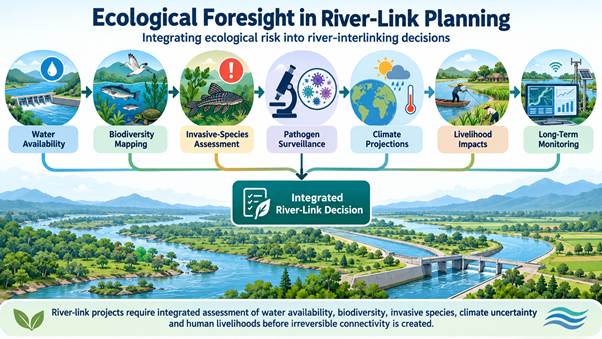
The planning framework should therefore become:
Hydrological assessment → biodiversity mapping → invasion risk → climate assessment → livelihood impact → adaptive monitoring
The Core Policy Lesson
River interlinking should not be viewed simply as the movement of excess water from one geographical location to another.
Rivers simultaneously transport water, sediment, nutrients, organisms and pathogens, while supporting distinctive ecosystems and human livelihoods.
The conceptual shift required is therefore:
Water-transfer infrastructure → river-basin ecosystem intervention
Infrastructure intended to solve water scarcity may generate new ecological costs if invasive species, pathogens, altered flows and biodiversity loss are not incorporated into project design.
The objective should not be to treat development and ecology as competing choices, but to ensure that water-security infrastructure is designed using ecological foresight before irreversible basin connectivity is created.
Probable Mains Question
“River interlinking should be assessed not merely as a water-transfer infrastructure project but as a large-scale intervention in river-basin ecosystems.” Discuss with reference to invasive species, downstream ecology and climate uncertainty.
Prelims Drill
MCQ 1
With reference to invasive alien species and river interlinking, consider the following statements:
Artificial connections between river basins can provide pathways for aquatic organisms to move into previously isolated ecosystems.
Endemic freshwater species may be especially vulnerable to newly introduced competitors, predators and pathogens.
Biological invasion refers only to invasive plants and does not include animals or microorganisms.
Which of the statements given above are correct?
A. 1 only
B. 1 and 2 only
C. 2 and 3 only
D. 1, 2 and 3
Correct Answer: B
Explanation: Artificial river connectivity can spread invasive plants, animals and pathogens between basins, while endemic species may be particularly vulnerable because they evolved within relatively isolated ecological systems.
MCQ 2
With reference to ecological impacts of river interlinking, consider the following statements:
Water diversion from a donor basin can alter downstream sediment transport.
Climate change can make historical classifications of surplus and deficit river basins less reliable.
Greater connectivity between river basins necessarily increases native biodiversity in both basins.
Which of the statements given above are correct?
A. 1 only
B. 1 and 2 only
C. 2 and 3 only
D. 1, 2 and 3
Correct Answer: B
Explanation: Water diversion can affect downstream flow and sediment dynamics, while climate change creates uncertainty about future water availability. Greater connectivity may instead spread invasive species and contribute to ecological homogenisation.
More Current Affairs - Daily
- Election Commission of India: Constitutional Design and Evolution into a Three-Member Body 12 Oct 2026
- Loknayak Jayaprakash Narayan: Total Revolution and Contribution to Democracy 12 Oct 2026
- India’s Russia-Ukraine Initiative: From Black Sea Security to Strategic Autonomy 12 Oct 2026
- Jayaprakash Narayan: Architect of Total Revolution and Defender of Democracy 12 Oct 2026