
Prorogation of Parliament: How Is It Different from Adjournment?
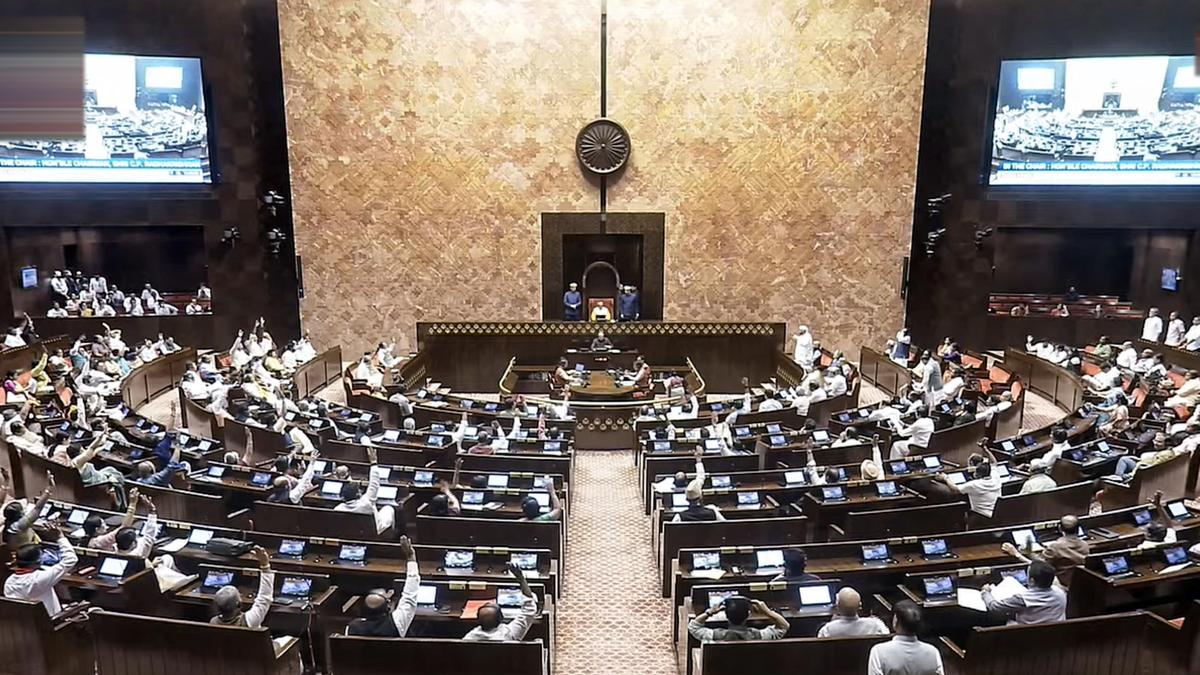
Adjournment sine die and prorogation are distinct parliamentary processes. Presiding officers adjourn a House, while the President prorogues it on ministerial advice. An unprorogued House can potentially be reconvened at short notice.
- Syllabus Mapping: GS Paper II — Parliament, Constitutional Provisions, Executive-Legislature Relations and Parliamentary Procedures.
- Source & Date: The Hindu, 23 November 2026.
Why in News?
The Monsoon Session of Parliament was adjourned sine die on August 13, 2026, but the two Houses were not prorogued for about 100 days.
This became the longest such unprorogued period on record and revived interest in the constitutional distinction between adjournment, adjournment sine die and prorogation.
What Does Article 85 Provide?
- Article 85 empowers the President to summon each House of Parliament from time to time.
- The President acts on the advice of the Council of Ministers.
- The Constitution requires that not more than six months should intervene between the last sitting of one session and the first sitting of the next.
- Parliament usually meets in three sessions by convention, though the Constitution does not prescribe three sessions.
The same Article also provides for the prorogation of either House.
How Is Prorogation Different from Adjournment?
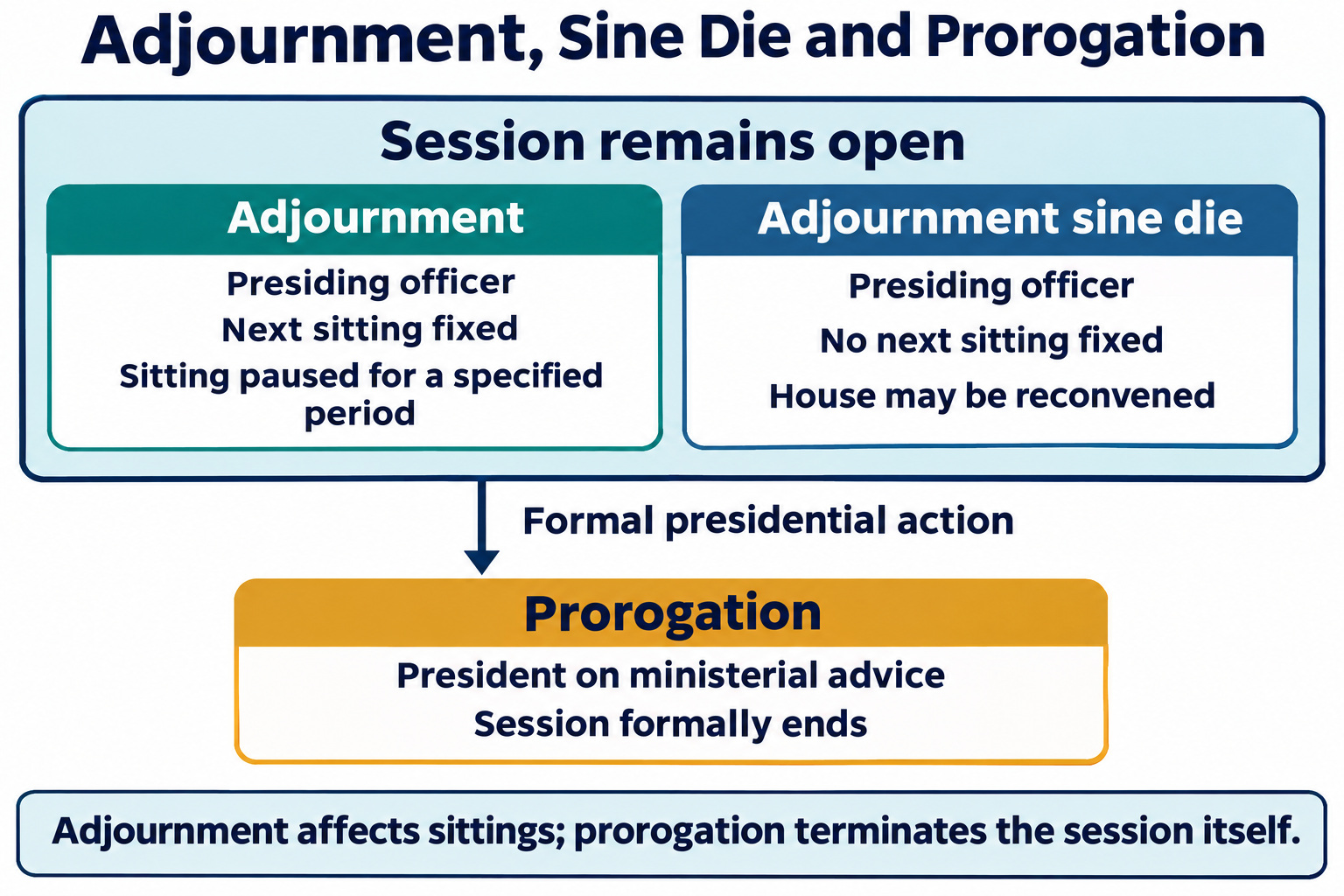
- Adjournment: suspends a sitting for a specified time or day.
- Adjournment sine die: ends the sitting of the House without fixing a date for the next meeting.
- Both are carried out by the presiding officer — the Speaker in Lok Sabha and Chairman in Rajya Sabha.
- Prorogation, however, formally ends a session and is done by the President on ministerial advice.
Normally, prorogation follows within a few days after a House is adjourned sine die.
Why Does an Unprorogued House Matter?
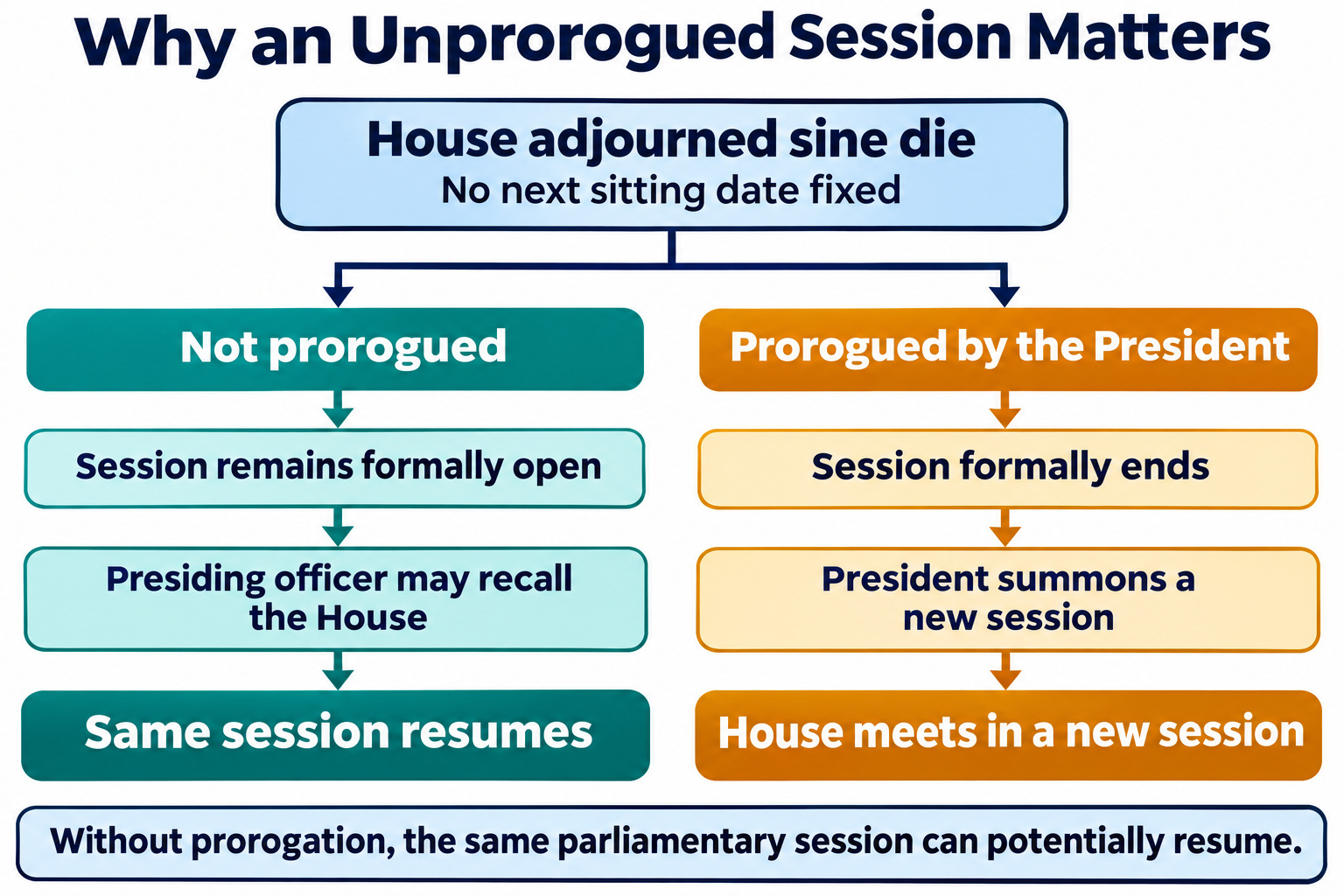
If a House has been adjourned sine die but not prorogued, it remains part of the same session.
- Under Rule 15 of the Lok Sabha Rules, the Speaker can call the House to meet again after adjournment sine die if it has not been prorogued.
- Rajya Sabha procedures similarly allow the Chairman to direct when the House shall sit.
- Unlike the usual convention of advance notice for a new session, such a sitting can potentially be convened at much shorter notice.
What Are the Wider Constitutional Implications?
- Parliament has experienced long unprorogued periods earlier as well, including in 2008 and on several occasions between the 1960s and 1980s.
- Parliamentary privileges of members continue during such periods.
- The issue is therefore not necessarily one of constitutional invalidity, but of parliamentary convention and executive discretion.
A broader concern is the declining number of parliamentary sitting days. The annual average has fallen substantially compared with the early Lok Sabhas.
Core Policy Lesson
The Constitution distinguishes clearly between ending a sitting and ending a session.
Adjournment lies with the presiding officers; prorogation lies formally with the President acting on ministerial advice.
The larger democratic concern is not merely how long a session remains technically alive, but whether Parliament meets frequently enough to perform its functions of law-making, scrutiny, debate and executive accountability.
---
Probable Mains Question
“The constitutional distinction between adjournment and prorogation reflects the separate roles of the presiding officers and the executive in parliamentary functioning.” Explain and discuss its significance for legislative accountability.
---
Prelims Drill
MCQ 1
With reference to the Parliament of India, consider the following statements:
1. Adjournment sine die is ordered by the presiding officer of the House.
2. Prorogation formally terminates a session of the House.
3. The President prorogues Parliament on the advice of the Council of Ministers.
Which of the statements given above are correct?
A. 1 only
B. 1 and 2 only
C. 2 and 3 only
D. 1, 2 and 3
Correct Answer: D
Explanation: Adjournment and adjournment sine die are functions of the presiding officers, while prorogation is effected by the President on ministerial advice.
MCQ 2
Consider the following statements regarding Article 85 of the Constitution:
1. It deals with summoning and prorogation of Parliament.
2. It requires Parliament to have exactly three sessions every year.
3. It provides that more than six months shall not intervene between the last sitting of one session and the first sitting of the next.
Which of the statements given above are correct?
A. 1 only
B. 1 and 3 only
C. 2 and 3 only
D. 1, 2 and 3
Correct Answer: B
Explanation: Three annual sessions are a convention, not a constitutional requirement. Article 85 requires that the interval between two sessions should not exceed six months.