The Challenge of Persistent Chemicals in India's Waters
PFAS are highly persistent synthetic chemicals that conventional water-treatment systems struggle to remove. India still lacks adequate baseline data on the scale of contamination, exposure and effective regulation.
The Challenge of Persistent Chemicals in India's Waters
- Syllabus Mapping: GS Paper III — Environment and Pollution, Public Health, Science and Technology, Water Resources and Environmental Governance.
- Source & Date: The Hindu, 14 October 2026.
Why in News?
Studies from different parts of India are increasingly detecting per- and polyfluoroalkyl substances (PFAS) in groundwater, surface water, sewage and coastal waters.
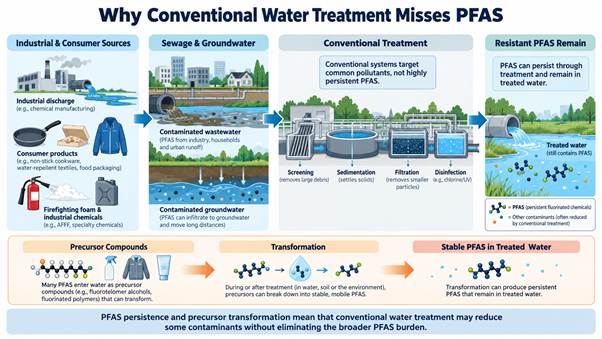
Recent research from Chennai and Visakhapatnam also suggests that conventional treatment systems may not reliably remove these compounds. In one Chennai study, concentrations of the eight PFAS being tracked were reported to be 5% to 103% higher in treated water than in raw water, possibly because unidentified precursor compounds transformed into more stable PFAS during treatment.
At the same time, India still lacks sufficiently harmonised national monitoring and a dedicated PFAS-specific limit in the existing IS 10500:2012 drinking-water standard. BIS records continue to identify IS 10500:2012 as the applicable drinking-water specification.
The policy challenge is:
Persistent contamination + incomplete detection + ineffective conventional treatment + uncertain exposure → emerging regulatory risk
PFAS Are Called ‘Forever Chemicals’ Because They Resist Degradation
PFAS are a large family of synthetic chemicals characterised by strong carbon-fluorine bonds.
They have been widely used in products requiring resistance to:
water + oil + stains + heat
Applications include coatings, textiles and various industrial materials.
Their chemical stability is also the reason for concern.
The carbon-fluorine bond is exceptionally difficult to break, allowing many PFAS compounds to persist for long periods in:
water + soil + sediments + organisms
This persistence has led to the popular description “forever chemicals.”
Conventional Treatment Plants Are Not Designed for PFAS
Most traditional drinking-water and wastewater-treatment processes are designed to remove:
suspended solids + pathogens + biodegradable organic matter + selected chemical contaminants
PFAS pose a different problem because many are highly stable and resistant to normal biological degradation.
Conventional biological wastewater treatment cannot effectively remove them.
This means:
Conventional treatment ≠ guaranteed PFAS removal
Some treatment systems may even transform precursor compounds into more stable PFAS that become easier to detect later.
Testing Only a Fixed List Can Miss the Wider Problem
PFAS comprise a very large and chemically diverse group.
If researchers test only a predefined set of compounds, substances outside that list may remain undetected.
The source distinguishes three analytical approaches:
- Targeted analysis → looks for known PFAS
- Suspect screening → searches for likely additional compounds
- Non-target analysis → attempts to identify previously unspecified chemicals
High-resolution mass spectrometry can therefore be important for detecting a broader range of fluorinated substances.
However, PFAS analysis itself is technically difficult because contamination can also be introduced during sample collection, storage or laboratory processing.
Precursors Complicate Monitoring
Some chemicals can act as PFAS precursors.
These compounds may transform into persistent terminal PFAS through environmental or treatment processes.
Therefore:
No detection of a target PFAS at one stage ≠ absence of future PFAS contamination
A regulatory system focusing only on a small list of named chemicals can miss:
precursors + transformation products + previously unidentified fluorinated compounds
This is why some researchers favour broader class-based or screening approaches rather than regulation confined exclusively to a narrow chemical list.
Pollution Sources Are Often Mixed
The Visakhapatnam study cited in the source tested 77 PFAS compounds and detected 38 in seawater and sewage.
Researchers estimated that sewage accounted for around 41% of median coastal PFAS concentrations, but separating municipal sewage from industrial sources remained difficult.
Environmental contamination often arises from:
municipal waste + industrial discharge + consumer products + landfill leachate
Where these streams mix, identifying the responsible source becomes technically and legally difficult.
Source apportionment may therefore require:
systematic sampling + chemical fingerprints + advanced analytical methods + modelling
Adsorption Can Remove PFAS but Creates New Challenges
adsorption-based treatment is a promising method for PFAS removal.
Adsorption works by attracting dissolved contaminants onto the surface of another material.
Potential approaches can include specialised sorbents, but the article stresses that low-cost materials suitable for widespread use still need development.
Treatment also raises a second problem:
removing PFAS from water does not destroy them
It transfers them into:
spent adsorbent + concentrated waste
Safe disposal or destruction is therefore necessary to avoid simply shifting contamination from one environmental medium to another.
Detecting PFAS Is Not the Same as Measuring Health Risk
The presence of PFAS in water does not by itself quantify the actual health risk.
Risk depends on:
chemical identity + concentration + exposure duration + route of exposure + biological response
This distinction can be expressed as:
- Hazard = capacity to cause harm
- Exposure = contact with the hazard
- Risk = hazard considered together with exposure
India currently lacks sufficient baseline exposure data to estimate population-level PFAS risk with confidence.
Some PFAS Have Established Health Concerns
Two well-studied compounds are:
- PFOA — perfluorooctanoic acid
- PFOS — perfluorooctanesulfonic acid
According to the cited 2025 IARC assessment, PFOA was classified as carcinogenic to humans, while PFOS was classified as possibly carcinogenic to humans.
The source also cites experimental work in zebrafish in which mixtures of multiple PFAS were associated with delayed hatching, growth effects, accumulation in blood and reduced heart rates.
However, these findings should not be treated as proof that every detected PFAS concentration in Indian water creates the same level of human health risk.
India Lacks a Dedicated PFAS Drinking-Water Limit
The existing IS 10500:2012 drinking-water specification contains limits for numerous chemical, biological and radiological contaminants, but PFAS-specific limits are not part of the current standard. BIS material confirms that IS 10500:2012 remains the drinking-water specification currently in use.
The unresolved questions include:
- Which PFAS should be regulated?
- What analytical method should be standard?
- What concentration limits should apply?
- Should regulation focus on individual chemicals or broader classes?
India Is Building a Better Baseline
India also has an ongoing institutional framework connected to the Stockholm Convention on Persistent Organic Pollutants.
A UNEP-supported project has been working with Indian institutions to review and update the country’s National Implementation Plan for persistent organic pollutants.
Growing analytical capability within Indian institutions, including the ability to test multiple classes of PFAS across environmental and consumer-product matrices.
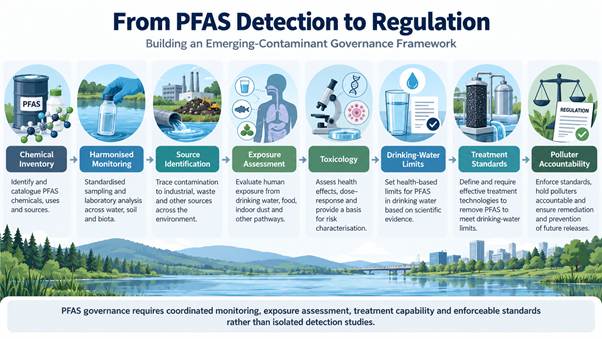
The essential first step is:
Inventory production and use → monitor environmental occurrence → assess exposure → establish standards → enforce controls
The Precautionary Principle Is Relevant
A central policy debate is whether India should wait for complete national exposure data before acting.
One view favours more monitoring before imposing broad controls because PFAS comprise many compounds with different toxicological profiles.
The alternative invokes the precautionary principle:
Where credible evidence of serious or persistent harm exists, scientific uncertainty should not automatically justify delaying preventive action.
Interim limits for well-studied PFAS could coexist with continued monitoring of less-understood compounds.
Regulation Must Also Address the Pollution Source
Drinking-water treatment is only one part of the response.
If PFAS continue entering the environment through industrial production, consumer products, sewage and waste disposal, downstream treatment becomes increasingly expensive.
The more durable hierarchy is:
Prevent unnecessary use → control industrial release → monitor waste streams → treat contaminated water → manage PFAS-containing waste
This shifts policy from solely cleaning contaminated water towards source prevention.
The Core Policy Lesson
PFAS illustrate the wider challenge of emerging contaminants.
Traditional environmental regulation often works by:
identify pollutant → set limit → treat discharge
PFAS complicate this model because there are many related compounds, some transform into others, measurement is difficult, conventional treatment may fail, and contamination can persist for years.
India therefore needs to move from isolated studies towards:
harmonised monitoring + broader analytical screening + source inventories + exposure data + precautionary limits + suitable treatment technology + enforceable accountability
The challenge is not simply to remove one chemical from drinking water, but to develop a regulatory system capable of dealing with a persistent and evolving class of contaminants.
Probable Mains Question
“PFAS contamination illustrates the limitations of conventional pollution-control systems in dealing with emerging contaminants.” Discuss the scientific, technological and regulatory challenges posed by ‘forever chemicals’ in India.
Prelims Drill
MCQ 1
With reference to PFAS, consider the following statements:
- They contain carbon-fluorine bonds that contribute to their environmental persistence.
- Conventional biological wastewater treatment can always completely degrade PFAS.
- Some PFAS precursor compounds can transform into more persistent PFAS.
Which of the statements given above are correct?
A. 1 only
B. 1 and 3 only
C. 2 and 3 only
D. 1, 2 and 3
Correct Answer: B
Explanation: Strong carbon-fluorine bonds make many PFAS highly resistant to degradation. Conventional biological treatment is generally ineffective against them, while some precursor compounds can transform into more persistent terminal PFAS.
MCQ 2
With reference to environmental risk assessment, consider the following statements:
- Detection of a hazardous chemical does not by itself establish the magnitude of human health risk.
- Risk assessment generally depends on both the intrinsic hazard and the level or duration of exposure.
- The precautionary principle can support preventive action even when some scientific uncertainty remains.
Which of the statements given above are correct?
A. 1 only
B. 1 and 2 only
C. 2 and 3 only
D. 1, 2 and 3
Correct Answer: D
Explanation: Environmental risk depends on both the hazardous properties of a substance and actual exposure. The precautionary principle allows preventive measures where credible risks of serious harm exist even if scientific evidence is not yet complete.