
Click to Cancel and Digital Consumer Rights
Easy sign-up combined with difficult cancellation can undermine consumer autonomy. Click-to-cancel rules seek parity, informed consent and stronger protection against deceptive digital design.
Click to Cancel Rules and Digital Consumer Protection
- Syllabus Mapping: GS Paper II — Consumer Protection, Regulatory Governance and Rights; GS Paper III — Digital Economy, E-Commerce and Digital Payments.
- Source & Date: The Hindu, 14 October 2026.
Why in News?
New York City’s “Click to Cancel” rule came into effect on October 1, 2026, requiring businesses offering automatic-renewal or continuous-service subscriptions to provide consumers with a simple cancellation mechanism comparable to the method used to subscribe.
The rule addresses a common digital-market problem:
Easy subscription → difficult cancellation → unwanted recurring payments
Businesses can no longer make online sign-up effortless while requiring customers to make phone calls, visit a physical location or navigate deliberately complex cancellation procedures.
For India, the issue is relevant because subscription services, free trials, recurring digital payments and app-based commerce are becoming increasingly common.
Subscription Traps Exploit Consumer Inertia
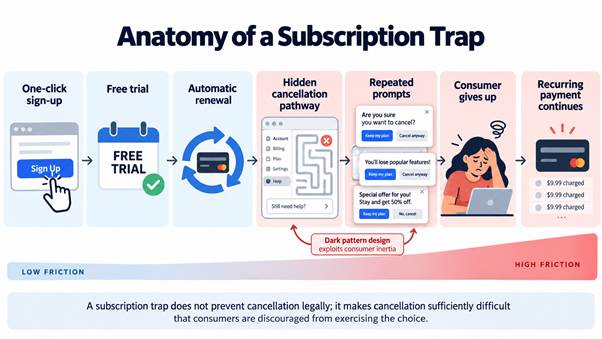
Many digital services reduce friction at the point of purchase.
A customer may subscribe to:
streaming + gym membership + grocery delivery + software + telecom + digital publications
with only a few clicks.
Cancellation, however, may involve:
- multiple menus;
- concealed cancellation buttons;
- repeated confirmation screens;
- mandatory calls or emails;
- in-person visits;
- confusing wording.
The economic model relies partly on consumer inertia — users continue paying because exiting is deliberately more difficult than entering.
Click to Cancel Creates Symmetry Between Entry and Exit
The New York City rule establishes a simple principle:
If consent is easy to give, it should also be easy to withdraw.
For an online subscription, a business cannot ordinarily require the consumer to switch to a more burdensome medium such as telephone or in-person cancellation.
The city requires a straightforward cancellation mechanism using the same method through which the consumer subscribed. It also requires clear disclosure of subscription and cancellation terms.
This can be described as:
Sign-up friction ≈ cancellation friction
The rule is enforced by New York City’s Department of Consumer and Worker Protection (DCWP), with civil penalties beginning at $525 for violations.
Dark Patterns Manipulate Consumer Choice
Subscription traps are part of the broader phenomenon of dark patterns.
A dark pattern is a user-interface or user-experience design that manipulates users into taking decisions they did not genuinely intend to take.
Examples can include:
hidden cancellation options + misleading buttons + forced action + confusing wording + automatic paid renewal
The problem is not simply inconvenient design.
It involves consumer autonomy because interface architecture is deliberately structured to influence choice.
The basic chain is:
Interface design → behavioural manipulation → unintended decision → financial gain for seller
Free Trials Can Become a Form of Behavioural Lock-In
Free trials can be legitimate marketing tools when consumers clearly understand the terms.
Problems arise when:
free trial → automatic paid subscription
occurs without sufficiently prominent information or meaningful reminders.
Consumers may continue paying because they:
- forget the renewal date;
- did not understand the conversion terms;
- cannot locate cancellation controls;
- or find cancellation disproportionately burdensome.
This is why transparency before automatic renewal is a major element of digital consumer protection.
India Already Regulates Dark Patterns
India does not currently have a universal “Click to Cancel” rule identical to New York City’s.
However, India does have a broader legal framework against manipulative digital design.
The Central Consumer Protection Authority (CCPA) issued the Guidelines for Prevention and Regulation of Dark Patterns, 2023 under the Consumer Protection Act, 2019.
The Guidelines define dark patterns as deceptive interface or user-experience practices that subvert consumer autonomy and can amount to misleading advertisements, unfair trade practices or violations of consumer rights.
Among the specified dark patterns is “subscription trap”.
Therefore, the difference is:
India → general prohibition/regulation of deceptive dark patterns
NYC → specific parity rule for subscription cancellation
RBI E-Mandate Rules Protect the Payment Layer
India also has safeguards for recurring digital payments through the RBI’s e-mandate framework.
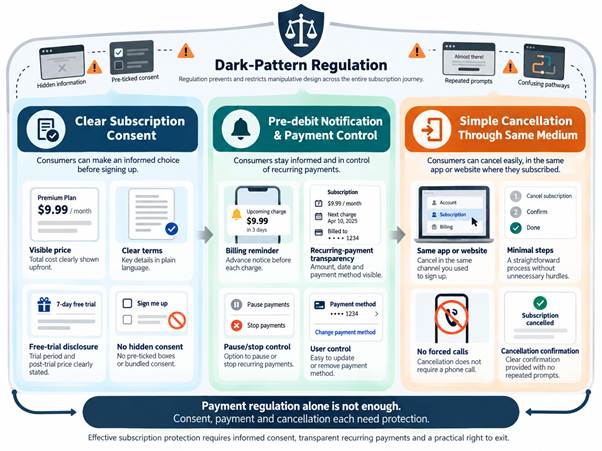
The framework requires issuers to send consumers a pre-debit notification at least 24 hours before a recurring transaction is charged.
This improves transparency by giving consumers advance notice before funds are deducted.
The protection operates primarily at the payment layer:
Upcoming debit → advance notification → consumer awareness
However, this is not identical to simplifying the merchant’s cancellation interface.
A consumer may know a debit is coming and still face a cumbersome process to terminate the underlying subscription.
Payment Protection and Cancellation Rights Are Different
This distinction is central.
RBI framework: regulates how recurring payments are authorised and notified.
Dark-pattern regulation: targets deceptive digital design.
Click-to-cancel rule: directly regulates the ease of terminating the commercial relationship.
These protections address different stages:
Consent → recurring payment → cancellation
A comprehensive consumer-protection framework needs safeguards across all three.
Consumer Vulnerability Is Unequally Distributed
Complex cancellation mechanisms impose greater burdens on:
senior citizens + minors + persons with disabilities + non-literate consumers + time-constrained workers + digitally inexperienced users
This means interface design can have distributive consequences.
A process that is merely inconvenient for a digitally sophisticated consumer may become a serious access barrier for someone with limited digital literacy.
Digital consumer protection therefore involves both:
fairness + accessibility
Choice Architecture Has Become a Regulatory Issue
Traditional consumer regulation focused heavily on whether information was technically disclosed.
Digital platforms create a newer challenge: how information and choices are presented.
Two interfaces can provide the same formal options but produce very different outcomes depending on:
- button placement;
- number of steps;
- default settings;
- visual prominence;
- wording;
- timing.
Thus:
Formal availability of choice ≠ meaningful consumer choice
Modern regulation increasingly examines the architecture through which consumers exercise decisions.
Effective Consent Must Include the Ability to Withdraw
The broader principle behind click-to-cancel is that consent should not become practically irreversible.
Digital markets often emphasise consent when a consumer purchases a service.
But genuine consumer autonomy also requires:
ability to understand + ability to refuse + ability to withdraw
Making cancellation intentionally difficult weakens the last element.
This principle has relevance well beyond subscriptions, including digital privacy, personalised advertising and platform permissions.
India Could Move Towards Cancellation Parity
India’s existing framework addresses subscription traps and recurring payments, but a clearer cancellation-parity standard could reduce ambiguity.
A possible principle would be:
Subscription through app/web → cancellation available through app/web with comparable ease
Such a framework could complement rather than replace existing consumer and payments regulation.
It would shift regulation from merely prohibiting obviously deceptive behaviour towards establishing a positive design standard for consumer exit.
The Core Policy Lesson
Digital consumer protection can no longer focus only on whether a transaction was technically authorised.
Platforms can influence consumer behaviour through friction, defaults, interface design and asymmetry between joining and leaving.
The policy evolution is:
Disclosure → informed consent → protection from dark patterns → easy withdrawal of consent
New York City’s Click to Cancel rule represents the final element by insisting that businesses should not make exit deliberately harder than entry.
India already regulates subscription traps through its dark-pattern framework and protects recurring payments through RBI e-mandate rules, but it does not yet provide the same universal same-medium, comparable-ease cancellation right.
Probable Mains Question
“Digital consumer protection must move beyond disclosure requirements to address how online interfaces manipulate choice.” Discuss with reference to dark patterns, subscription traps and the principle of easy cancellation.
Prelims Drill
MCQ 1
With reference to dark patterns in digital markets, consider the following statements:
- They can involve user-interface designs intended to manipulate consumers into choices they did not originally intend to make.
- India’s Central Consumer Protection Authority has issued guidelines for prevention and regulation of dark patterns.
- “Subscription trap” is recognised within India’s dark-pattern regulatory framework.
Which of the statements given above are correct?
A. 1 only
B. 1 and 2 only
C. 2 and 3 only
D. 1, 2 and 3
Correct Answer: D
Explanation: The CCPA’s Guidelines for Prevention and Regulation of Dark Patterns, 2023 address deceptive digital design that impairs consumer autonomy and expressly identify subscription traps among regulated dark patterns.
MCQ 2
With reference to recurring digital payments in India, consider the following statements:
- RBI’s e-mandate framework provides safeguards for recurring transactions.
- It requires a pre-debit notification to the customer at least 24 hours before the actual recurring charge.
- A pre-debit notification by itself necessarily guarantees that cancellation of the underlying subscription can be completed in a single click.
Which of the statements given above are correct?
A. 1 only
B. 1 and 2 only
C. 2 and 3 only
D. 1, 2 and 3
Correct Answer: B
Explanation: RBI’s e-mandate framework protects consumers at the recurring-payment stage and requires advance notification. It does not by itself establish a universal one-click cancellation requirement for the underlying commercial subscription.
More Current Affairs - Daily
- Keynesian vs Orthodox Economics: Why the Debate Matters for Growth, Employment and Inflation 15 Oct 2026
- Gandhi in Riot-Hit Calcutta: A Search for Peace on Independence Day 15 Oct 2026
- The Challenge of Persistent Chemicals in India's Waters 15 Oct 2026
- Rise of the Houthis and Their Iran Connection 15 Oct 2026