
National Media Council in India
The rise of digital and independent journalism has revived the question of who should recognise journalists and whether government accreditation should determine professional status.
National Media Council in India
- Syllabus Mapping: GS Paper II — Fundamental Rights, Media, Governance, Accountability and Democratic Institutions.
- Source & Date: The Hindu, 26 October 2026.
Why in News?
Recent restrictions on freelance and independent journalists covering public protests have revived a basic question: who is entitled to be recognised as a journalist?
Government accreditation systems such as PIB or State-level accreditation provide access to official events and information, but not every working journalist receives such accreditation. This creates difficulties when authorities treat accreditation as the practical test of who may report from a restricted or sensitive location.
Who Is a Journalist?
The Occupational Safety, Health and Working Conditions Code, 2020 defines a working journalist broadly as a person whose principal avocation is journalism and who works in print, electronic or digital media, subject to statutory conditions.
However, the media ecosystem has changed rapidly. Alongside employees of established organisations, there are freelancers, independent reporters, camera professionals and digital creators.
The difficulty is that professional journalism and general content creation increasingly overlap, especially in digital spaces.
Accreditation Is Not the Same as Professional Status
Government accreditation is primarily an access mechanism. It allows eligible journalists to cover certain official institutions and events.
But accreditation usually depends on organisational criteria such as circulation, subscribers, licensing or digital reach. Therefore, even journalists employed by recognised organisations may not individually receive accreditation.
Treating accreditation as the sole proof of journalistic status can therefore exclude genuine reporters simply because they fall outside a quota or institutional system.
Why a National Media Council Is Proposed
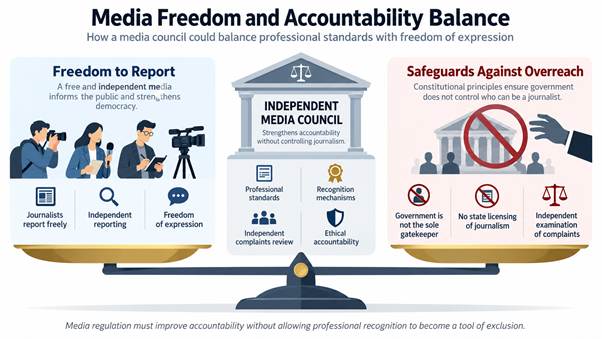
A National Media Council could provide a common mechanism for recognising journalists across print, television and digital media.
Its possible functions could include maintaining professional registers, setting ethical standards, providing identity credentials and handling complaints.
Such a system could reduce dependence on government departments for professional recognition and offer freelancers a clearer institutional route.
However, this raises a difficult constitutional question: should journalism become a licensed profession?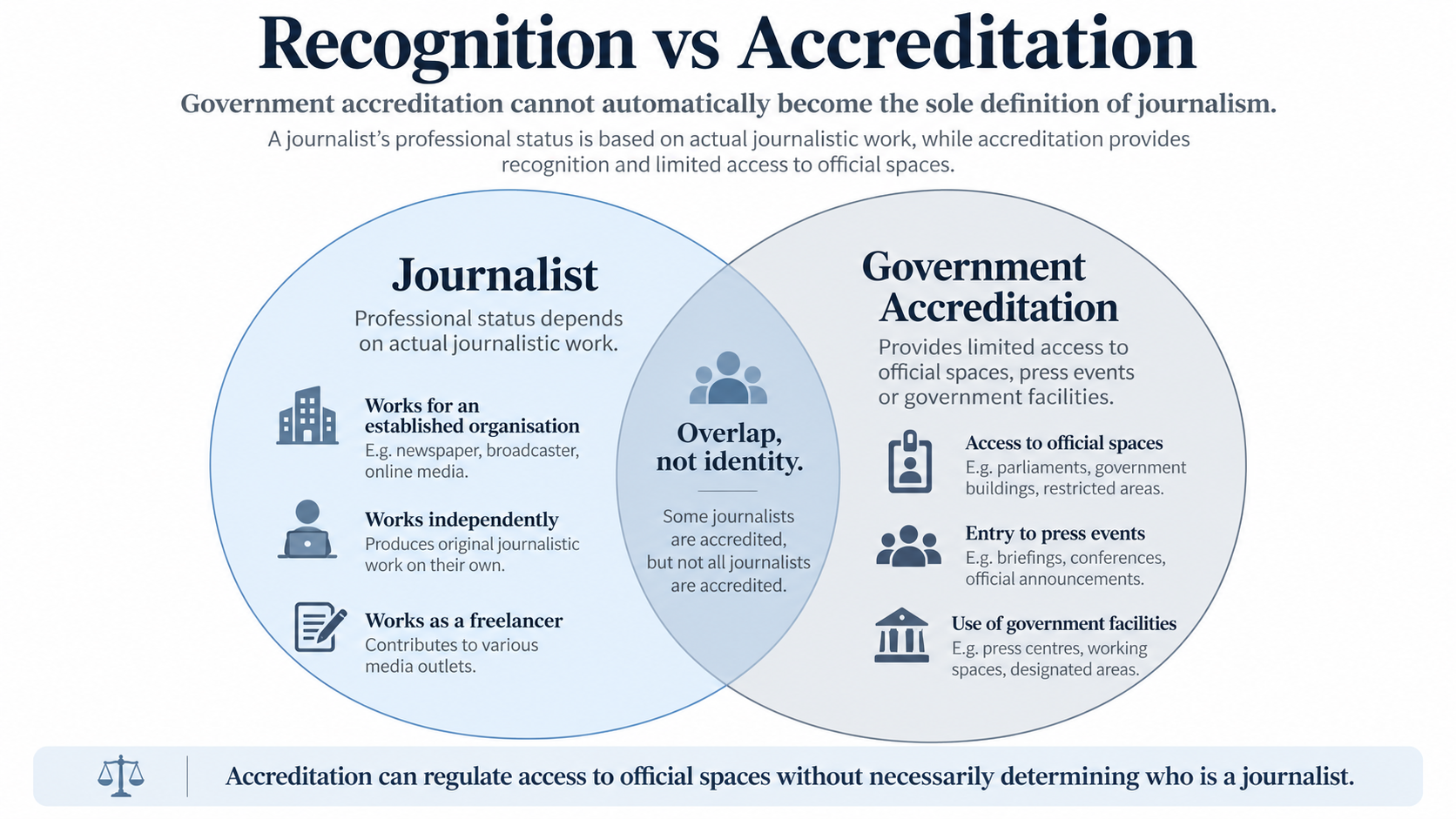
Freedom of Expression Complicates Licensing
Journalism is closely connected to Article 19(1)(a), which guarantees freedom of speech and expression.
Unlike medicine or law, public communication cannot easily be restricted only to licensed professionals. Citizens retain the right to gather information, express opinions and document public events.
A mandatory licence that determines who may report could therefore create barriers to entry and risk excessive control over the press.
The challenge is to create professional recognition without turning recognition into permission to speak.
Existing Institutions Have Limits
India already has institutions such as the Press Council of India, but its jurisdiction is centred mainly on the press and journalistic standards rather than a unified professional recognition system covering the entire contemporary media ecosystem.
Digital media, independent journalism and platform-based reporting have made the institutional landscape more fragmented.
Any new council would therefore need to avoid duplication and clearly define its relationship with existing regulatory and self-regulatory bodies.
Core Policy Lesson
The real policy problem is not simply deciding who may call themselves a journalist.
India needs to distinguish between professional recognition, access accreditation and the constitutional freedom to report and express.
A National Media Council could improve standards and provide recognition to freelancers and independent journalists, but it should be independent, transparent and designed so that accreditation or registration does not become a licence for exercising freedom of expression.
Probable Mains Question
“The regulation of journalism must distinguish between professional recognition and the constitutional freedom of expression.” Discuss the case for and concerns surrounding the creation of a National Media Council in India.
Prelims Drill
MCQ 1
Consider the following statements regarding regulation of journalism:
- Freedom of speech and expression under Article 19(1)(a) is relevant to journalistic activity.
- A professional media body can potentially set ethical standards without necessarily possessing the power to prohibit all unregistered persons from reporting.
- Converting professional recognition into mandatory permission to speak would raise constitutional concerns.
Which of the statements given above are correct?
A. 1 and 2 only
B. 2 and 3 only
C. 1 and 3 only
D. 1, 2 and 3
Correct Answer: D
Explanation: Journalism is closely connected with Article 19(1)(a). A professional body can support ethics and accountability, but making registration a precondition for exercising speech or reporting rights would raise significant constitutional questions.