Soil Health and Fertiliser Imbalance in India
India’s fertiliser-pricing structure can encourage excessive urea use and underuse of other nutrients, affecting soil fertility, groundwater, the environment and long-term farm productivity.
Soil Health and Fertiliser Imbalance in India
- Syllabus Mapping: GS Paper III — Agriculture, Farm Subsidies, Environmental Pollution and Sustainable Resource Management.
- Source & Date: The Indian Express, 26 October 2026.
Why in News?
The Union Agriculture Ministry has renewed attention on the imbalanced use of chemical fertilisers, arguing that excessive application of some nutrients is damaging soils, groundwater and air quality.
The deeper problem is economic. India's fertiliser-pricing system keeps urea relatively cheap while phosphatic and potassic fertilisers face much higher prices. This gives farmers a strong incentive to use more nitrogen even when crop and soil requirements call for a more balanced nutrient mix.
Why the N:P Balance Matters
Plants need several nutrients, but nitrogen, phosphorus and potassium are the major macronutrients supplied through fertilisers.
Nitrogen promotes vegetative growth. Phosphorus is important for roots, flowering and energy transfer, while potassium improves water regulation, disease resistance and crop quality.
When one nutrient is applied excessively while others remain deficient, the additional fertiliser does not necessarily translate into proportional yield gains. Instead, nutrient-use efficiency declines.
How Subsidy Policy Creates Distortion
The Nutrient Based Subsidy (NBS) system introduced in 2010 applies to phosphatic and potassic fertilisers, while urea continues under a separate heavily controlled pricing regime.
As prices of DAP and MOP rose much faster than urea, the relative price of nitrogen became increasingly attractive to farmers.
This produces a classic price distortion: farmers respond rationally to the prices they face, even though the resulting nutrient combination may be agronomically inefficient.
Soil Damage Extends Beyond Farms
Excess nitrogen does not remain entirely in crops.
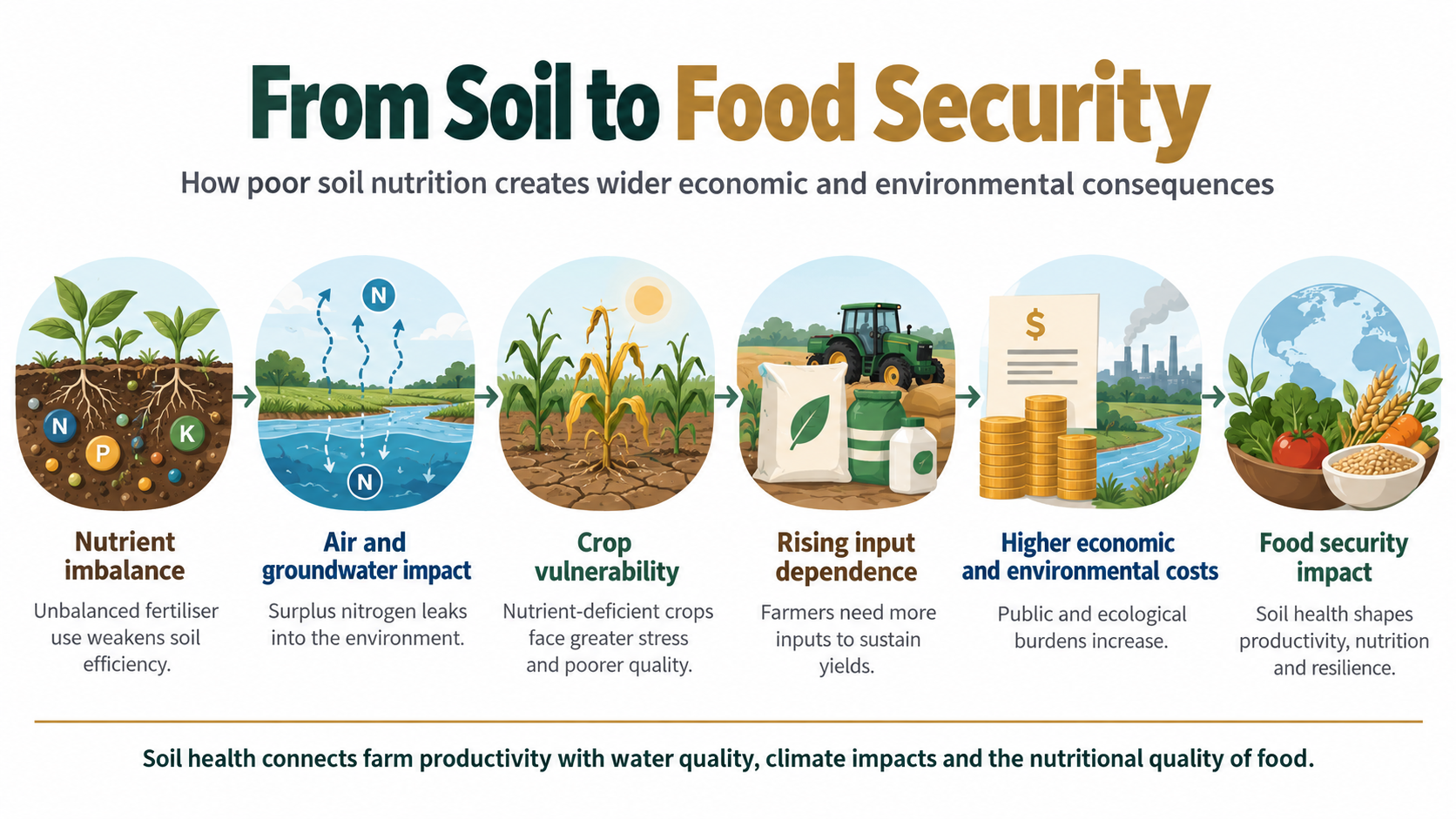
The article notes that crops may absorb only a fraction of applied nitrogen. The remainder can escape into the atmosphere, including as nitrous oxide, or move into water systems as nitrate.
Low soil organic carbon makes the problem worse because degraded soils are less capable of retaining nutrients effectively.
Nitrate contamination of groundwater creates health risks, while nitrous oxide contributes strongly to global warming.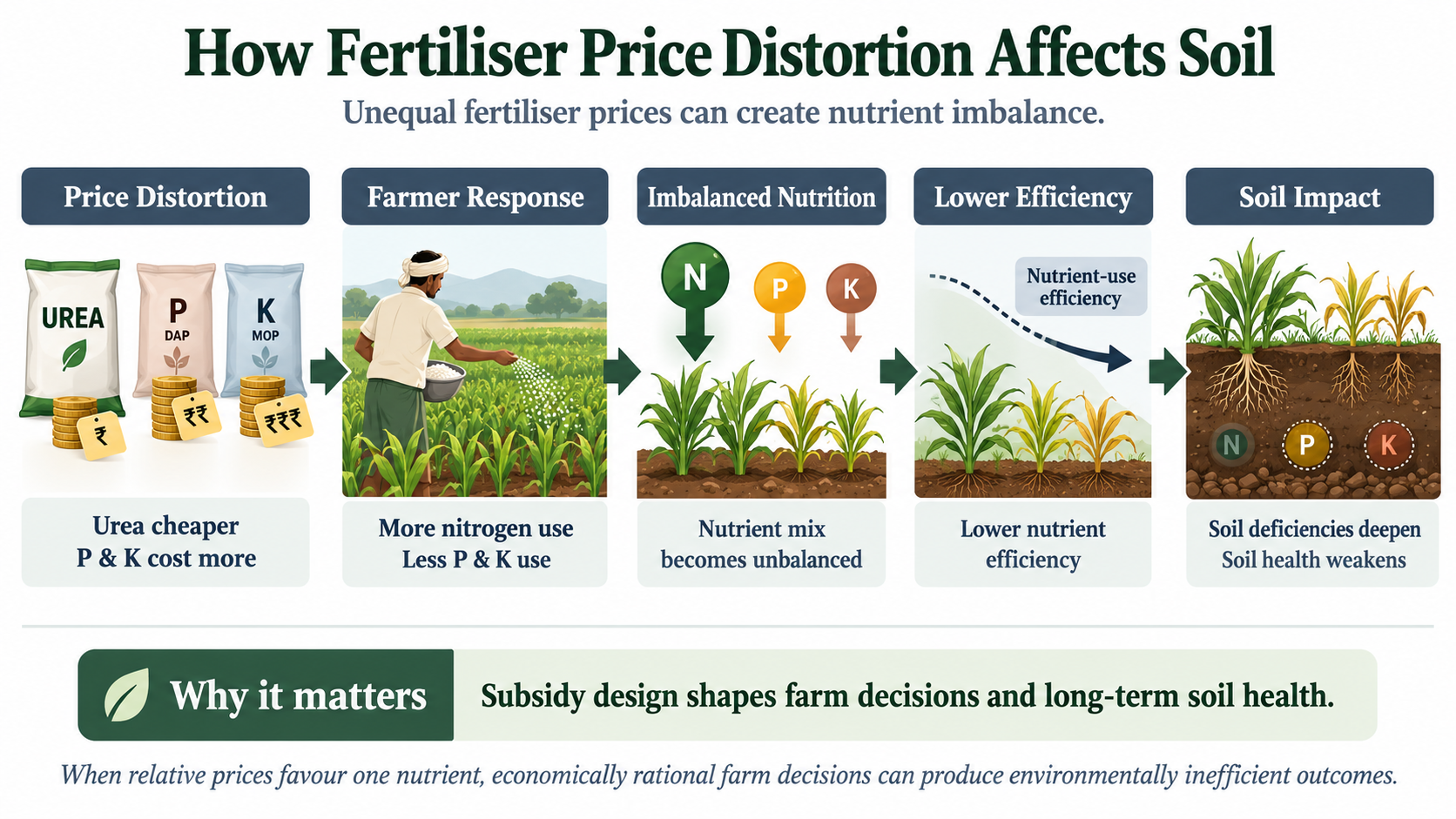
Nutrient Imbalance Can Affect Nutrition
Soil health is linked to food quality.
Deficiencies in potassium can reduce crop resistance to drought and disease, while phosphorus deficiencies can delay plant development. Deficiencies in micronutrients such as zinc may also translate into lower nutrient concentration in food crops.
Thus, soil degradation is not merely an agricultural productivity problem; it can also contribute to hidden hunger and nutritional insecurity.
Reforming Fertiliser Subsidies
One proposed reform is to shift from subsidising the price of individual fertilisers towards direct income or per-hectare support that is neutral across nutrients.
Such a system would allow farmers to see the actual relative prices of fertilisers and reduce the artificial advantage enjoyed by urea.
A more gradual option is to bring urea within a nutrient-based framework while recalibrating subsidies on phosphorus and potassium.
Better Nutrient Management
Price reform alone is insufficient.
The 4R approach promotes the right nutrient source, at the right rate, at the right time and in the right place. Soil testing can provide plot-specific recommendations instead of uniform fertiliser application.
Drip irrigation and fertigation, customised fertilisers, biofertilisers, improved formulations and crop rotations involving pulses can further improve nutrient efficiency.
Schemes such as PM-PRANAM can also encourage States to reduce excessive chemical fertiliser use if incentives are implemented effectively.
Core Policy Lesson
India's fertiliser problem is not simply about using “more” or “less” fertiliser. It is about using the right combination of nutrients efficiently.
A sustainable policy must align farmer incentives with soil requirements. This requires reforming price distortions, strengthening soil testing, improving irrigation and nutrient-delivery technology, and linking agricultural support policies with long-term resource conservation.
The true measure of success should therefore move from the quantity of fertiliser consumed to nutrient-use efficiency and soil health.
Probable Mains Question
“India’s fertiliser problem is as much a consequence of distorted economic incentives as of inappropriate farm practices.” Discuss the need for reforming fertiliser subsidies to improve soil health and agricultural sustainability.
Prelims Drill
MCQ 1
With reference to the Nutrient Based Subsidy system in India, consider the following statements:
- It was introduced to promote more balanced use of plant nutrients.
- Urea has historically remained outside the same pricing framework applied to many phosphatic and potassic fertilisers.
- A large difference in relative fertiliser prices can influence the nutrient combination chosen by farmers.
Which of the statements given above are correct?
A. 1 only
B. 1 and 2 only
C. 2 and 3 only
D. 1, 2 and 3
Correct Answer: D
Explanation: The NBS framework was intended to encourage balanced fertilisation, but urea continued under a different price-control structure. Relative prices strongly influence farmers' fertiliser choices.
MCQ 2
Consider the following statements regarding nutrient management:
- The 4R approach refers to applying the right nutrient source, at the right rate, at the right time and in the right place.
- Excessive nitrogen application necessarily implies that soil nitrogen availability will remain high.
- Crop rotation with legumes can reduce the nitrogen requirement of subsequent crops.
Which of the statements given above are correct?
A. 1 only
B. 1 and 3 only
C. 2 and 3 only
D. 1, 2 and 3
Correct Answer: B
Explanation: Excess application does not guarantee efficient nutrient availability because nitrogen may be lost through leaching, volatilisation and other pathways. Leguminous crops can improve nitrogen availability through biological nitrogen fixation.