
Maharashtra Drought 2026: Trigger-1, Relief Measures and Farm Compensation
Maharashtra has activated Trigger-1 drought measures in 265 talukas following deficient and uneven monsoon rainfall, triggering automatic relief while crop-loss compensation will follow field surveys.
Maharashtra Drought 2026: Trigger-1, Relief Measures and Farm Compensation
- Syllabus Mapping: GS Paper II — Governance, Welfare Delivery and Centre-State/State Administration; GS Paper III — Agriculture, Disaster Management, Water Resources and Climate Resilience.
- Source & Date: The Hindu, 29 September 2026, supplemented by Maharashtra government drought-assessment material and recent official reporting.
Why Has Maharashtra Declared Drought?
Maharashtra has declared drought conditions in 265 of its 358 talukas, covering nearly three-fourths of the State, after deficient and uneven rainfall during the 2026 kharif season. The State received about 798.2 mm of rainfall against a normal 970.9 mm between June 1 and September 26, implying an overall deficit of around 18%.
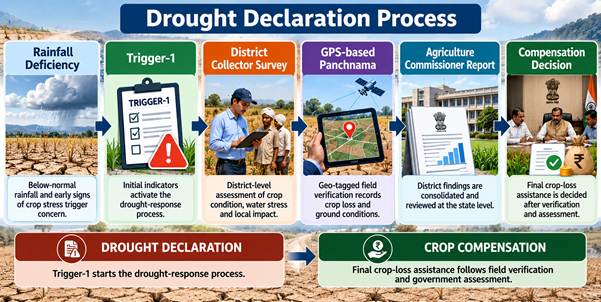
The declaration followed a report from the Agriculture Commissioner and activation of Trigger-1 under the State’s drought-assessment framework. Official reporting confirms that District Collectors have been directed to begin crop-loss surveys immediately in the affected talukas.
The administrative sequence can be understood as:
Rainfall deficiency → Trigger-1 → field assessment → panchnama → government report → crop-loss assistance
What Is Trigger-1?
Trigger-1 is the first formal drought-alert stage used to identify talukas requiring deeper assessment. Rainfall deficiency and prolonged dry spells are among the relevant indicators, including situations where a monsoon dry spell extends for at least 21 days.
Maharashtra’s drought-assessment framework also monitors agricultural, vegetation, soil-moisture and hydrological indicators rather than depending only on total seasonal rainfall. Official State assessment formats include indicators such as crop sowing, vegetation condition, soil-moisture adequacy and groundwater stress.
This is important because:
Low rainfall ≠ complete drought assessment
A credible drought declaration should combine rainfall data with evidence of crop, soil, groundwater and livelihood stress.
Why Is Regional Variation Important?
The rainfall deficit is not uniform across Maharashtra. Marathwada and Vidarbha have experienced particularly severe shortfalls, while even the normally wetter Konkan belt has recorded below-normal rainfall in several districts.
This highlights a broader climate-management problem: annual rainfall totals alone can conceal the agricultural impact of long dry spells, poor temporal distribution and crop-stage stress.
For agriculture, the timing of rainfall can be as important as the total amount received.
What Relief Becomes Available Immediately?
The State has activated a 12-point relief package for drought-affected areas. These measures include land-revenue relief, restructuring or deferment of agricultural loan recovery, electricity-related concessions for irrigation pumps, examination-fee waivers for students, drinking-water tankers, fodder support and expanded Employment Guarantee Scheme works.
Other measures include protection against disconnection of agricultural pump electricity in scarcity-hit villages, targeted foodgrain support, water-conservation works and planning for drinking water for both people and livestock.
The relief framework therefore covers three immediate dimensions:
Income and debt relief + water and fodder security + employment and social support
Why Is Crop Compensation Separate?
The drought declaration does not automatically determine the amount of crop-loss compensation.
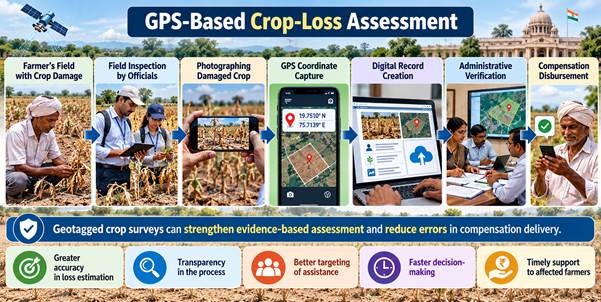
District officials first conduct panchnamas, or field assessments, recording crop damage through photographs, GPS coordinates and other evidence. These reports are then forwarded through the Agriculture Commissioner for a final government decision on compensation.
This distinction is important:
Drought notification = eligibility for general concessions
Panchnama = evidence for crop-specific financial assistance
Why Water Management Is Central to Drought Governance
Agricultural drought can quickly evolve into a wider rural crisis affecting drinking water, livestock, groundwater and the following rabi season.
The State has therefore prioritised drinking water before irrigation, tanker supply where required, fodder availability and water-conservation works.
This reflects the correct drought-management hierarchy:
Drinking water → livestock survival → livelihood protection → irrigation planning
The larger objective should be to move from emergency tanker-based relief towards long-term resilience through watershed development, groundwater recharge, micro-irrigation, crop diversification and reservoir planning.
Why This Is a Governance Issue, Not Only a Weather Event
Drought management requires coordination across the Revenue Department, Agriculture Department, Water Resources Department, district administration, local bodies and welfare-delivery systems.
The effectiveness of relief depends on how quickly the State can convert climatic information into verified local assessments and then into targeted benefits.
The governance chain is:
Early warning → objective assessment → transparent survey → automatic relief → timely compensation → long-term resilience
The Core Policy Lesson
The Maharashtra drought shows that modern drought governance should not be limited to declaring scarcity after crop failure.
A resilient system must combine real-time rainfall monitoring, soil and groundwater indicators, geotagged crop surveys, social protection, debt relief, water planning and climate-resilient agriculture.
The central principle is that:
Drought management should move from reactive compensation towards anticipatory risk management.
Probable Mains Question
“Drought management in India must move from post-disaster compensation towards anticipatory, data-driven and livelihood-centred risk management.” Discuss with reference to Maharashtra’s 2026 drought response.
Prelims Drill
MCQ 1
With reference to drought assessment in Maharashtra, consider the following statements:
- Trigger-1 initiates the process of deeper drought assessment and relief administration.
- Rainfall deficiency is the only indicator used for final drought assessment.
- Crop, vegetation, soil-moisture and hydrological indicators can also form part of drought assessment.
Which of the statements given above are correct?
A. 1 only
B. 1 and 3 only
C. 2 and 3 only
D. 1, 2 and 3
Correct Answer: B
Explanation: Trigger-1 initiates further assessment, while Maharashtra’s drought framework considers multiple indicators rather than rainfall deficiency alone.
MCQ 2
With reference to crop-loss assessment during drought, consider the following statements:
- Panchnamas are field assessments used to document crop conditions.
- GPS coordinates and photographs can be used in crop-loss verification.
- Declaration of drought automatically fixes the final crop-compensation amount for every farmer.
Which of the statements given above are correct?
A. 1 only
B. 1 and 2 only
C. 2 and 3 only
D. 1, 2 and 3
Correct Answer: B
Explanation: Panchnamas document crop losses using field evidence, including geotagged photographs, while the final amount of crop-loss assistance is determined separately after assessment.
More Current Affairs - Daily
- Election Commission of India: Constitutional Design and Evolution into a Three-Member Body 12 Oct 2026
- Loknayak Jayaprakash Narayan: Total Revolution and Contribution to Democracy 12 Oct 2026
- India’s Russia-Ukraine Initiative: From Black Sea Security to Strategic Autonomy 12 Oct 2026
- Jayaprakash Narayan: Architect of Total Revolution and Defender of Democracy 12 Oct 2026