
Current Affairs - Daily
23 November 2026
Lonar Lake Impact Crater Joins IUGS Geological Heritage List
Why In News?
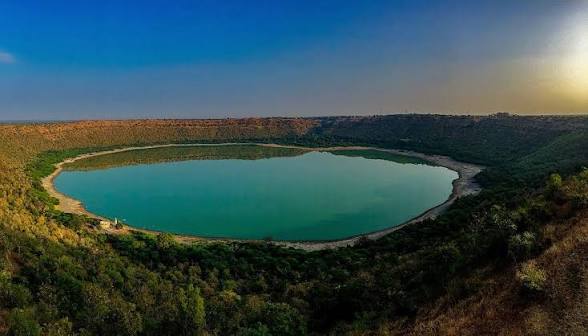
- On November 2026, India’s Ministry of Mines confirmed that the International Union of Geological Sciences (IUGS) had included the Lonar Lake impact crater in Maharashtra’s Buldhana district in its list of Geological Heritage Sites. The “Third 100” is the third group of 100 sites recognised for their geological significance.
- Lonar is the second Indian site to receive this recognition. Mawmluh Cave in Meghalaya was included in the first group in 2022.
How Did a Lake Form in Volcanic Rock?
- Two geological events explain Lonar’s formation. About 65 million years ago, successive lava flows formed the basalt layers of the Deccan Traps. Much later, a meteorite struck the basalt, creating a bowl-shaped depression called an impact crater. Water eventually collected in the depression and formed the lake.
- The crater measures approximately 1.88 kilometres across, from rim to rim. The lake’s water surface is narrower. The crater’s preservation in basalt allows scientists to study how a high-energy impact reshapes a rocky surface.
What Makes Lonar Lake’s Water Distinctive?
- Lonar lies in a closed drainage basin. Rainfall, surface runoff and springs supply the lake with water, but it has no surface outlet. As water evaporates, dissolved salts remain in the lake, which can increase their concentration.
- Salinity refers to the amount of dissolved salts in water, while a pH above seven indicates alkaline conditions. Lonar Lake’s water is both saline and alkaline and supports microorganisms adapted to these conditions. Its sediments also preserve evidence of past monsoons and prolonged dry periods.
Why Did Lonar Receive Ramsar and IUGS Recognition?
- On 22 July 2020, Lonar Lake was designated a Ramsar Site, recognising its ecological importance as a wetland of international importance. The designated site covers 427 hectares.
- The 2026 IUGS recognition highlights the scientific value of the impact crater preserved in basalt. It provides a natural setting for studying how meteorite impacts create landforms.
Practice Question
Question - With reference to Lonar Lake, consider the following statements.
- Its crater formed when a meteorite struck the basalt rocks of the Deccan Traps.
- A permanent surface stream flows out of the lake and carries away dissolved salts.
- Lonar Lake received its Ramsar designation before its impact crater was included in the IUGS list of Geological Heritage Sites.
Which of the statements given above are correct?
(A) 1 and 2 only (B) 1 and 3 only (C) 2 and 3 only (D) 1, 2 and 3
Answer - (B)
Explanation: A meteorite impact formed the crater in the basalt of the Deccan Traps. Statement 2 is incorrect because Lonar Lake occupies a closed drainage basin and has no permanent surface outlet. Its Ramsar designation in 2020 preceded its IUGS recognition in 2026.