
Legislative Privileges vs Free Speech: The Constitutional Conflict Remains Open
The Supreme Court closed the seven-judge reference arising from the 2003 Tamil Nadu Assembly privilege dispute as infructuous, while leaving the larger constitutional questions on legislative privilege and fundamental rights open.
Legislative Privileges vs Free Speech: The Constitutional Conflict Remains Open
- Syllabus Mapping: GS Paper II — Parliament and State Legislatures, Fundamental Rights, Judiciary, Constitutional Interpretation and Judicial Review.
- Source & Date: The Indian Express, 6 October 2026, updated with the Supreme Court’s disposal of the seven-judge reference on the same day.
Why Is the Issue in Focus?
The dispute arose from the 2003 Tamil Nadu Assembly action against journalists of The Hindu and Murasoli over reports and an editorial critical of the State government. The Assembly found them guilty of breach of privilege and ordered imprisonment, after which the Supreme Court stayed the arrests. The matter was eventually referred to a seven-judge Bench to examine the relationship between legislative privileges and fundamental rights.
On October 6, 2026, however, the Supreme Court closed the reference because the impugned Assembly resolution had been withdrawn in 2004. The Court therefore did not settle the substantive constitutional conflict, leaving the questions of law open.
The core tension remains:
Legislative autonomy ↔ free speech and press freedom ↔ personal liberty ↔ judicial review
What Are Legislative Privileges?
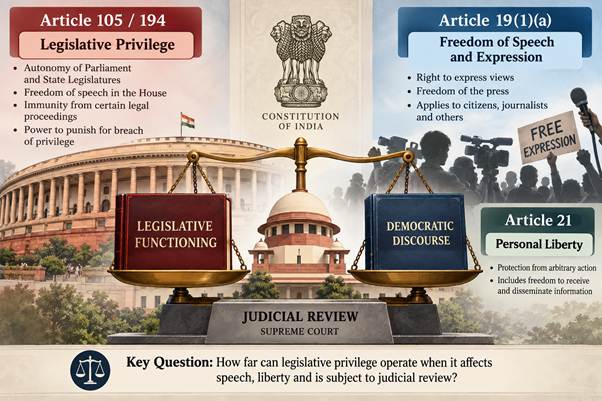
Article 105 deals with the powers, privileges and immunities of Parliament and its members, while Article 194 contains parallel provisions for State Legislatures.
Privileges exist to ensure that legislatures can perform their constitutional functions without obstruction or intimidation.
They include protections relating to speech within the House and certain collective powers necessary for legislative functioning.
The key principle is:
Privilege exists to protect legislative functioning, not as an unlimited personal immunity.
Why Does Article 19(1)(a) Come Into Conflict?
Article 19(1)(a) guarantees citizens freedom of speech and expression, from which press freedom has also been judicially derived.
Conflict arises when a legislature treats external reporting, criticism or publication as contempt or breach of privilege.
The constitutional question is therefore whether a House can punish such expression even when it would otherwise fall within Article 19 protection.
What Did the Searchlight Case Hold?
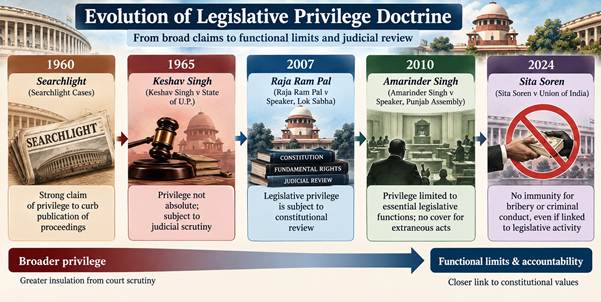
In Pandit M.S.M. Sharma v. Sri Krishna Sinha (1959), commonly called the Searchlight case, the Supreme Court dealt with publication of Assembly proceedings that the House had prohibited.
The majority treated Article 194(3) as a special constitutional provision and held, in that context, that Article 19(1)(a) could not defeat the legislative privilege claimed by the Assembly.
This judgment was later read cautiously rather than as establishing a universal rule that privileges always override Fundamental Rights.
What Changed in the Keshav Singh Case?
In the Special Reference No. 1 of 1964, or Keshav Singh case, the Uttar Pradesh Assembly ordered the imprisonment of a citizen and later sought action against judges and a lawyer connected with his release.
The Supreme Court held that constitutional courts could examine the legality of detention arising from privilege proceedings and rejected the idea that legislative privilege automatically overrides every Fundamental Right.
This marked an important shift toward constitutional supremacy and judicial review.
The evolution can be understood as:
Legislative privilege → not absolute → subject to constitutional structure → reviewable by courts
How Has the Doctrine Evolved Further?
Later judgments narrowed the idea of unchecked legislative privilege.
In Raja Ram Pal v. Speaker, Lok Sabha (2007), arising from the cash-for-query episode, the Supreme Court upheld Parliament’s power to expel members but also held that the exercise of privilege is subject to judicial review.
In Amarinder Singh v. Punjab Vidhan Sabha (2010), the Court quashed an expulsion because the conduct punished was not sufficiently connected to the functioning of the House.
In Sita Soren v. Union of India (2024), a seven-judge Bench rejected immunity for legislators accused of bribery connected with votes or speeches, emphasising that privilege is functional in character and must be tied to legislative functioning.
Constitutional Supremacy vs Parliamentary Sovereignty
India does not follow the British model of unlimited parliamentary sovereignty.
Parliament and State Legislatures derive their powers from the Constitution and remain subject to constitutional limitations, including Fundamental Rights, federal distribution of powers and judicial review.
Therefore:
British model → parliamentary sovereignty
Indian model → constitutional supremacy
This distinction is central to debates over privileges that affect citizens outside the House.
Can Privileges Be Used Against Non-Members?
Legislatures may possess powers to deal with contempt or obstruction affecting their functioning, including conduct by non-members.
However, the unresolved issue is how far such powers can extend when used against journalists, citizens or other outsiders for criticism or publication.
The modern constitutional approach increasingly asks whether the conduct has a sufficiently direct relationship with the functioning, dignity or independence of the House.
Why Are Articles 14 and 21 Also Relevant?
Privilege proceedings can sometimes lead to coercive action such as arrest or imprisonment.
This brings Article 21, protecting life and personal liberty, and Article 14, guarding against arbitrary State action, into the discussion.
Where liberty is affected, the larger constitutional question becomes:
Privilege power + deprivation of liberty → requirement of legality, fairness and judicial scrutiny
Why Is Judicial Review Important?
Legislative privilege protects the autonomy of the House, but judicial review protects the supremacy of the Constitution.
The courts generally do not supervise ordinary internal legislative proceedings, yet precedent establishes that privilege cannot be wholly insulated where constitutional limits are alleged to have been crossed.
The Core Constitutional Lesson
Legislative privileges are necessary because a legislature that cannot function independently cannot perform its democratic role.
But privilege cannot be understood simply as a shield against criticism.
The enduring constitutional test is increasingly:
Does the claimed privilege genuinely protect legislative functioning, and is its exercise consistent with the broader constitutional order?
The October 2026 disposal means the Supreme Court has not yet given a definitive seven-judge ruling on the direct conflict between Article 194(3) and Article 19(1)(a). That question remains open for a future case.
Probable Mains Question
“Legislative privileges are intended to secure the independent functioning of legislatures, not to place them outside the Constitution.” Discuss with reference to Fundamental Rights and judicial review in India.
Prelims Drill
MCQ 1
With reference to legislative privileges under the Constitution of India, consider the following statements:
- Article 105 deals with the privileges of Parliament and its members.
- Article 194 contains corresponding provisions for State Legislatures.
- Legislative privileges are entirely beyond judicial review because they concern internal proceedings of the House.
Which of the statements given above are correct?
A. 1 only
B. 1 and 2 only
C. 2 and 3 only
D. 1, 2 and 3
Correct Answer: B
Explanation: Articles 105 and 194 deal with legislative privileges at the Union and State levels respectively. Supreme Court decisions such as Raja Ram Pal establish that the exercise of privilege is not completely immune from judicial review.
MCQ 2
With reference to the constitutional position of Parliament in India, consider the following statements:
- India follows the principle of constitutional supremacy rather than unlimited parliamentary sovereignty.
- Parliament’s powers are subject to Fundamental Rights and judicial review.
- Legislative privilege can operate only when expressly codified by Parliament through an ordinary law.
Which of the statements given above are correct?
A. 1 only
B. 1 and 2 only
C. 2 and 3 only
D. 1, 2 and 3
Correct Answer: B
Explanation: Indian legislatures function within a written Constitution and are subject to constitutional limitations and judicial review. Legislative privileges do not depend exclusively on ordinary statutory codification, as Articles 105 and 194 themselves provide the constitutional foundation.
More Current Affairs - Daily
- Election Commission of India: Constitutional Design and Evolution into a Three-Member Body 12 Oct 2026
- Loknayak Jayaprakash Narayan: Total Revolution and Contribution to Democracy 12 Oct 2026
- India’s Russia-Ukraine Initiative: From Black Sea Security to Strategic Autonomy 12 Oct 2026
- Jayaprakash Narayan: Architect of Total Revolution and Defender of Democracy 12 Oct 2026