
Legal Infrastructure for Innovation: Why Responsive Courts Matter
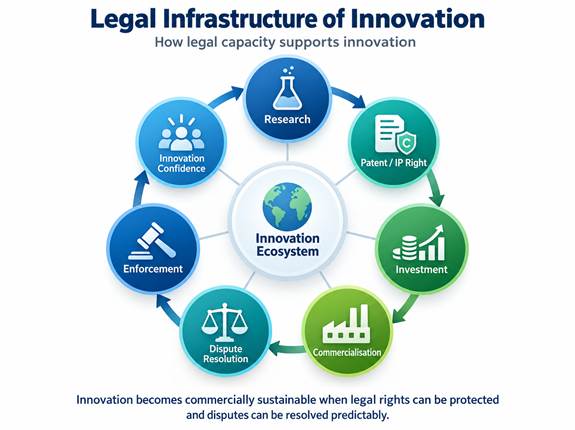
Innovation depends not only on research, capital and technology but also on a legal system capable of protecting intellectual property and resolving complex commercial disputes predictably and efficiently.
Legal Infrastructure for Innovation
Syllabus Mapping: GS Paper II — Judiciary, Legal and Institutional Reforms, Ease of Doing Business; GS Paper III — Intellectual Property Rights, Innovation, Investment, Technology and Industrial Growth.
Source & Date: The Indian Express, 30 September 2026, supplemented by the Commercial Courts Act, 2015 and Delhi High Court Intellectual Property Rights Division Rules, 2022.
Innovation Need a Strong Legal System
An innovation ecosystem requires more than laboratories, research funding and venture capital because innovators and investors must also have confidence that contracts, patents, trademarks and other commercial rights can be enforced within a predictable period.
India’s intellectual-property framework expanded significantly after reforms undertaken to meet WTO-TRIPS obligations, including the 2005 patent-law changes that restored product-patent protection in areas such as pharmaceuticals and chemicals.
At the same time, Indian law retains public-interest safeguards such as compulsory licensing and restrictions against patent evergreening, showing that innovation policy involves balancing private incentives with wider social interests.
The institutional relationship can be understood as:
Innovation → intellectual property → investment → commercial dispute → timely adjudication → investor confidence → further innovation
Commercial Dispute Resolution Become More Important
Economic liberalisation, technology-intensive industries and increasingly complex commercial transactions increased both the volume and sophistication of business disputes in India.
Delayed adjudication creates economic costs because patents may expire, technologies may become obsolete, investments may remain blocked and contractual uncertainty may increase.
A responsive legal system therefore has two objectives: quality of adjudication + speed of resolution.
India has mainly pursued this through Alternative Dispute Resolution and specialised commercial courts.
Role of ADR
Arbitration and mediation can provide specialised and relatively flexible mechanisms for resolving commercial disputes without requiring every disagreement to move through a conventional civil trial.
Their broader policy objective is:
Specialised dispute resolution → faster settlement → reduced court burden → greater commercial certainty
However, ADR works best when courts themselves efficiently support arbitration agreements, interim relief and enforcement of awards.
Thus, ADR and judicial reform are complementary rather than competing approaches.
Commercial Courts Act, 2015
The Commercial Courts Act, 2015 created Commercial Courts, Commercial Divisions and Commercial Appellate Divisions for disputes of specified value and introduced specialised procedures for commercial litigation.
The larger objective was to make commercial adjudication more predictable and efficient by adapting ordinary civil procedure to the requirements of complex business disputes.
This reflects an important governance principle:
Specialised economic activity often requires specialised adjudicatory capacity.
Delhi High Court Reference
The Delhi High Court has developed substantial experience in complex patent, pharmaceutical, copyright, trademark and technology disputes.
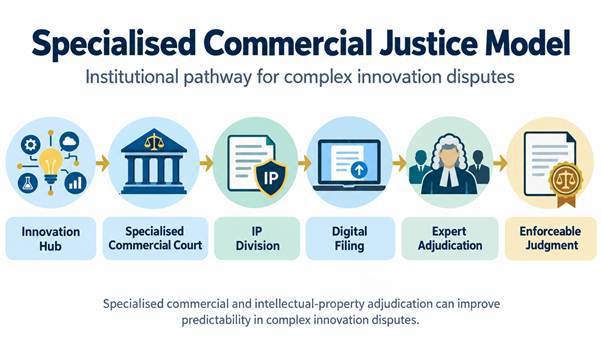
Following the restructuring of the former Intellectual Property Appellate Board framework, the Delhi High Court created a dedicated Intellectual Property Division, with its specialised rules notified in 2022. The IP Division handles original, appellate and other proceedings relating to multiple intellectual-property statutes.
Its framework combines specialised benches, procedural rules and increasingly digital court processes, making it an important institutional model for innovation-intensive commercial centres.
Can the Model Be Replicated?
Replication requires more than merely creating a new court or division.
Effective commercial justice requires trained judges, specialised court staff, digital infrastructure, strong case management, technically competent lawyers and adequate judicial capacity.
Innovation hubs in pharmaceuticals, biotechnology, semiconductors, software and advanced manufacturing may particularly benefit from courts capable of understanding technically complex disputes.
The model should therefore be:
Economic cluster + specialised judicial capacity + digital infrastructure + procedural efficiency
Balancing IP Protection and Public Interest
Stronger enforcement does not mean that intellectual-property rights should become absolute.
Indian patent law operates within a framework that also recognises public health, competition, access to technology and safeguards against abuse of monopoly rights.
A credible legal system must therefore protect genuine innovation while retaining lawful mechanisms to prevent excessive private control from undermining wider public interests.
The Core Policy Lesson
Courts should be viewed as part of India’s economic infrastructure in the same way that logistics, digital networks, finance and skilled labour are viewed as enablers of investment.
For India’s innovation ambitions, the relevant chain is:
R&D capacity + capital + IP framework + responsive courts + enforceable contracts = stronger innovation ecosystem
The challenge is not merely to enact sophisticated commercial laws but to ensure that institutions can apply them with speed, expertise, consistency and credibility.
Probable Mains Question
“A responsive legal system is an essential component of a national innovation ecosystem.” Discuss with reference to commercial courts, intellectual-property adjudication and Alternative Dispute Resolution in India.
Prelims Drill
MCQ 1
With reference to the Commercial Courts Act, 2015, consider the following statements:
It provides for specialised adjudication of commercial disputes of specified value.
It provides for Commercial Divisions and Commercial Appellate Divisions in High Courts.
Its objective is limited exclusively to disputes involving intellectual-property rights.
Which of the statements given above are correct?
A. 1 only
B. 1 and 2 only
C. 2 and 3 only
D. 1, 2 and 3
Correct Answer: B
Explanation: The Commercial Courts Act covers a wider category of commercial disputes and is not restricted to intellectual-property litigation.
MCQ 2
With reference to the Delhi High Court Intellectual Property Division, consider the following statements:
The Delhi High Court has framed specialised Intellectual Property Rights Division Rules.
The IP Division deals only with patent disputes and cannot hear matters involving trademarks or copyrights.
Specialised judicial procedures can support faster and more technically informed commercial adjudication.
Which of the statements given above are correct?
A. 1 only
B. 1 and 3 only
C. 2 and 3 only
D. 1, 2 and 3
Correct Answer: B
Explanation: The Delhi High Court IP Division framework covers several intellectual-property statutes, including patents, trademarks, copyright, designs, geographical indications and related matters.
More Current Affairs - Daily
- Election Commission of India: Constitutional Design and Evolution into a Three-Member Body 12 Oct 2026
- Loknayak Jayaprakash Narayan: Total Revolution and Contribution to Democracy 12 Oct 2026
- India’s Russia-Ukraine Initiative: From Black Sea Security to Strategic Autonomy 12 Oct 2026
- Jayaprakash Narayan: Architect of Total Revolution and Defender of Democracy 12 Oct 2026