
Sentencing and the Need for a Sentencing Council
India lacks a comprehensive sentencing framework, which can produce wide disparities in punishment. A Sentencing Council could structure judicial discretion without eliminating judicial independence.
Sentencing and the Need for a Sentencing Council
- Syllabus Mapping: GS Paper II — Judiciary, Criminal Justice Reform, Fundamental Rights and Governance.
- Source & Date: The Indian Express, 23 October 2026.
Why in News?
India’s criminal-justice system gives judges wide discretion while deciding the exact punishment after conviction. Statutes generally prescribe maximum and, in some cases, minimum sentences, but there is no comprehensive national framework explaining how courts should consistently weigh harm, culpability, aggravating factors, mitigation, rehabilitation and alternatives to imprisonment.
The Supreme Court has previously warned that sentencing should not become a “lottery” and has asked the Union government to examine the feasibility of a national sentencing policy.
What is Sentencing?
Sentencing is the stage where a court converts a statutory punishment range into a specific penalty.
For example, if the law permits imprisonment “up to ten years”, the judge must decide the actual term after considering the facts of the offence and circumstances of the offender. The court may also consider fines, probation and other lawful alternatives.
The difficulty arises when similar cases receive sharply different punishments because different judges attach different importance to the same factors.
Why Unguided Discretion Is a Problem
Judicial discretion is necessary because no two cases are completely identical. But discretion without clear principles can create arbitrariness and disparity.
Research on sentencing has shown that courts have sometimes relied on irrelevant considerations while giving insufficient weight to factors such as psychological harm, abuse of trust or vulnerability of the victim.
This has constitutional implications because Article 14 protects equality before law, while Article 21 requires any deprivation of liberty to follow fair, just and reasonable procedure.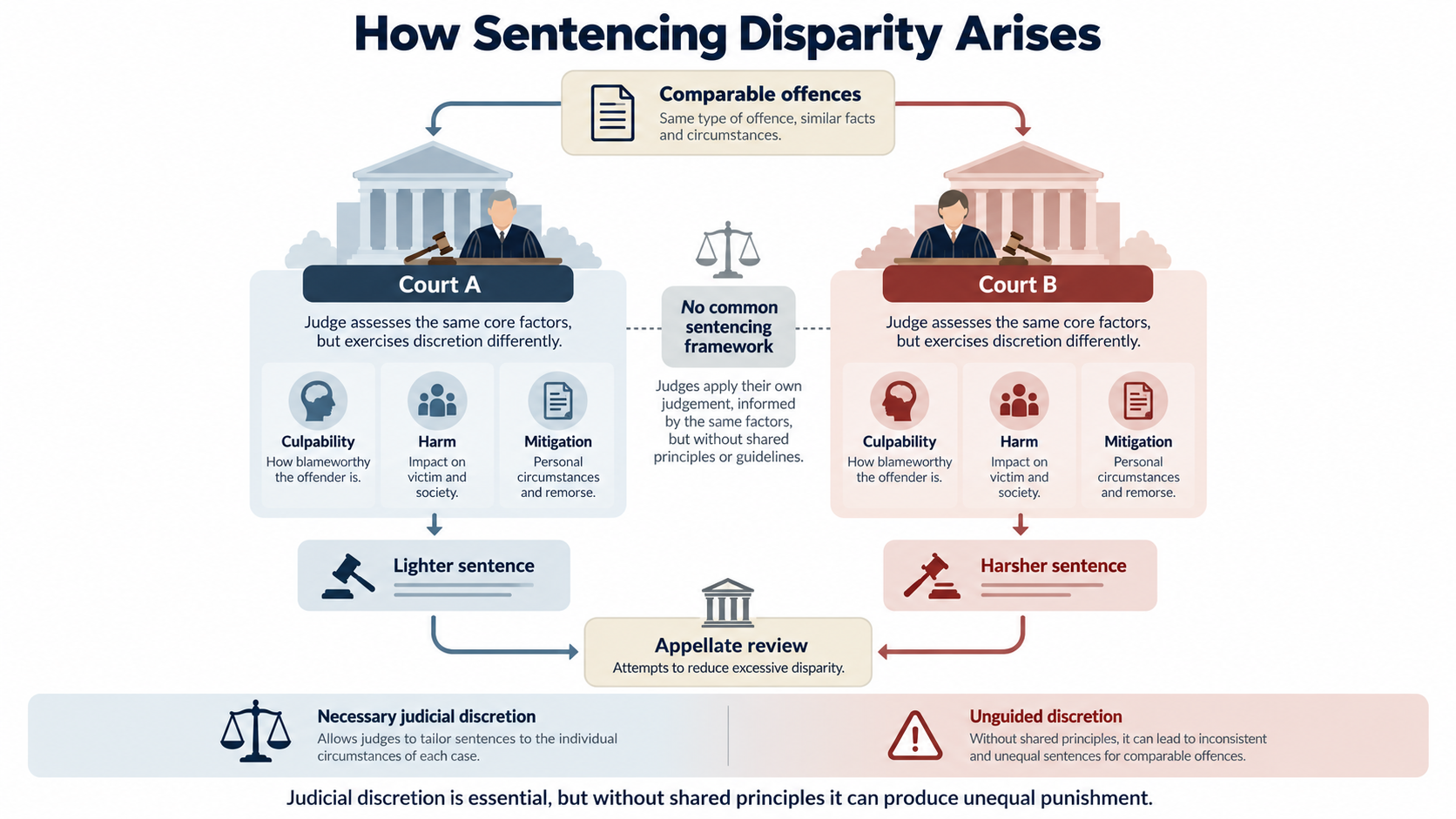
Alternatives to Prison Are Underused
Indian law already provides alternatives to incarceration.
The Probation of Offenders Act, 1958 permits courts in eligible cases to release offenders on probation rather than send them immediately to prison. The BNSS also contains provisions relevant to sentencing and post-conviction relief.
However, India lacks a general framework explaining when rehabilitation, deterrence, public protection or reformation should receive greater weight.
As a result, imprisonment may be used even where a structured assessment could support a non-custodial alternative.
What a Sentencing Council Could Do
A statutory Sentencing Council could develop offence-specific guidelines.
Courts could first assess the seriousness of the crime through culpability and harm. They could then identify an indicative starting point and sentencing range before adjusting the sentence for recognised aggravating or mitigating circumstances.
The objective would not be identical punishment in every case. It would be uniform principles for exercising discretion.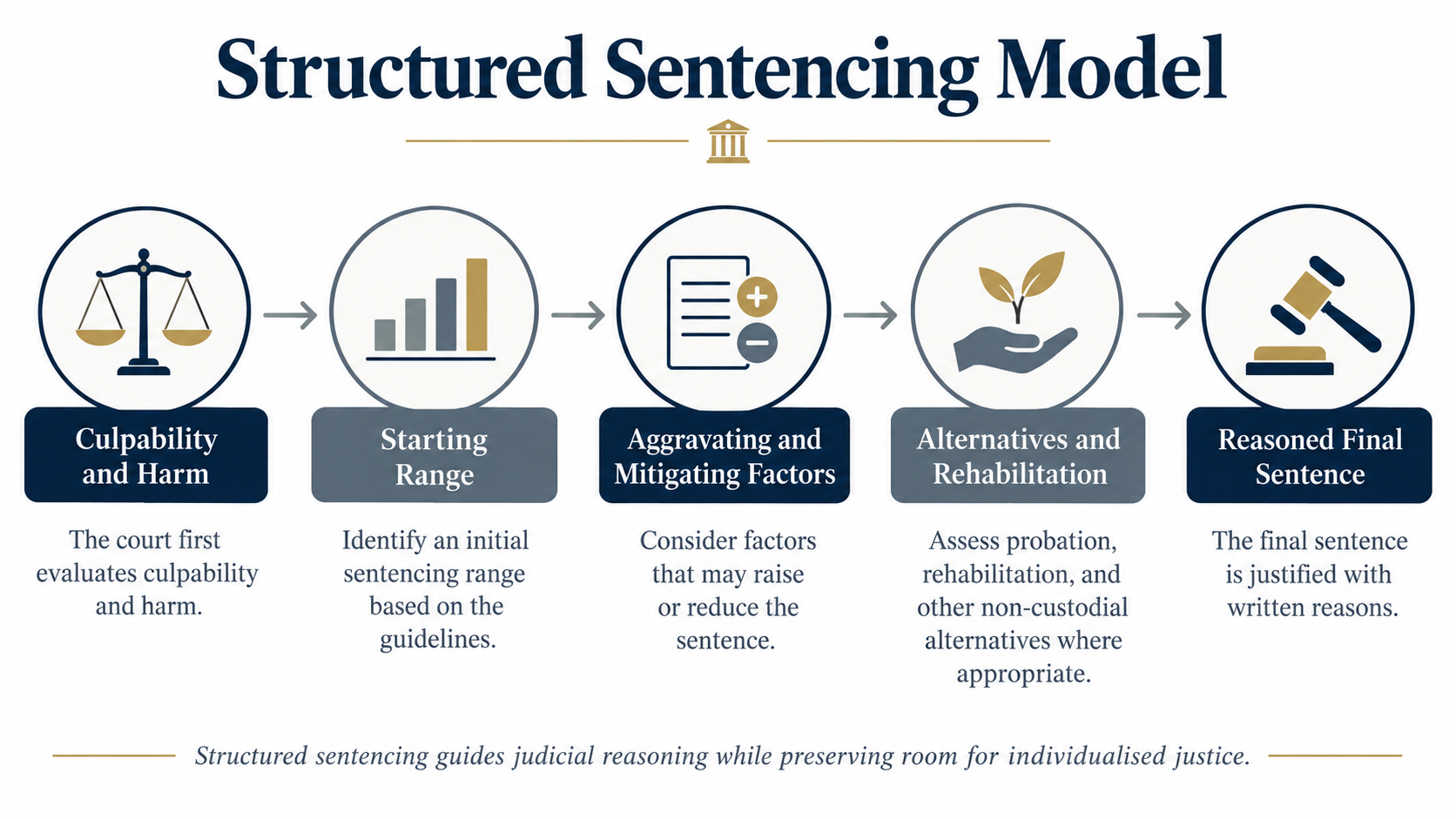
Data Can Improve Sentencing Policy
A Sentencing Council could also maintain a national sentencing database, potentially drawing on the National Judicial Data Grid.
Anonymised data on offence type, harm, culpability, adjustments and final punishment could reveal where disparities are concentrated and whether particular guidelines are working.
Such evidence could also help assess the impact of sentencing policy on prison overcrowding and recidivism.
Lessons from England and Wales
England and Wales use a statutory Sentencing Council that issues detailed guidelines.
Courts assess culpability and harm, identify a category range and then modify the sentence based on aggravating and mitigating circumstances. Judges may depart from guidelines, but must justify doing so.
This model illustrates how guidance can structure rather than dictate judicial discretion.
Risks of a Guideline System
Sentencing guidelines are not automatically beneficial.
Political pressure can encourage penal populism, resulting in longer prison terms without evidence of greater deterrence. Excessive standardisation can also ignore regional differences in prison capacity and social conditions.
There is also a risk that judges mechanically complete checklists without genuinely engaging with individual circumstances.
Any Indian Sentencing Council would therefore need institutional independence, transparent data and periodic review.
Core Policy Lesson
India’s sentencing problem is not that judges possess discretion, but that this discretion often operates without a common national framework.
A Sentencing Council could improve consistency, transparency and proportionality by providing empirically grounded principles while still allowing courts to individualise punishment.
The goal should not be uniform sentences, but uniform reasoning and accountable discretion.
Probable Mains Question
“The objective of sentencing reform should be to structure judicial discretion rather than eliminate it.” Discuss the need for a Sentencing Council in India and the safeguards required to preserve judicial independence.
Prelims Drill
MCQ
With reference to sentencing in India, consider the following statements:
- Criminal statutes may prescribe a range within which courts determine the actual punishment.
- Judicial discretion in sentencing necessarily violates Article 14 of the Constitution.
- Probation may serve as an alternative to imprisonment in eligible cases.
Which of the statements given above are correct?
A. 1 only
B. 1 and 3 only
C. 2 and 3 only
D. 1, 2 and 3
Correct Answer: B
Explanation: Judicial discretion is not inherently unconstitutional; the concern arises when it becomes arbitrary or lacks principled guidance. Probation is a recognised non-custodial alternative in appropriate cases.