
India’s Research Funding Crisis
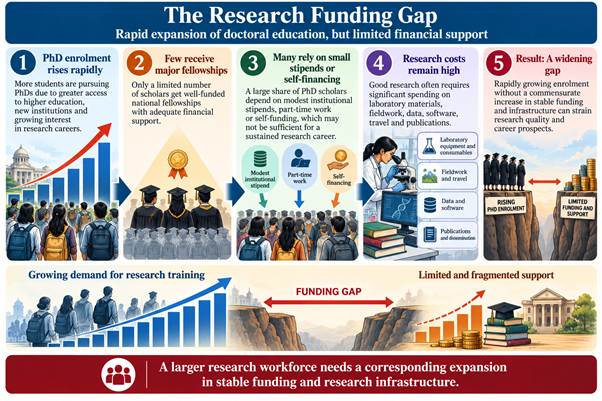
India’s PhD enrolment has expanded rapidly, but fellowships, research resources and stable career opportunities have not grown at the same pace, creating a gap between national research ambitions and support for researchers.
India’s Research Funding Crisis
- Syllabus Mapping: GS Paper II — Education and Human Resource Development; GS Paper III — Science and Technology, Innovation and R&D.
- Source & Date: The Hindu, 23 October 2026.
Why in News?
India’s research ecosystem is expanding rapidly, but financial support for doctoral scholars remains highly uneven. PhD enrolment rose from about 2.03 lakh in 2019-20 to 3.44 lakh in 2023-24, while the UGC awards Junior Research Fellowships to only a small fraction of researchers each year.
Many scholars therefore depend on low institutional stipends, family support, outside work or personal savings to finance laboratory experiments, fieldwork, books, publication costs and everyday living.
Funding Has Not Kept Pace
The central problem is not simply the number of researchers, but the gap between enrolment and financial support.
The UGC's JRF provides significantly higher support than many university-level fellowships, but only a limited number of scholars receive it. Researchers without JRF may receive much smaller stipends or no fellowship at all.
The non-NET fellowship, for example, has remained at ₹8,000 per month since 2012 in some central universities. For scholars conducting laboratory or field-based research, this amount can be lower than the cost of essential research equipment, travel or documentation.
Delays Can Be as Harmful as Low Stipends
Even an approved fellowship loses much of its value when payments are irregular.
Researchers may need continuous funding for rent, food, laboratory consumables and fieldwork. Long delays can force scholars to borrow money, postpone experiments or abandon parts of their research.
Research therefore depends not only on the amount of funding, but also on predictability and timely disbursement.
India’s R&D Spending Remains Limited
India's gross expenditure on research and development reached around 0.84% of GDP in 2023-24.
This remains significantly below major research-intensive economies. Lower national R&D expenditure can translate into fewer fellowships, constrained laboratories, limited project funding and weaker long-term research careers.
A country seeking technological leadership therefore needs to invest not only in major laboratories and missions, but also in the people who conduct day-to-day research.
Women Face Additional Constraints
Women account for nearly half of PhD enrolment, but their representation among researchers remains much lower.
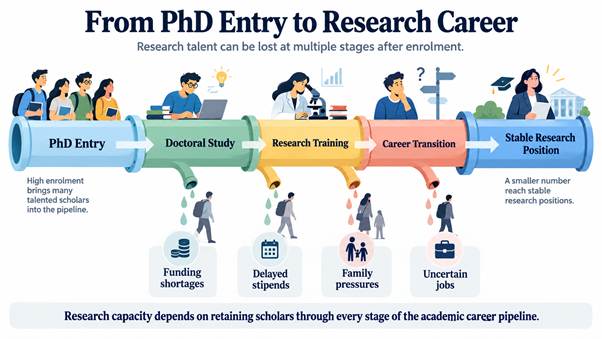
Financial insecurity can combine with social expectations, safety concerns, caregiving responsibilities and restrictions on working hours. These pressures can reduce retention and progression even when women enter doctoral programmes in large numbers.
Research Quality Also Suffers
Funding shortages affect more than researchers' personal welfare.
Experiments may be reduced because reagents are unaffordable. Fieldwork may be shortened. Scholars may avoid ambitious questions because they cannot finance the additional work required.
This can produce a system where researchers complete degrees but have limited opportunities to pursue high-risk, original or interdisciplinary research.
Career Uncertainty Weakens Incentives
The end of a PhD does not guarantee a stable or well-paid research career.
When highly trained researchers find that available jobs offer salaries similar to positions requiring much lower qualifications, the incentive to remain in research declines.
This can contribute to brain drain, movement away from academia and underuse of highly specialised skills.
Core Policy Lesson
India’s research ambitions depend on more than increasing PhD enrolment or launching major science missions.
A sustainable research ecosystem requires adequate fellowships, timely payments, affordable research inputs, strong institutional funding and credible career pathways.
If researchers struggle to meet basic living and research costs, the country risks expanding the number of PhDs without building the depth of research capacity needed for long-term innovation.
Probable Mains Question
“Expanding doctoral enrolment without strengthening financial and career support can weaken rather than strengthen a country’s research ecosystem.” Discuss in the context of India’s science and higher-education policy.
Prelims Drill
MCQ 1
With reference to research funding and innovation, consider the following statements:
- An increase in PhD enrolment by itself necessarily leads to a proportional increase in national research output.
- Predictability of fellowship payments can influence the continuity of fieldwork and laboratory research.
- Low research funding can affect both the welfare of researchers and the scope of research questions they are able to pursue.
Which of the statements given above are correct?
A. 1 only
B. 2 and 3 only
C. 1 and 3 only
D. 1, 2 and 3
Correct Answer: B
Explanation: Higher enrolment does not automatically translate into stronger research output. Timely funding affects continuity, while financial constraints can reduce both researcher welfare and research ambition.
MCQ 2
Consider the following statements regarding research capacity:
- A country may have high doctoral enrolment but still face a shortage of professional researchers.
- Gender parity in PhD enrolment necessarily implies gender parity in long-term research careers.
- Stable career opportunities can influence whether highly trained researchers remain in academia and research.
Which of the statements given above are correct?
A. 1 and 3 only
B. 1 and 2 only
C. 2 and 3 only
D. 1, 2 and 3
Correct Answer: A
Explanation: Doctoral enrolment and long-term research employment are different stages of the research pipeline. Women may enter PhD programmes in large numbers but still face attrition later. Stable research careers are therefore essential for retaining skilled researchers.
More Current Affairs - Daily
- What Is AEBS? India Proposes Mandatory Emergency Braking for New Car Models 24 Oct 2026
- Children in Political Campaigns: Legal and Ethical Debate 24 Oct 2026
- Sentencing and the Need for a Sentencing Council 24 Oct 2026
- Patriarchy and Women’s Rights in Bangladesh: Debate Over Selective Activism 24 Oct 2026