
Why India’s Public Policy Schools Need to Rethink How They Teach
India has expanded public policy education, but the next challenge is producing professionals capable of making sound decisions amid uncertainty, institutional constraints and competing public interests
- Syllabus Mapping: GS Paper II — Governance, Civil Services, Institutional Capacity, Public Administration and Policy Implementation.
- Source & Date: The Hindu, 22 November 2026.
Why in News?
India now has 56 institutions offering public policy programmes, indicating rapid expansion in policy education.
The next challenge is qualitative: whether these institutions can prepare graduates to make decisions in real administrative situations rather than merely understand policy concepts.
Why Lecture-Based Learning Is Not Enough
Public policy is a practice-based discipline, much like law, medicine or management.
- Real policy problems are rarely neat or technically well-defined.
- Administrators work with incomplete information, time pressure, institutional limits and competing interests.
- Many governance issues are “wicked problems” — complex problems with no single correct solution.
Traditional lectures can explain theories and frameworks, but they cannot fully develop the judgement required to act under uncertainty.
Why Case-Based Teaching Matters
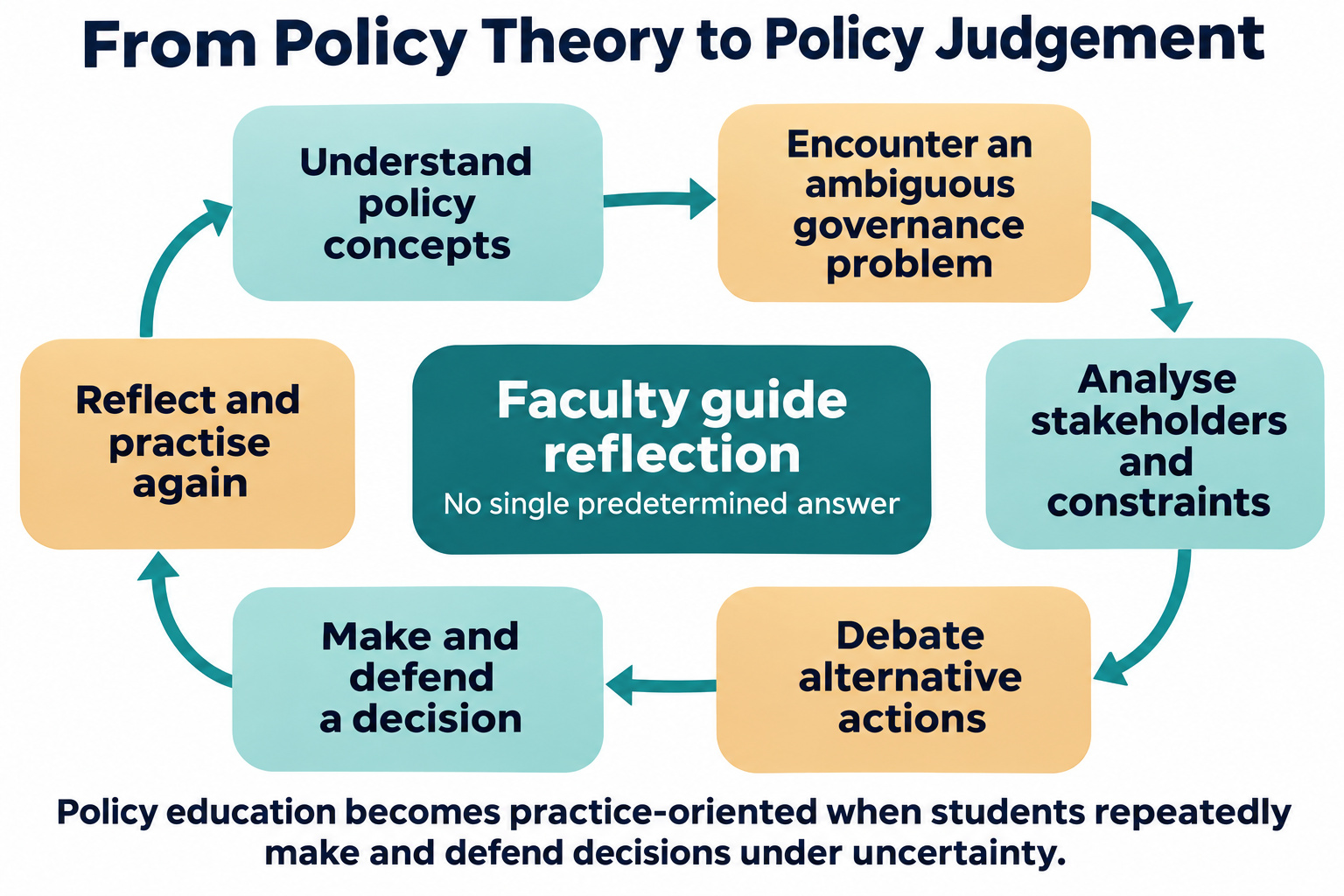
Teaching cases place students inside realistic decision situations.
Instead of asking, “What is the correct theory?”, students must ask:
- What should the decision-maker do?
- Which interest should receive priority?
- What are the trade-offs between efficiency and equity?
- What information is missing?
- What institutional constraints matter?
Repeated engagement with such dilemmas develops tacit and reflective judgement, which is difficult to acquire through lectures alone.
India’s Major Gap: Too Few Indian Cases
Many Indian policy classrooms still depend heavily on Western cases and examples.
This creates an important gap because Indian governance has distinctive features:
- federal and multi-level administration;
- large differences in State capacity;
- complex Centre-State relations;
- powerful local social and political contexts;
- uneven municipal and panchayat capacity.
Internships, fieldwork and practitioner-led courses help, but they cannot fully substitute for a large collection of rigorous Indian teaching cases that can be repeatedly discussed in classrooms.
What Policy Schools Need to Change
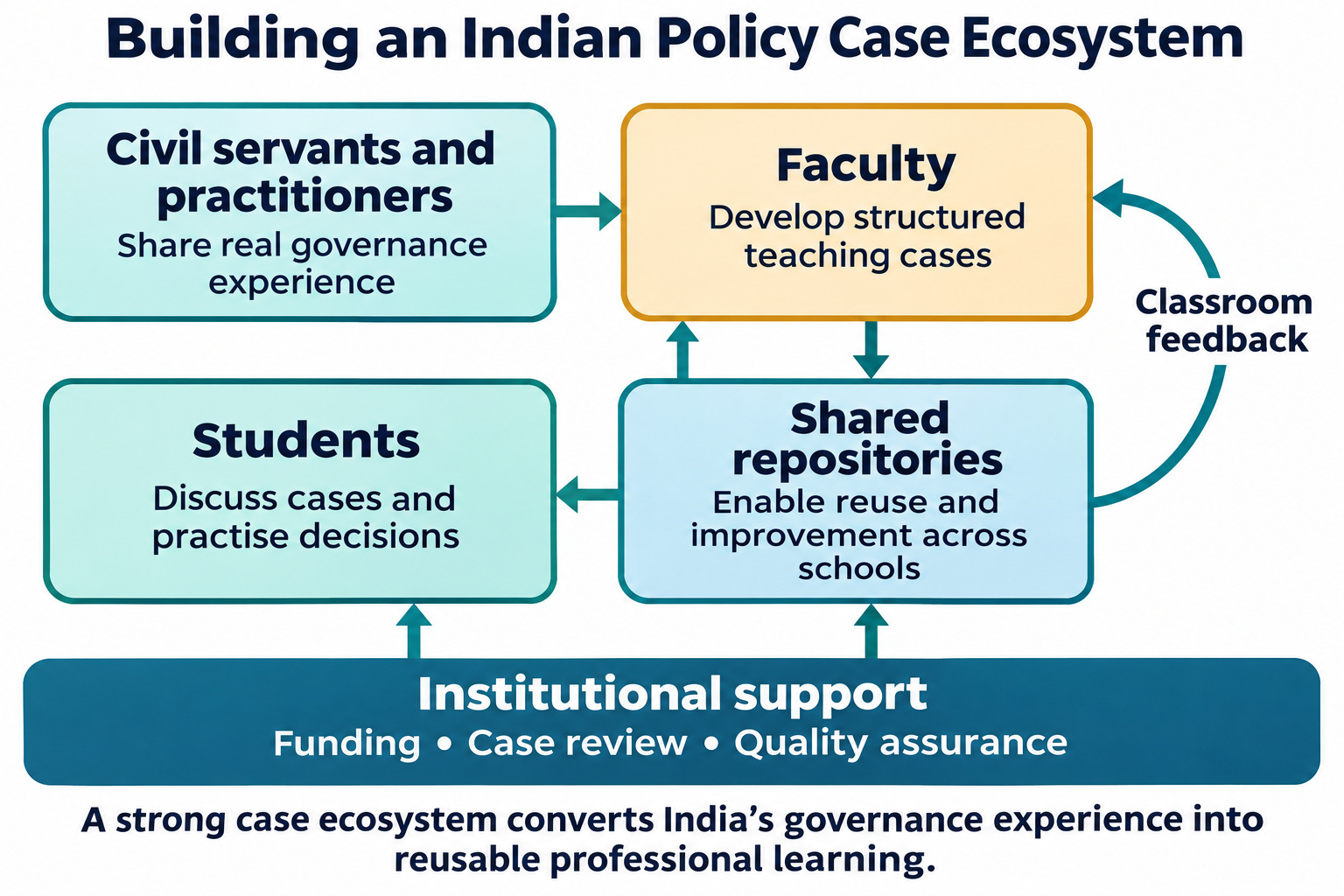
India needs an institutional ecosystem for producing indigenous policy cases.
Key steps include:
- establishing dedicated case-writing centres;
- partnering with serving and retired civil servants;
- building shared repositories of Indian governance cases;
- giving faculty research assistance and funding for case development;
- recognising case writing as legitimate academic scholarship.
Cases should cover real trade-offs in areas such as health, urban governance, education, public finance, regulation and disaster management.
Core Policy Lesson
India has largely solved the scale problem in public policy education; it now faces an epistemic and pedagogical problem.
Good policy professionals need more than technical knowledge. They need the ability to exercise judgement when evidence is incomplete, interests conflict and decisions have irreversible consequences.
Public policy schools should therefore move from merely teaching policy conclusions towards repeatedly training students to make policy decisions.
---
Probable Mains Question
“Public policy is a practice-based discipline in which judgement is as important as technical knowledge.” Discuss the need for case-based and India-specific pedagogy in strengthening governance capacity.
---
Prelims Drill
MCQ 1
With reference to “wicked problems” in public policy, consider the following statements:
1. They often involve competing values and interests.
2. They generally have a single technically optimal solution.
3. They may require decision-making under uncertainty.
Which of the statements given above are correct?
A. 1 only
B. 1 and 3 only
C. 2 and 3 only
D. 1, 2 and 3
Correct Answer: B
Explanation: Wicked problems are complex, value-laden and difficult to define conclusively. They rarely have a single universally accepted solution.
MCQ 2
Case-based teaching in public policy is primarily useful because it:
1. exposes students to realistic decision trade-offs;
2. develops judgement under incomplete information;
3. eliminates the need for theoretical and conceptual learning.
Which of the statements given above are correct?
A. 1 only
B. 1 and 2 only
C. 2 and 3 only
D. 1, 2 and 3
Correct Answer: B
Explanation: Case-based teaching complements rather than replaces theory. Its distinctive value lies in practising judgement, trade-off analysis and decision-making.