
Manila Summits: Broadening India’s Act East Strategy
India’s Manila engagements showed how New Delhi is strengthening the Quad while simultaneously investing in ASEAN centrality, East Asian cooperation and diversified trusted partnerships.
- Syllabus Mapping: GS Paper II — International Relations, Regional and Global Groupings, India’s Neighbourhood and Indo-Pacific Strategy.
- Source & Date: The Hindu, 21 November 2026.
Why in News?
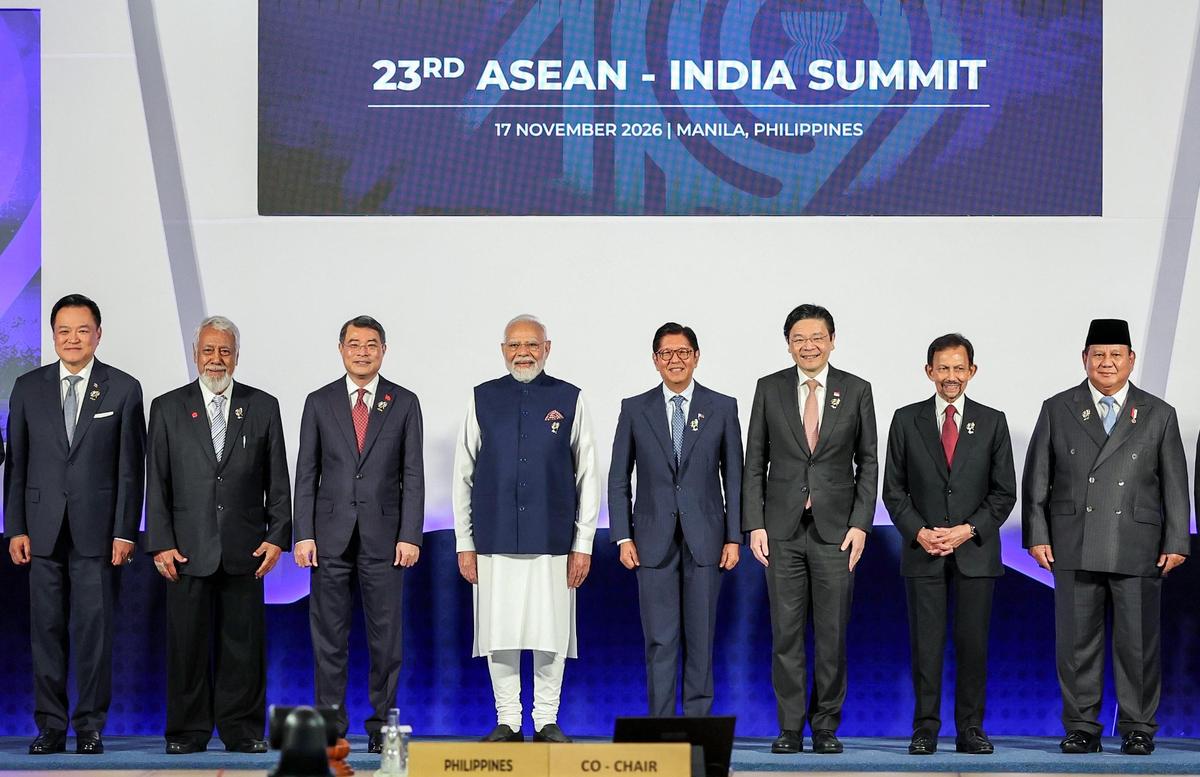
Prime Minister Narendra Modi participated in three major meetings in Manila — the ASEAN-India Summit, East Asia Summit (EAS), and Quad Leaders’ Summit.
Together, they underline an important shift in India’s diplomacy: strengthening strategic ties with major powers while simultaneously investing in ASEAN centrality, middle-power partnerships and diversified supply chains.
ASEAN-India: Act East Beyond Strategic Signalling
- ASEAN remains central to India’s Act East Policy and its wider Indo-Pacific vision. It accounts for roughly 11% of India’s global trade, with bilateral trade reaching about $128 billion in 2025-26.
- India announced free tourist visas for ASEAN citizens and expanded cooperation in disaster management and maritime affairs.
- A joint statement on disaster-management cooperation seeks to strengthen regional resilience.
However, the long-pending review of the ASEAN-India Trade in Goods Agreement (AITIGA) saw no major breakthrough. This remains significant as ASEAN economies deepen integration through the Regional Comprehensive Economic Partnership, which India chose not to join.
East Asia Summit: Wider Regional Security Platform
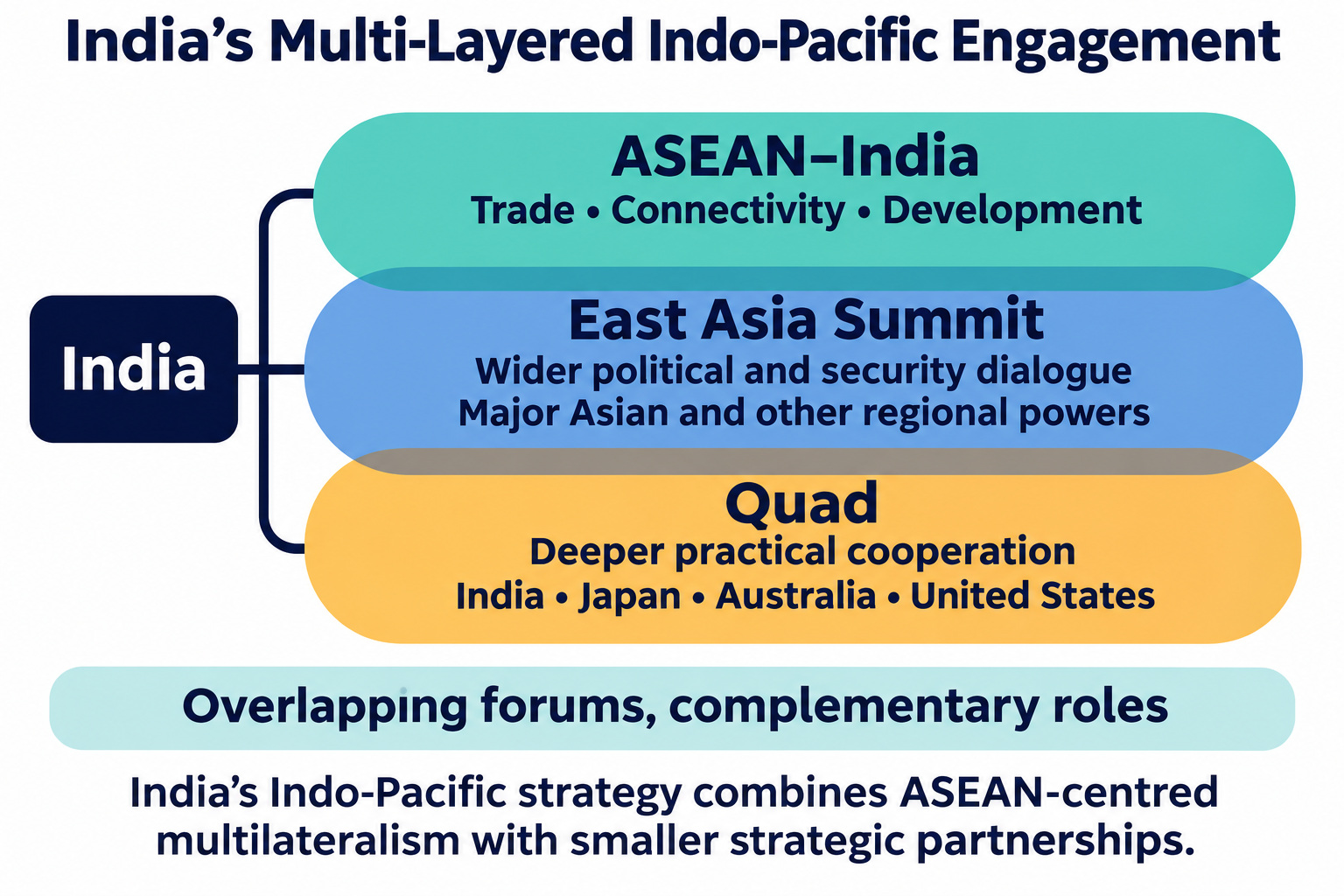
The East Asia Summit brings ASEAN together with major external powers, including India, the U.S., China, Russia, Japan and South Korea.
Key outcomes included:
- cooperation on seafarers’ safety, training and emergency response;
- stronger measures against online scams and cybercrime;
- renewed emphasis on regional peace, stability and predictability.
For India, the EAS is important because it provides a forum where competing powers remain within an ASEAN-led regional architecture, reducing dependence on exclusive great-power blocs.
Quad: From Uncertainty to Practical Cooperation
The Manila summit demonstrated that the Quad remains operational despite doubts over its political momentum.
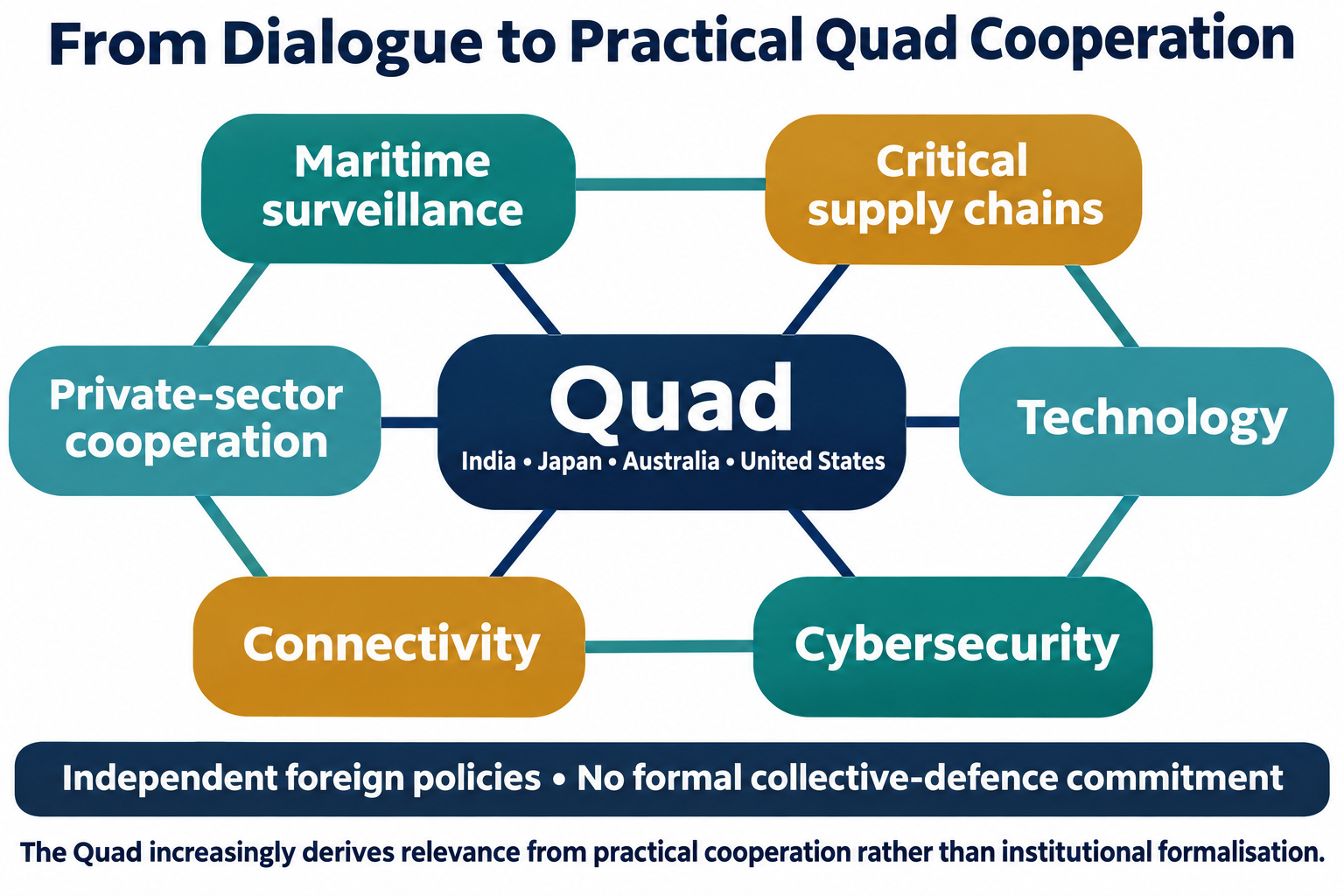
India, the U.S., Japan and Australia announced:
- a Quad Business Leaders’ Forum in 2027;
- maritime surveillance cooperation;
- planned use of P-8 and P-3C patrol aircraft in a Quad-context maritime exercise;
- stronger cybersecurity cooperation;
- work on resilient critical supply chains and connectivity.
The Quad remains a strategic partnership, not a treaty-based military alliance. Its focus is increasingly on practical capabilities that strengthen a free, open and resilient Indo-Pacific.
What the Three Summits Mean for India
The larger message is strategic diversification.
India is simultaneously strengthening the Quad, deepening ASEAN ties, expanding relations with Japan and South Korea, and cultivating other middle powers.
This gives India alternatives when U.S.-China competition, economic coercion, wars or critical-mineral restrictions disrupt established supply chains.
ASEAN is particularly valuable because many of its members also seek strategic space between competing major powers.
Core Policy Lesson
India’s Act East Policy is evolving from connectivity-focused engagement into a broader strategy covering maritime security, resilient supply chains, technology, disaster resilience and strategic autonomy.
The Manila meetings show that India does not view the Quad and ASEAN-centred institutions as competing choices. Instead, it uses both to build trusted partnerships without locking itself into a rigid alliance system.
---
Probable Mains Question
“India’s Indo-Pacific strategy increasingly combines ASEAN centrality with minilateral partnerships such as the Quad.” Examine how this approach strengthens India’s strategic autonomy and economic resilience.
---
Prelims Drill
MCQ 1
Consider the following statements:
1. The East Asia Summit is an ASEAN-led forum.
2. India is a member of both the East Asia Summit and the Quad.
3. The Quad contains a treaty-based collective-defence commitment among its members.
Which of the statements given above are correct?
A. 1 only
B. 1 and 2 only
C. 2 and 3 only
D. 1, 2 and 3
Correct Answer: B
Explanation: India participates in both the EAS and Quad. The Quad is not a formal collective-defence alliance.
MCQ 2
With reference to India-ASEAN economic relations, consider the following statements:
1. AITIGA relates to trade in goods between India and ASEAN.
2. India is currently a member of the Regional Comprehensive Economic Partnership.
3. ASEAN is an important component of India’s Act East Policy.
Which of the statements given above are correct?
A. 1 only
B. 1 and 3 only
C. 2 and 3 only
D. 1, 2 and 3
Correct Answer: B
Explanation: AITIGA governs India-ASEAN trade in goods. India withdrew from RCEP negotiations in 2019 and is not a member.