
Blue Bonds: India’s New Ocean of Finance
Sagarmala Finance Corporation’s proposed ₹1,000 crore blue bond could establish a new channel for financing sustainable maritime and water-related infrastructure through India’s capital markets.
Blue Bonds: India’s New Ocean of Finance
- Syllabus Mapping: GS Paper III — Indian Economy, Infrastructure, Mobilisation of Resources, Capital Markets, Blue Economy and Sustainable Development.
- Source & Date: The Hindu, 24 September 2026, supplemented by SEBI, Sagarmala, Ministry of Ports, Shipping and Waterways and World Bank material.
Why Are Blue Bonds in Focus?
Sagarmala Finance Corporation Ltd. proposes to raise about ₹1,000 crore through a blue bond, which would be India’s maiden major blue-labelled issuance linked to the Sagarmala maritime ecosystem.
The amount is small compared with Sagarmala’s overall pipeline of about 845 projects worth ₹6.06 lakh crore, but its importance lies in creating a new financing route for long-duration maritime infrastructure.
India has traditionally financed such infrastructure through budgetary support, bank lending and conventional bonds, while thematic bonds can attract specialised long-term investors.
What Is a Blue Bond?
A blue bond works like an ordinary bond because investors provide capital to an issuer in return for interest payments and repayment of principal at maturity.
Its distinguishing feature is the use of proceeds.
Blue bond = Conventional debt instrument + proceeds earmarked for eligible ocean or water-related projects
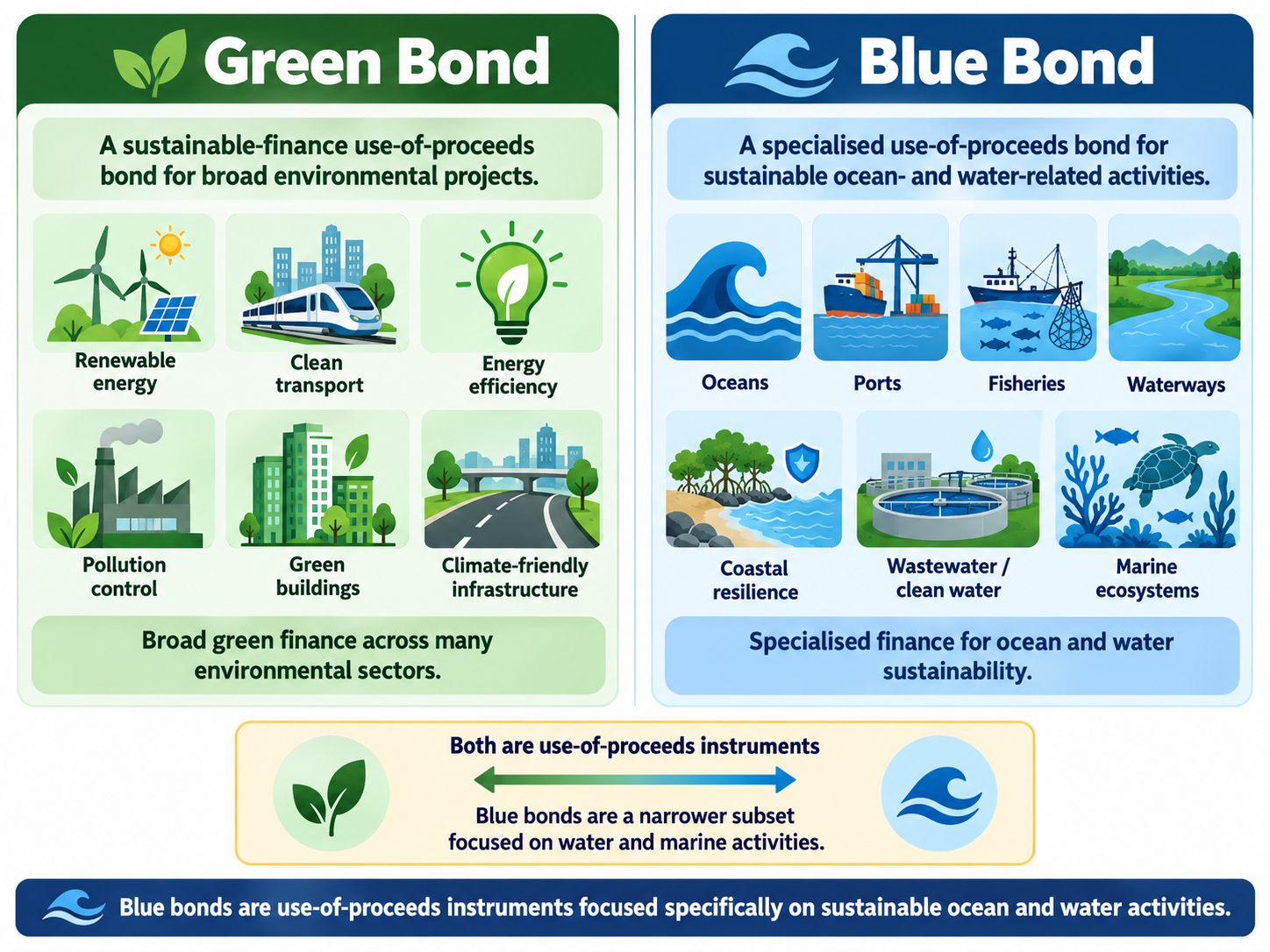
Possible eligible areas can include sustainable fisheries, marine conservation, water infrastructure, cleaner ports, coastal transport and pollution reduction.
The World Bank describes blue bonds as instruments that mobilise finance for sustainable ocean and water ecosystems.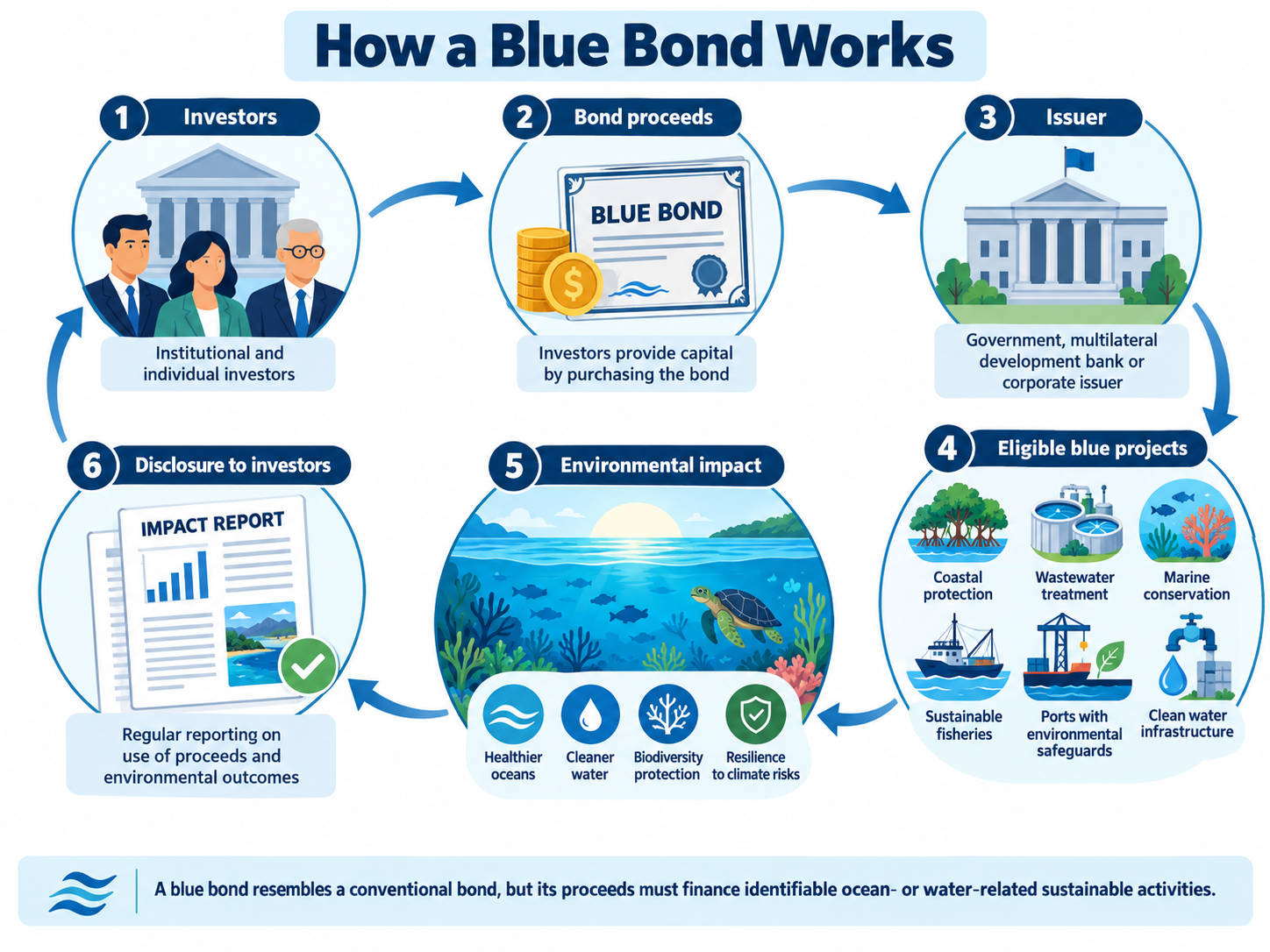
Why Does Sagarmala Need Such Finance?
Infrastructure projects create a maturity challenge because ports, waterways and related assets can generate returns over many years, while shorter-term borrowing must be refinanced more frequently.
A longer-duration bond can reduce this asset-liability mismatch by bringing borrowing maturity closer to the life of the underlying assets.
It can also diversify financing beyond banks and attract insurance companies, pension funds and sustainability-focused investors.
Where Could the Money Be Used?
Sagarmala covers five broad pillars: port modernisation, port connectivity, port-led industrialisation, coastal community development, and coastal shipping and inland water transport.
However, not every Sagarmala project automatically qualifies as a blue project.
Eligibility would require identifiable ocean- or water-related sustainability outcomes.
Potential areas include cleaner port operations, shore power, energy-efficient cargo systems, inland-water transport, Ro-Ro and Ro-Pax services, fishing-harbour improvements and sustainable coastal infrastructure.
Why Disclosure Matters
A thematic bond creates additional accountability because investors need assurance that money is actually being used for the promised environmental purpose.
This requires:
Clear project eligibility → use-of-proceeds tracking → impact indicators → periodic reporting → independent review where applicable
Without credible measurement, issuers risk bluewashing, where ordinary projects are marketed as environmentally sustainable without adequate evidence.
SEBI’s sustainable-finance framework has progressively strengthened disclosure and independent review requirements for ESG debt securities.
Global Experience
The Seychelles issued the world’s first sovereign blue bond in October 2018, raising $15 million for sustainable fisheries and marine conservation with World Bank support.
By June 2025, the global blue-bond market had reached about $15.25 billion, showing rapid growth from a very small base.
Blue finance nevertheless remains far smaller and less standardised than green finance.
Why Blue Bonds Still Lag Green Bonds
The main challenges are:
Absence of a universally accepted blue taxonomy + difficulty measuring marine outcomes + shortage of investment-ready projects + risk of bluewashing + relatively narrow investor base
Environmental outcomes such as coral restoration, biodiversity recovery or healthier fish stocks can be much harder to quantify financially than electricity generated from a solar project.
Why This Matters for India
India’s current officially measured coastline is about 11,099 km, while its economy depends heavily on maritime trade and port infrastructure.
If the first issuance establishes credible standards, blue bonds could gradually complement traditional finance for:
Ports + inland waterways + fisheries + coastal communities + marine conservation + water infrastructure
The real test will not simply be whether the bond raises money, but whether India can develop a pipeline of projects with credible, measurable blue outcomes.
Probable Mains Question
“Blue bonds can diversify infrastructure finance while simultaneously supporting India’s blue economy, but their credibility depends on strong project taxonomy and impact disclosure.” Discuss.
Prelims Drill
MCQ 1
With reference to blue bonds, consider the following statements:
- Their proceeds are intended for eligible ocean- or water-related sustainable projects.
- They necessarily provide investors ownership rights in the underlying maritime project.
- The Seychelles issued the world’s first sovereign blue bond.
Which of the statements given above are correct?
A. 1 only
B. 1 and 3 only
C. 2 and 3 only
D. 1, 2 and 3
Correct Answer: B
Explanation: A blue bond is a debt instrument rather than an equity instrument, so purchasing the bond does not automatically confer ownership in the financed project. The Seychelles issued the world’s first sovereign blue bond in 2018.
MCQ 2
Consider the following statements regarding the Sagarmala Programme:
- It promotes port-led development in India.
- Coastal community development is one of its pillars.
- Every project under Sagarmala automatically qualifies for financing through a blue bond.
Which of the statements given above are correct?
A. 1 only
B. 1 and 2 only
C. 2 and 3 only
D. 1, 2 and 3
Correct Answer: B
Explanation: Sagarmala includes port modernisation, connectivity, port-led industrialisation, coastal community development, and coastal shipping and inland water transport, but blue-bond financing requires projects to satisfy relevant sustainability and use-of-proceeds criteria.
More Current Affairs - Daily
- Election Commission of India: Constitutional Design and Evolution into a Three-Member Body 12 Oct 2026
- Loknayak Jayaprakash Narayan: Total Revolution and Contribution to Democracy 12 Oct 2026
- India’s Russia-Ukraine Initiative: From Black Sea Security to Strategic Autonomy 12 Oct 2026
- Jayaprakash Narayan: Architect of Total Revolution and Defender of Democracy 12 Oct 2026