
Ganga Water Treaty: Key Issues Before India-Bangladesh Renewal
The Ganga Water Treaty created a dry-season sharing framework at Farakka, but changing water availability, rising domestic needs and climate risks have intensified calls to revisit its terms
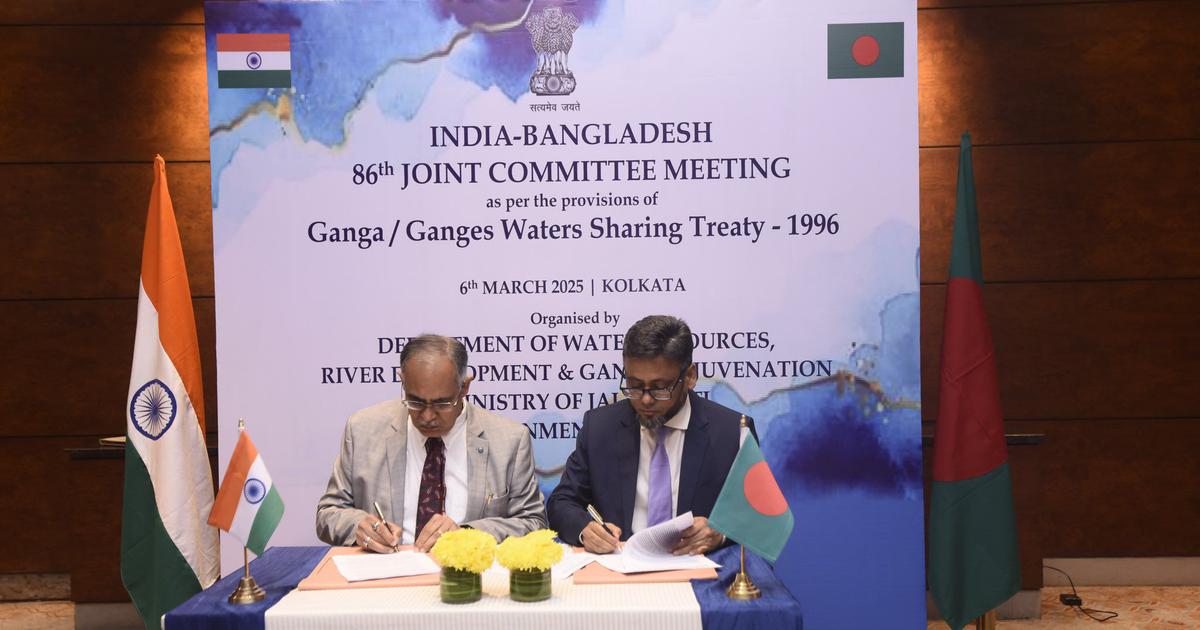
- Source & Date: The Indian Express, 24 November 2026.
Why in News?
The 1996 Ganga Water Sharing Treaty is due to expire on December 12, 2026.
India and Bangladesh recently held the 91st meeting of their Joint Committee in Dhaka. Both sides appear willing to continue cooperation, but disagreements remain over dry-season allocations, minimum guarantees, treaty duration and climate-related water uncertainty.
How Did the Treaty Emerge?
- The dispute dates to India’s construction of the Farakka Barrage, completed in 1975, to divert Ganga water into the Hooghly and improve navigability around Kolkata port.
- Bangladesh feared reduced downstream flows in the Padma.
- Temporary arrangements in 1977, 1982 and 1985 failed to create a durable solution.
- The 1996 treaty created a 30-year dry-season sharing arrangement from January to May.
What Are the Main Treaty Provisions?
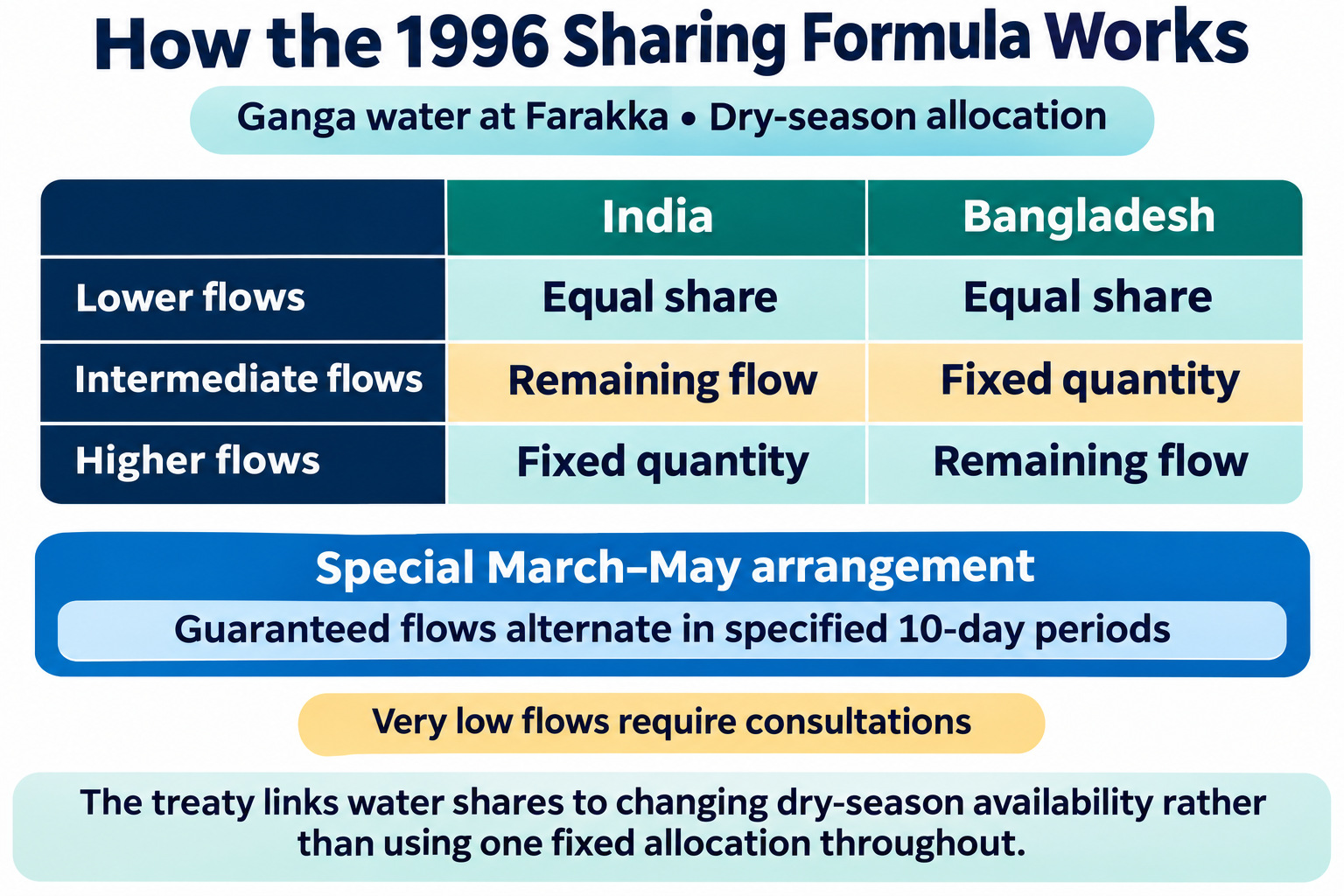
- If flows are 70,000 cusecs or less, India and Bangladesh share them equally.
- Between 70,000 and 75,000 cusecs, Bangladesh receives 35,000 cusecs and India gets the remainder.
- At 75,000 cusecs or above, India gets 40,000 cusecs and Bangladesh receives the balance.
- Between March 11 and May 10, both countries receive 35,000 cusecs in alternate three 10-day periods.
- If flows fall below 50,000 cusecs, both governments must consult immediately on an emergency adjustment based on equity, fair play and no harm.
Where Do India and Bangladesh Differ?
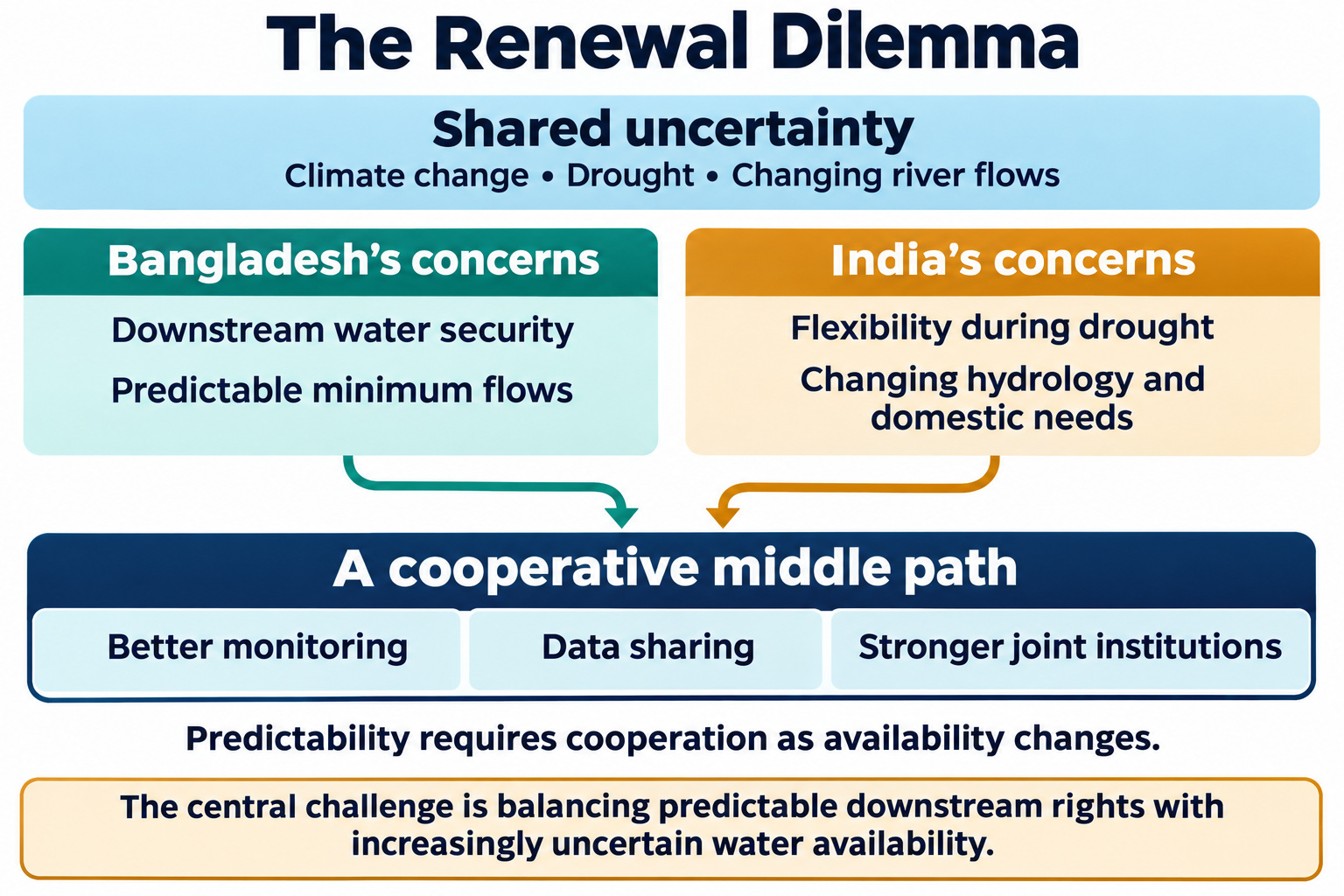
Bangladesh has reportedly sought:
- a higher guaranteed release during the lean season;
- restoration of a minimum guarantee similar to the 1977 arrangement;
- a longer renewal period;
- better flood and hydrological data sharing.
India is concerned that a fixed minimum guarantee, irrespective of actual river flows, could place disproportionate climate risk on the upstream country.
Indian discussions have also focused on growing domestic water requirements and the possibility of a shorter 10–15 year renewal period.
Why Climate Change Changes the Negotiation
The original formula relied heavily on historical flow data.
Today, rainfall variability, changing river flows, droughts and extreme floods make future availability less predictable.
A renewed framework may therefore need:
- adaptive allocation rules;
- better real-time data sharing;
- stronger drought and flood protocols;
- improved dispute-resolution mechanisms;
- periodic review rather than rigid long-term assumptions.
Core Policy Lesson
The Ganga dispute is no longer simply about dividing a fixed quantity of water.
It is increasingly about sharing hydrological risk under uncertainty.
A durable agreement will require India and Bangladesh to move from narrow volumetric bargaining towards stronger joint monitoring, flexible allocation mechanisms and resilient transboundary institutions.
---
Probable Mains Question
“Transboundary river treaties must increasingly manage uncertainty rather than merely divide fixed quantities of water.” Discuss with reference to the India-Bangladesh Ganga Water Sharing Treaty.
---
Prelims Drill
MCQ 1
With reference to the Ganga Water Sharing Treaty, consider the following statements:
1. It governs dry-season sharing of Ganga waters at Farakka.
2. It provides for emergency consultations if flows fall below a specified threshold.
3. The Joint Rivers Commission was created by the 1996 treaty itself.
Which of the statements given above are correct?
A. 1 only
B. 1 and 2 only
C. 2 and 3 only
D. 1, 2 and 3
Correct Answer: B
Explanation: The Joint Rivers Commission predates the treaty and was established in 1972. The 1996 treaty created a specific sharing and monitoring framework for the Ganga.
MCQ 2
Consider the following statements regarding transboundary river agreements:
1. Fixed volumetric guarantees may become harder to implement when river flows become highly variable.
2. Real-time data sharing can improve cooperation during droughts and floods.
3. Climate change necessarily eliminates the need for bilateral water-sharing treaties.
Which of the statements given above are correct?
A. 1 only
B. 1 and 2 only
C. 2 and 3 only
D. 1, 2 and 3
Correct Answer: B
Explanation: Climate variability makes adaptive cooperation more important, not less. Data sharing and flexible institutional mechanisms can strengthen water-sharing arrangements.