
gandhi-voting-rights-adult-franchise-article-326-electoral-rolls
Gandhi’s early campaign against the disenfranchisement of Indians in South Africa helped connect voting rights with dignity, representation and equal political citizenship.
Gandhi’s First Political Fight: From Voting Rights to Universal Adult Franchise
- Syllabus Mapping: GS Paper I — Modern Indian History and Gandhian Thought; GS Paper II — Constitution, Electoral Democracy, Representation of the People and Election Commission.
- Source & Date: The Indian Express, 2 October 2026, supplemented by constitutional and historical material on adult franchise and electoral democracy.
Gandhi’s Early Struggle for the Vote
One of Mohandas Gandhi’s earliest organised political struggles in South Africa arose in 1894, when the Natal government moved to restrict the franchise available to Indians. Gandhi organised petitions and political mobilisation against disenfranchisement, treating the vote not merely as an electoral privilege but as a question of political equality and civic dignity.
This struggle preceded his later development of satyagraha and helped shape his understanding that exclusion from political representation could reinforce wider racial and social subordination.
The political progression can be understood as:
Disenfranchisement → political organisation → representation → equal citizenship → democratic participation
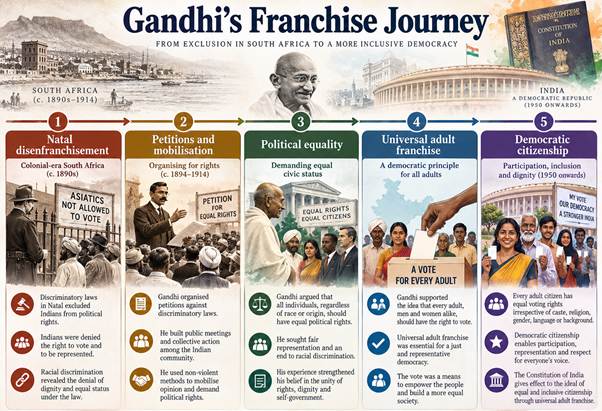
From Limited Franchise to Universal Adult Suffrage
Colonial India did not have universal voting rights. Franchise under British rule was restricted by qualifications such as property, taxation, education and other eligibility conditions, leaving most adults outside the electorate.
The Constitution transformed this principle by adopting universal adult suffrage from the beginning of the Republic, despite widespread poverty, illiteracy and social inequality.
Article 326 provides that elections to the Lok Sabha and State Legislative Assemblies shall be based on adult suffrage, subject to constitutionally permitted disqualifications.
This was a major democratic choice because India did not make literacy, property ownership or income prerequisites for political equality.
Why Electoral Rolls Matter
Universal adult franchise becomes meaningful only when eligible citizens are actually included in electoral rolls.
The constitutional promise therefore has two dimensions:
Universal eligibility + accurate electoral registration
Electoral-roll revision must simultaneously remove ineligible, duplicate or deceased entries and protect eligible citizens from wrongful exclusion.
The current debate surrounding Special Intensive Revision processes has revived this tension between roll accuracy and inclusion, but competing political claims about specific exercises must be assessed separately on evidence rather than treated as settled conclusions.
Article 324 and Electoral Administration
Article 324 vests the superintendence, direction and control of elections in the Election Commission of India.
However, electoral administration operates within a wider statutory framework, particularly the Representation of the People Act, 1950, which deals with electoral rolls, allocation of seats and voter registration, and the Representation of the People Act, 1951, which primarily governs the conduct of elections, qualifications, disqualifications and electoral offences.
The institutional framework is therefore:
Article 324 → Election Commission → RPA 1950 → electoral rolls → RPA 1951 → conduct of elections
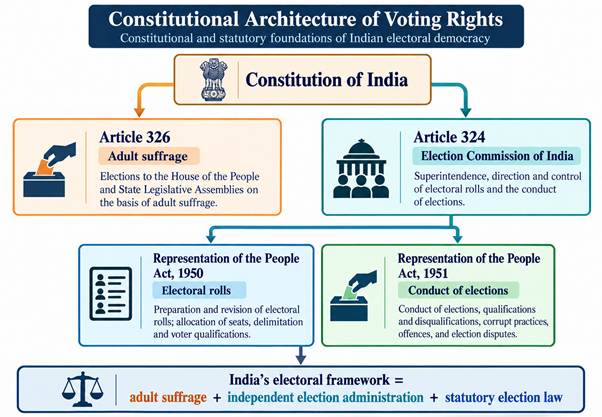
Gandhi’s Larger Democratic Idea
Gandhi’s political thought cannot be reduced to voting alone. His conception of democracy placed substantial emphasis on participation, decentralisation, moral responsibility, self-rule and the agency of ordinary citizens.
His concept of swaraj included political independence but also implied self-government and individual self-discipline.
Thus, representative democracy and Gandhian democracy overlap but are not identical.
Ballot-based participation + decentralised self-government + civic responsibility = broader democratic citizenship
Why the Historical Link Matters Today
The enduring relevance of Gandhi’s early franchise struggle lies in the principle that formal political equality loses meaning when citizens cannot participate effectively.
Modern electoral governance must therefore balance three objectives: accuracy of electoral rolls, inclusion of eligible voters and procedural fairness in deletion or correction processes.
The issue is institutional rather than partisan: a credible electoral system must make it difficult both for ineligible entries to remain and for eligible citizens to be wrongly excluded.
The Core Constitutional Lesson
India’s adoption of universal adult suffrage was one of the Republic’s most consequential institutional choices.
The democratic chain remains:
Citizenship → electoral registration → equal vote → representation → political accountability
Gandhi’s early experience with disenfranchisement therefore provides a useful historical lens for understanding why the vote is not merely an administrative entry on a list but an instrument through which political equality becomes operational.
Probable Mains Question
“Universal adult suffrage converted political equality from an aspiration into an institutional principle of the Indian Republic.” Discuss with reference to Gandhi’s early struggle for voting rights and the constitutional framework of electoral democracy in India.
Prelims Drill
MCQ 1
With reference to elections under the Constitution of India, consider the following statements:
- Article 324 deals with the superintendence, direction and control of elections.
- Article 326 provides for elections to the Lok Sabha and State Legislative Assemblies on the basis of adult suffrage.
- The Constitution originally restricted voting rights to citizens satisfying prescribed property qualifications.
Which of the statements given above are correct?
A. 1 only
B. 1 and 2 only
C. 2 and 3 only
D. 1, 2 and 3
Correct Answer: B
Explanation: Articles 324 and 326 provide the constitutional foundations for election administration and adult suffrage respectively. Independent India adopted universal adult franchise without imposing property qualifications as a general condition for voting.
MCQ 2
With reference to the Representation of the People Acts, consider the following statements:
- The Representation of the People Act, 1950 contains provisions relating to electoral rolls.
- The Representation of the People Act, 1951 deals substantially with the conduct of elections and electoral offences.
- Preparation of electoral rolls is governed exclusively by the Representation of the People Act, 1951.
Which of the statements given above are correct?
A. 1 only
B. 1 and 2 only
C. 2 and 3 only
D. 1, 2 and 3
Correct Answer: B
Explanation: The 1950 Act primarily provides the legal framework for electoral rolls and related representation matters, while the 1951 Act deals substantially with election conduct, qualifications, disqualifications, corrupt practices and electoral offences.
More Current Affairs - Daily
- Election Commission of India: Constitutional Design and Evolution into a Three-Member Body 12 Oct 2026
- Loknayak Jayaprakash Narayan: Total Revolution and Contribution to Democracy 12 Oct 2026
- India’s Russia-Ukraine Initiative: From Black Sea Security to Strategic Autonomy 12 Oct 2026
- Jayaprakash Narayan: Architect of Total Revolution and Defender of Democracy 12 Oct 2026