
Financing Viksit Bharat 2047: From Higher Savings to Stronger States
The Financing Viksit Bharat conference highlighted that India’s 2047 ambitions require higher domestic savings, private investment, stronger State finances and innovative financing mechanisms.
Financing Viksit Bharat 2047: From Higher Savings to Stronger States
Why Financing Has Become Central to Viksit Bharat
Viksit Bharat 2047 represents the government’s vision of transforming India into a developed, inclusive, self-reliant and globally competitive economy by the centenary of Independence. Its broader ambitions span economic prosperity, social development, modern infrastructure, technological capability and environmental sustainability.
The core challenge is financing this transformation.
The September 2026 conference emphasised that government budgets alone cannot provide the required scale of investment. India therefore needs:
Higher savings → larger investment pool → greater private capital → productive infrastructure → sustained growth
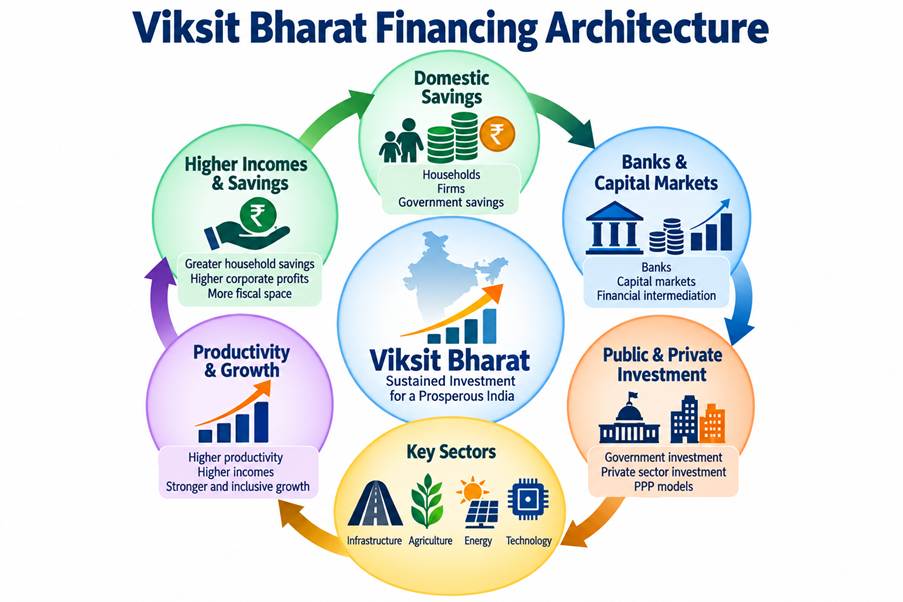
Savings and Investment: The Macroeconomic Foundation
Former Finance Commission Chairman N.K. Singh noted that India’s gross domestic savings rate is around 34% of GDP and argued that it may need to approach 38–40% to sustain growth of around 7–8% needed for the long-term development journey.
Higher savings matter because domestic savings finance investment while reducing excessive dependence on volatile external capital.
However, mobilisation alone is insufficient. Savings must reach productive investment in infrastructure, manufacturing, technology and human capital.
Public Finance Must Crowd In Private Capital
The conference repeatedly emphasised a transition from reliance on public finance toward greater mobilisation of private capital, with government resources playing a catalytic role.
Private investment requires:
- predictable regulations,
- enforceable contracts,
- faster dispute resolution,
- efficient land availability,
- reliable power and logistics, and
- credible project pipelines.
Thus:
Public expenditure should not merely replace private investment; it should help crowd it in.
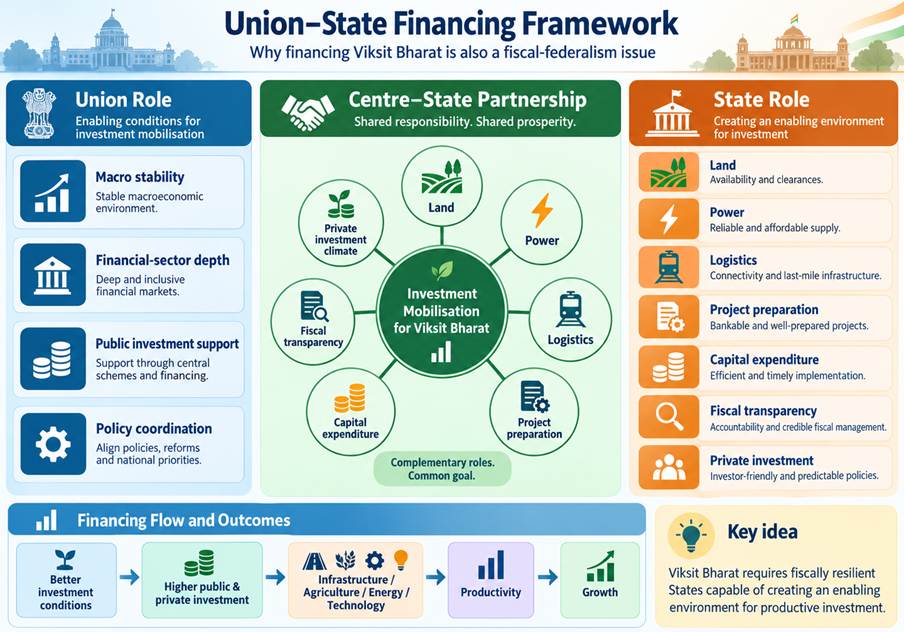
Why States Are Central
The development pathway depends heavily on States because investment decisions involving land, logistics, power, local infrastructure and project clearances are substantially shaped at the State level.
The Chief Economic Adviser identified three major State priorities:
Enabling private investment + improving project quality + strengthening State capital expenditure
A proposal discussed at the conference suggested raising State capital outlay from about 2.4% to 3% of GSDP by 2031-32.
Hence the conference’s broader principle:
“Viksit Bharat depends on Viksit Rajya.”
Fiscal Sustainability and Transparency
Development expenditure must also remain fiscally sustainable.
The conference highlighted the need for State-specific debt sustainability assessments and fuller disclosure of:
Off-budget borrowings + guarantees + arrears + borrowing by State-owned entities
Such liabilities can weaken fiscal transparency when they remain outside headline budget numbers.
Technology can simultaneously strengthen revenue mobilisation. AI and machine learning applied to existing tax databases may help identify compliance gaps and broaden the effective tax base without simply raising tax rates.
Agriculture and Energy Need Special Financing Architecture
Agricultural transformation requires more than farm credit. Financing must cover:
Market access + post-harvest infrastructure + logistics + food processing + scalable financial instruments
The conference separately examined these components of agricultural finance.
Similarly, the energy transition requires enormous long-duration investment in:
Renewable energy + transmission + Battery Energy Storage Systems + pumped storage + CCUS
Carbon-market frameworks also need to remain aligned with India’s Nationally Determined Contributions (NDCs).
The Core Policy Challenge
India must simultaneously achieve:
Growth + fiscal prudence + investment mobilisation + inclusion + green transition
Excessive public borrowing may constrain fiscal space, while inadequate public investment can weaken infrastructure and crowding-in effects.
The sustainable route therefore lies in:
Higher domestic savings + quality public capex + stronger State finances + private investment + innovative finance
Probable Mains Question
“Government budgets alone cannot finance India’s transition to a developed economy by 2047.” Discuss the role of domestic savings, private capital, State finances and innovative financing mechanisms in achieving Viksit Bharat.
Prelims Drill
MCQ 1
With reference to financing long-term economic growth, consider the following statements:
- A higher domestic savings rate can enlarge the pool of resources available for investment.
- Off-budget borrowings have no relevance for assessing the fiscal sustainability of a State government.
- Public capital expenditure can potentially crowd in private investment by improving infrastructure.
Which of the statements given above are correct?
A. 1 only
B. 1 and 3 only
C. 2 and 3 only
D. 1, 2 and 3
Correct Answer: B
Explanation: Domestic savings support investment, while high-quality public capital expenditure can improve conditions for private investment. Off-budget borrowings remain relevant to overall fiscal sustainability and transparency.
Trap Identified: Off-budget ≠ outside fiscal risk.
MCQ 2
Consider the following sectors discussed at the 2026 Conference on “Financing India’s Journey towards Viksit Bharat”:
- Agricultural transformation
- Renewable energy and transmission
- Battery energy storage and pumped storage
- Gross State Domestic Product measurement
Which of the above were discussed at the conference?
A. 1 and 2 only
B. 1, 2 and 3 only
C. 2, 3 and 4 only
D. 1, 2, 3 and 4
Correct Answer: D
Explanation: The second day covered agricultural transformation and energy-transition financing, including renewable energy, BESS and pumped storage, while a special session examined measurement of the Viksit Bharat journey from a GSDP perspective.
Trap Identified: The conference was broader than macroeconomics; it also covered sectoral finance and GSDP measurement.
More Current Affairs - Daily
- Election Commission of India: Constitutional Design and Evolution into a Three-Member Body 12 Oct 2026
- Loknayak Jayaprakash Narayan: Total Revolution and Contribution to Democracy 12 Oct 2026
- India’s Russia-Ukraine Initiative: From Black Sea Security to Strategic Autonomy 12 Oct 2026
- Jayaprakash Narayan: Architect of Total Revolution and Defender of Democracy 12 Oct 2026