
Edible Oil Inflation: Biofuels, El Niño and War
Global edible-oil prices are being pushed higher by biofuel blending mandates, El Niño-related production risks, war-disrupted logistics and high import dependence in countries such as India.
Why Edible Oils Are Bearing the Brunt of Food Inflation
- Syllabus Mapping: GS Paper III — Agriculture, Food Inflation, Energy Security, Biofuels, External Sector and Climate Variability.
- Source & Date: The Indian Express, 5 October 2026, supplemented by FAO and Government of India biofuel data.
Why in Focus?
The FAO Food Price Index averaged 136 points in September 2026, while its Vegetable Oil Price Index rose to 198.6 points, up 18.3% from a year earlier. Palm-oil prices were a major driver, reflecting strong import demand and concerns over dry weather in Southeast Asia.
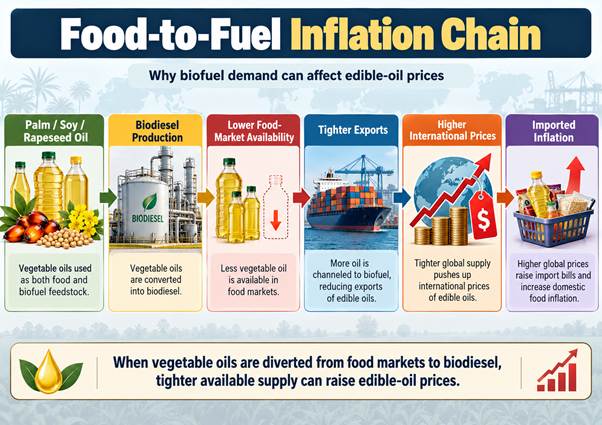
Edible oils are especially vulnerable because the same commodities can serve both as food and energy feedstocks.
The pressure chain is: Biofuel diversion + weather stress + war logistics → tighter exportable supply → higher global edible-oil prices → imported food inflation
 .
.
What Is the Biofuel Link?
Vegetable oils such as palm, soybean and rapeseed oil can be converted into Fatty Acid Methyl Esters (FAME) through transesterification.
In this process, triglycerides react with an alcohol such as methanol in the presence of a catalyst to produce biodiesel.
Thus: Vegetable oil → transesterification → FAME → biodiesel
This creates direct competition between food and fuel uses of the same agricultural commodity.
How Do Blending Mandates Affect Prices?
Governments increasingly require minimum quantities of biofuels to be blended into conventional transport fuels.
Indonesia, a major palm-oil producer and exporter, has progressively increased the share of palm-based biodiesel in diesel. Higher domestic blending requirements absorb more palm oil internally, leaving less available for export.
The mechanism is straightforward:
Higher blending mandate → greater domestic feedstock demand → lower export surplus → tighter global supply
This matters greatly for India because it relies heavily on imported edible oils, especially palm oil from Southeast Asia.
Why Does El Niño Matter?
El Niño can reduce rainfall in major tropical producing regions and create water stress for oil-palm plantations.
Its impact on palm-oil output is often delayed because water stress affects flowering and fruit formation before the resulting yield loss becomes visible months later.
Thus:
El Niño → moisture stress → weaker flowering/fruit formation → lagged yield decline → lower palm-oil supply
The effect is particularly important when weather stress coincides with rising domestic biofuel demand in producer countries.
How Does War Affect Sunflower Oil?
Russia and Ukraine are among the world’s major sunflower producers.
Even when crop output is adequate, conflict can disrupt ports, storage terminals, shipping routes and inland logistics, limiting the amount that can reach global markets.
This distinction is important:
Production availability ≠ export availability
War can therefore generate food inflation through logistics even when agricultural output itself does not collapse.
Why Is India Especially Exposed?
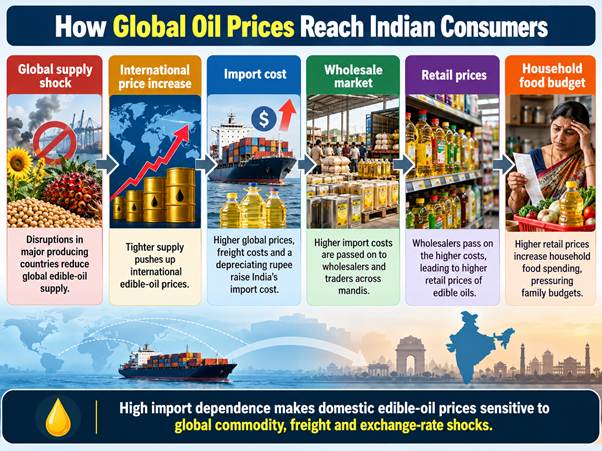
India’s domestic edible-oil production is insufficient to meet total consumption, making the country structurally dependent on imports of palm, soybean and sunflower oils.
This means international commodity shocks can pass relatively quickly into the domestic economy through:
Higher import price → higher landed cost → wholesale price rise → retail edible-oil inflation → broader food inflation
Exchange-rate depreciation can intensify this transmission because most global edible-oil trade is invoiced in foreign currency.
Food Security vs Energy Security
Biofuel mandates can reduce fossil-fuel imports and support energy-security objectives.
India itself has rapidly expanded ethanol blending in petrol and achieved the 20% blending level in 2025-26.
However, when biofuels use food or edible-oil feedstocks, policymakers face a trade-off:
Energy security ↔ food affordability
The challenge is not to reject biofuels, but to reduce dependence on feedstocks that directly compete with food consumption.
What Should India Do?
India’s long-term response should combine:
- Higher domestic oilseed productivity, especially mustard, soybean and groundnut.
- Diversification of import sources to reduce concentration risk.
- Strategic monitoring of global edible-oil stocks and freight conditions.
- Greater use of non-food biofuel feedstocks, including waste oils and advanced biofuels.
- Stable trade and tariff policy so sudden import-duty changes do not amplify price volatility.
- Climate-resilient oilseed cultivation to reduce domestic production risk.
The policy chain should be:
Higher productivity + diversified imports + non-food biofuels + climate resilience = lower inflation vulnerability
The Core Policy Lesson
Edible-oil inflation is increasingly shaped by the interaction of agriculture, energy and geopolitics.
The same litre of vegetable oil may compete between a household kitchen, an industrial user and a biodiesel plant, while weather and war simultaneously affect how much reaches world markets.
For India, the durable policy lesson is clear:
Import dependence converts global commodity shocks into domestic food inflation.
Reducing this vulnerability requires not only short-term import management but also stronger domestic oilseed production and careful coordination between food security and biofuel policy.
Probable Mains Question
“The growing convergence of food, energy and commodity markets has made edible-oil inflation increasingly vulnerable to global biofuel policies, climate shocks and geopolitical disruptions.” Discuss with reference to India’s import dependence.
Prelims Drill
MCQ 1
With reference to biodiesel production, consider the following statements:
- Fatty Acid Methyl Esters can be produced from vegetable oils through transesterification.
- Triglycerides in vegetable oils can react with an alcohol in the presence of a catalyst during this process.
- Biodiesel production necessarily requires crude petroleum as its principal feedstock.
Which of the statements given above are correct?
A. 1 only
B. 1 and 2 only
C. 2 and 3 only
D. 1, 2 and 3
Correct Answer: B
Explanation: FAME biodiesel can be produced by transesterifying triglyceride-rich vegetable oils with an alcohol such as methanol. Crude petroleum is not the necessary feedstock for this process.
MCQ 2
With reference to inflation transmission in an import-dependent economy, consider the following statements:
- A rise in international commodity prices can raise domestic inflation through higher landed import costs.
- Depreciation of the domestic currency can amplify the price effect of imported commodities.
- High import dependence generally insulates domestic consumers from supply shocks in exporting countries.
Which of the statements given above are correct?
A. 1 only
B. 1 and 2 only
C. 2 and 3 only
D. 1, 2 and 3
Correct Answer: B
Explanation: Higher international prices and currency depreciation can both increase the domestic cost of imported commodities. High import dependence usually increases, rather than reduces, exposure to external supply shocks.
More Current Affairs - Daily
- Election Commission of India: Constitutional Design and Evolution into a Three-Member Body 12 Oct 2026
- Loknayak Jayaprakash Narayan: Total Revolution and Contribution to Democracy 12 Oct 2026
- India’s Russia-Ukraine Initiative: From Black Sea Security to Strategic Autonomy 12 Oct 2026
- Jayaprakash Narayan: Architect of Total Revolution and Defender of Democracy 12 Oct 2026