
Protecting Patient Data under the DPDP Framework
Protecting health data requires more than secure software. Hospitals need trained staff, clear consent systems, controlled access and strong data-governance practices.
Protecting Patient Data under the DPDP Framework
- Syllabus Mapping: GS Paper II — Health, Governance and Rights; GS Paper III — Digital Infrastructure, Cybersecurity and Technology.
- Source & Date: The Hindu, 26 October 2026.
Why in News?
India's Digital Personal Data Protection Act, 2023 and the DPDP Rules, 2025 are moving towards phased implementation, bringing hospitals and other healthcare institutions under a more structured data-governance framework.
The Rules were notified on November 13, 2025. The provision concerning registration and obligations of Consent Managers takes effect one year later, while several substantive rules governing consent, security safeguards, breach notification and individual rights become applicable after an 18-month transition period.
Why Healthcare Is Different
Hospitals continuously generate highly sensitive information such as diagnoses, laboratory reports, prescriptions, scans, nursing notes and treatment histories.
At the same time, this information must be accessible to several people during treatment. Doctors, nurses, laboratories and emergency teams may need different parts of the same record.
Too little access can delay treatment, while unrestricted access increases privacy risks. Healthcare therefore requires a balance between clinical accessibility and data confidentiality.
Clinical Consent Is Not Data Consent
Consent to receive medical treatment and consent to process personal data are related but distinct.
A patient agreeing to undergo a scan does not automatically authorise every future use of that scan for unrelated purposes. Hospitals must therefore distinguish between consent necessary for clinical care and consent for additional processing of personal information.
The DPDP framework also recognises that certain emergencies and legally permitted situations may justify processing without ordinary consent requirements.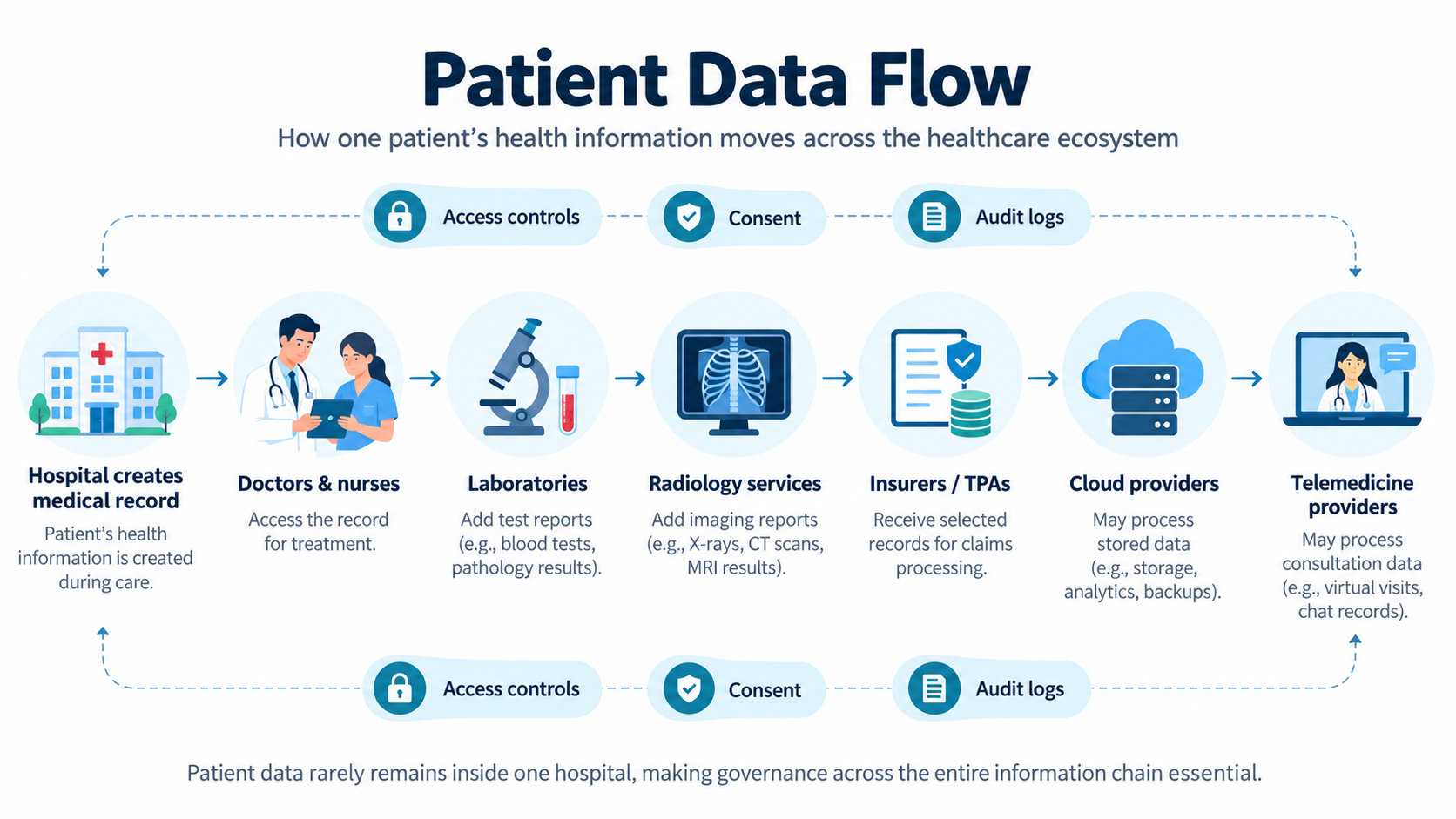
Who Is Responsible?
Under the DPDP framework, the patient is generally the Data Principal, while the organisation deciding the purpose and means of processing is the Data Fiduciary.
A cloud provider, software company or other organisation processing information on behalf of the hospital may function as a Data Processor.
This distinction matters because outsourcing digital infrastructure does not automatically remove the hospital's responsibility for protecting patient information.
Compliance Has a Cost
Hospitals will need role-based access controls, encryption or masking where appropriate, audit logs, backups, vendor controls and breach-response systems.
Failure to take reasonable security safeguards can attract substantial financial penalties under the Act.
The burden could be especially heavy for smaller hospitals and primary health centres. Shared infrastructure can reduce costs because software, cybersecurity services and legal templates need not be developed independently by every facility.
The Human Factor
Technology alone cannot protect health data.
A single employee using a shared password, sending records through an insecure application or granting excessive access can defeat sophisticated cybersecurity systems.
Doctors, nurses, administrators, laboratory workers and healthcare-IT personnel therefore need data literacy as a professional competency.
Building Shared Infrastructure
The Ayushman Bharat Digital Mission already seeks to create an interoperable national digital-health ecosystem, with the Unified Health Interface among its building blocks.
Government-supported consent templates, cybersecurity tools, vendor standards and training modules could reduce compliance costs, particularly for smaller facilities.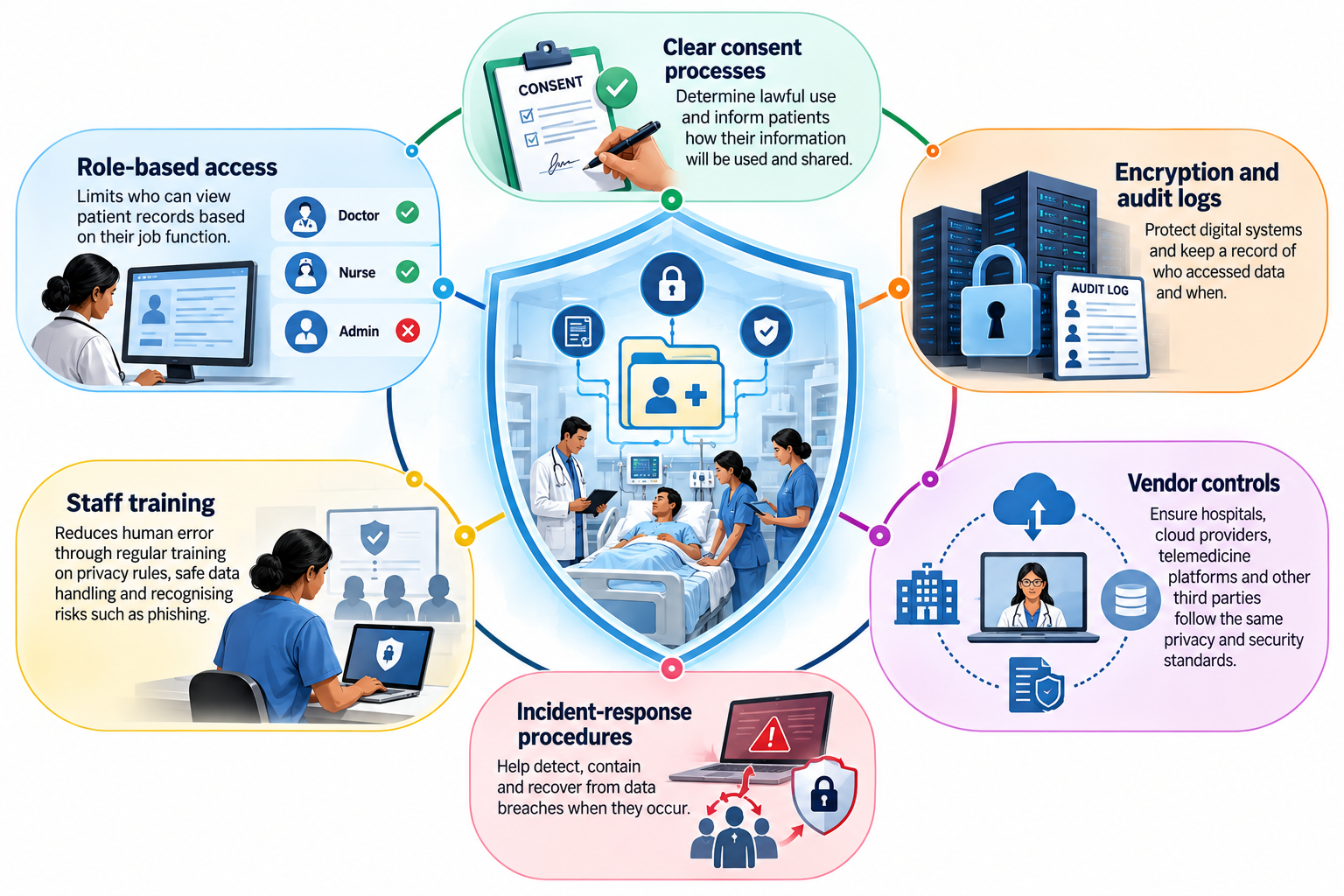
Core Policy Lesson
Health-data protection should not become a choice between privacy and medical care.
India needs a system where clinicians can obtain necessary information quickly while access remains proportionate, traceable and secure.
The DPDP framework provides the legal foundation, but effective implementation will depend on affordable digital infrastructure, healthcare-specific standards and, above all, a workforce trained to handle sensitive data responsibly.
Probable Mains Question
“Effective protection of digital health data requires institutional capacity and trained personnel as much as legal safeguards.” Discuss in the context of India's emerging personal-data protection framework.
Prelims Drill
MCQ 1
With reference to the Digital Personal Data Protection framework, consider the following statements:
- A Data Principal is the individual to whom the personal data relates.
- A Data Fiduciary determines the purpose and means of processing personal data.
- Appointment of a Data Processor automatically transfers all statutory responsibility for personal data away from the Data Fiduciary.
Which of the statements given above are correct?
A. 1 only
B. 1 and 2 only
C. 2 and 3 only
D. 1, 2 and 3
Correct Answer: B
Explanation: The Data Principal is the individual concerned, while the Data Fiduciary determines why and how data is processed. Using an external processor does not automatically extinguish the fiduciary's responsibility.
MCQ 2
Consider the following statements regarding protection of digital health information:
- Role-based access can restrict healthcare workers to information relevant to their functions.
- Consent for a medical procedure necessarily constitutes unrestricted consent for every future use of the resulting health data.
- Audit logs can help establish who accessed or modified digital records.
Which of the statements given above are correct?
A. 1 only
B. 1 and 3 only
C. 2 and 3 only
D. 1, 2 and 3
Correct Answer: B
Explanation: Role-based access and audit trails strengthen accountability. Clinical consent does not automatically authorise every subsequent use of personal health information.
More Current Affairs - Daily
- Pendency and Punishment: Reforming Delays and Sentencing in India 26 Oct 2026
- AI Neolabs: Why New Research Laboratories Are Betting on Safe Superintelligence 26 Oct 2026
- ITBP’s Changing Strategy Along the China Border 26 Oct 2026
- Nilgiri Tahr: Habitat Fragmentation and Invasive Species Pose Conservation Challenges 26 Oct 2026