
ITBP’s Changing Strategy Along the China Border
ITBP is expanding beyond conventional border guarding towards high-altitude combat, specialised commando training, drone warfare and stronger defensive infrastructure.
ITBP’s Changing Strategy Along the China Border
- Syllabus Mapping: GS Paper III — Internal Security, Border Management, Defence Technology and Security Challenges.
- Source & Date: The Hindu, 24 October 2026.
Why in News?
The Indo-Tibetan Border Police is overhauling its training and operational strategy along the India-China frontier. Its leadership has emphasised specialised high-altitude combat, drone and counter-drone systems, modern weapons and underground defensive structures.
The shift reflects the changing character of border security, where surveillance, rapid response and technology are becoming as important as traditional patrols.
ITBP’s Core Role
ITBP was raised in 1962 after the India-China war and is the primary Central Armed Police Force guarding the India-China border.
Its personnel operate at extreme altitudes, often in areas cut off by road and exposed to severe cold, avalanches and difficult terrain. Since the Line of Actual Control is neither fully demarcated nor fenced, ITBP performs regular patrols and acts as an important source of information on activities across the frontier.
It works alongside the Army at several locations, but retains a distinct border-guarding role.
Why Training Is Changing
The experience of recent confrontations has shown that border incidents can escalate rapidly and may occur without conventional firearms or formal war.
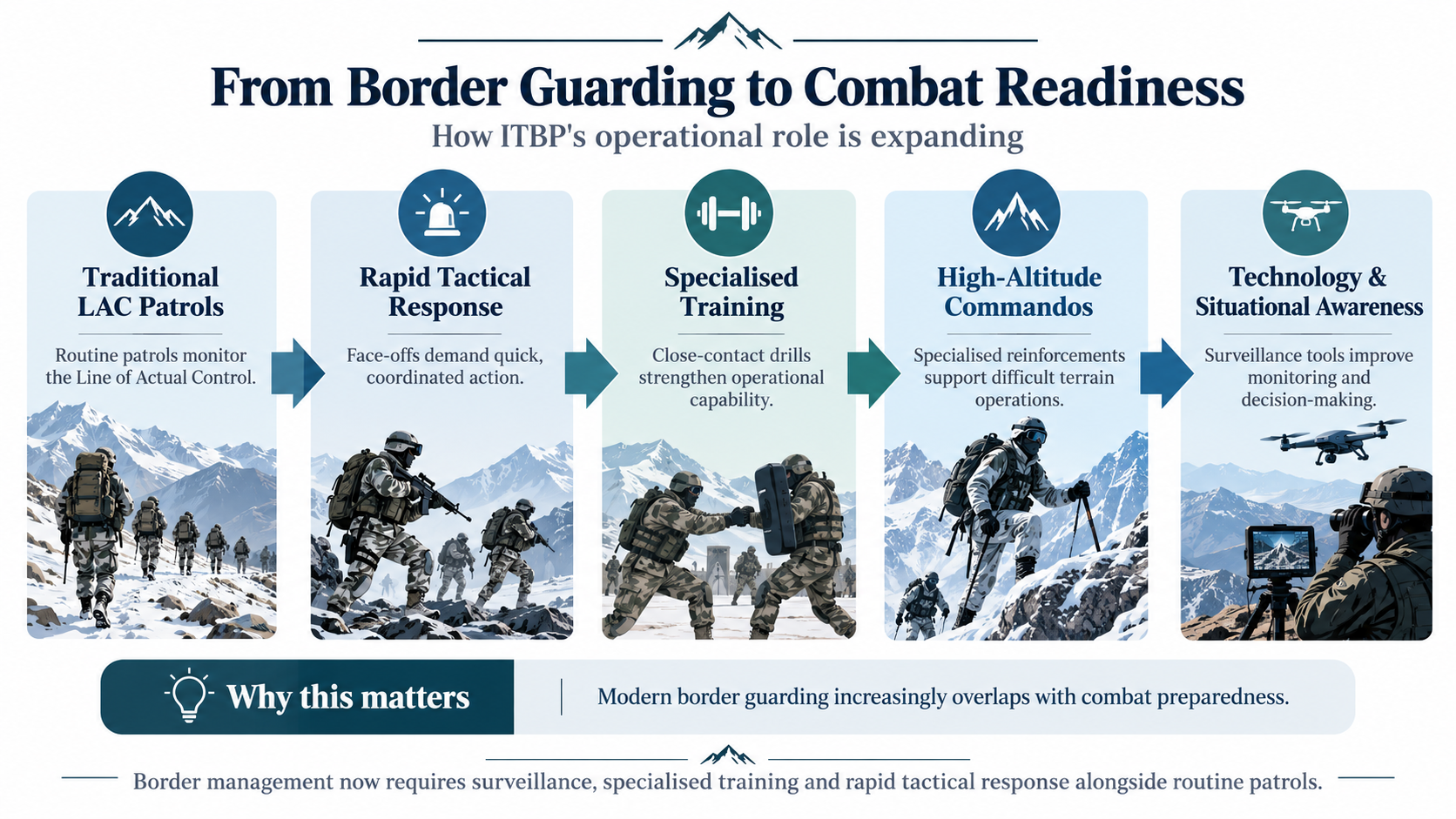
ITBP has therefore introduced the Strike course, aimed at improving readiness for close-contact and high-pressure situations. Master trainers have been prepared, and the training is being expanded across the force.
The larger objective is to ensure that personnel at forward posts possess a standardised response capability instead of relying only on traditional patrol experience.
Shaurya Commandos
ITBP plans to develop a dedicated high-altitude commando battalion built around its Shaurya commandos.
The idea is to create a capability suited specifically to mountain warfare rather than replicate conventional Army formations or other CAPF commando units.
This reflects ITBP’s comparative advantage: long experience of operating at extreme altitude, where acclimatisation, mobility, survival skills and terrain knowledge are critical.
Drones Change Border Warfare
Drones are becoming central to modern warfare because they can perform surveillance, logistics, targeting and reconnaissance at relatively low cost.
ITBP plans to create drone platoons in border-guarding battalions and invest heavily in both drone and counter-drone systems.
This matters especially in mountainous terrain where visibility is limited and conventional movement is slow. Drones can provide persistent surveillance, while anti-drone systems can protect posts and personnel from hostile unmanned platforms.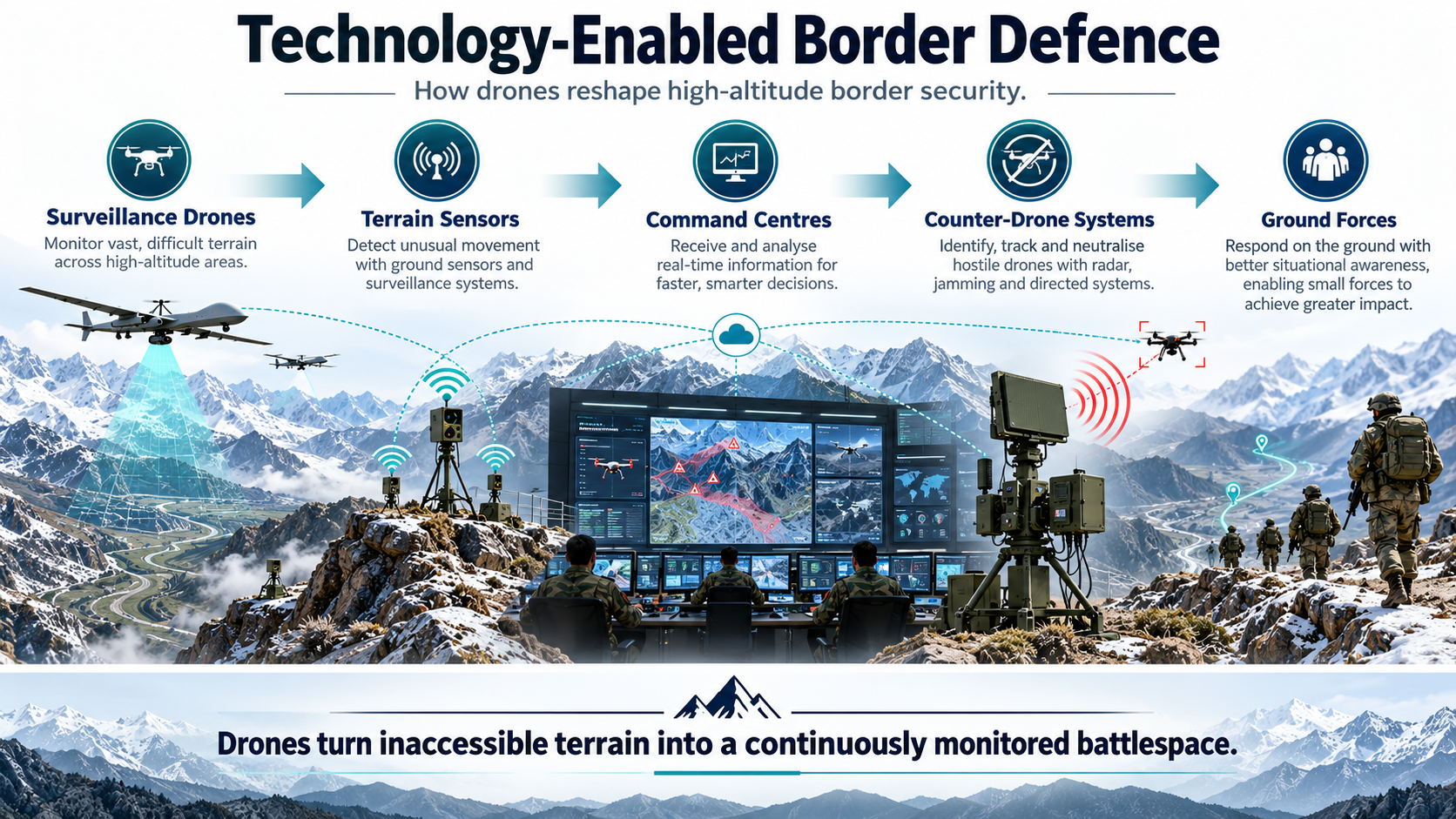
Why Underground Structures Matter
Modern precision weapons and drones make exposed installations more vulnerable.
ITBP therefore plans to build underground shelters at forward locations. Such structures can protect personnel, ammunition and communication systems during intense conflict.
The move represents a shift from temporary border posts towards hardened, survivable infrastructure designed for prolonged deployment.
Strategic Significance
The broader transformation is from static border guarding to a model combining intelligence, high-altitude specialisation, drones, hardened infrastructure and rapid response.
It also reflects the need to prepare for grey-zone situations where military pressure may remain below the threshold of full-scale war.
Core Policy Lesson
Modern border security is no longer defined only by the number of troops deployed.
Effectiveness increasingly depends on technology, specialised training, resilient infrastructure and real-time information. For ITBP, the challenge is to strengthen these capabilities while retaining its distinct role as India’s specialised high-altitude border force.
Probable Mains Question
“Border guarding along the Line of Actual Control increasingly requires capabilities traditionally associated with modern warfare.” Discuss with reference to high-altitude specialisation, drones and resilient infrastructure.
Prelims Drill
MCQ 1
With reference to the Indo-Tibetan Border Police, consider the following statements:
- It was raised in the aftermath of the 1962 India-China war.
- Its primary responsibility includes guarding the India-China frontier.
- It functions as one of India's Central Armed Police Forces.
Which of the statements given above are correct?
A. 1 and 2 only
B. 2 and 3 only
C. 1 and 3 only
D. 1, 2 and 3
Correct Answer: D
Explanation: ITBP was raised in 1962, is a Central Armed Police Force and performs the principal border-guarding role along the India-China frontier.
MCQ 2
Consider the following statements regarding the use of drones in border security:
- Drones can improve surveillance in terrain that is difficult for ground patrols to access continuously.
- Counter-drone systems are relevant only in conventional declared wars.
- Unmanned systems can improve situational awareness even when troop numbers remain unchanged.
Which of the statements given above are correct?
A. 1 only
B. 1 and 3 only
C. 2 and 3 only
D. 1, 2 and 3
Correct Answer: B
Explanation: Drones can extend surveillance and improve situational awareness in difficult terrain. Counter-drone systems are also useful in grey-zone and limited-conflict situations, not only in formally declared wars.
More Current Affairs - Daily
- Pendency and Punishment: Reforming Delays and Sentencing in India 26 Oct 2026
- AI Neolabs: Why New Research Laboratories Are Betting on Safe Superintelligence 26 Oct 2026
- Protecting Patient Data under the DPDP Framework 26 Oct 2026
- Nilgiri Tahr: Habitat Fragmentation and Invasive Species Pose Conservation Challenges 26 Oct 2026